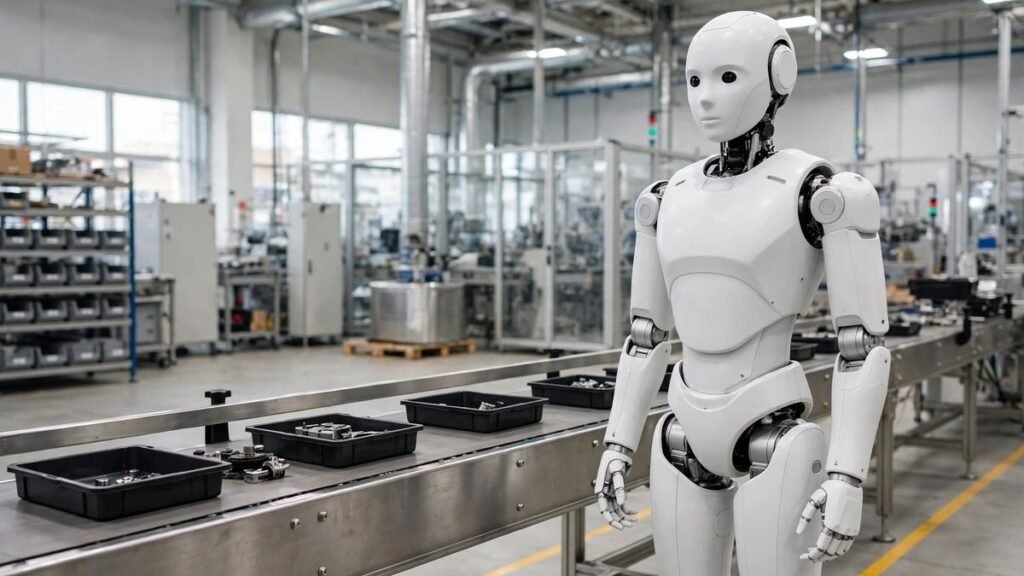
AI robots in warehouses are machines that move, pick and sort goods with little or no human direction. They carry shelves to pickers, unload trucks, sort parcels and navigate shared floors alongside people. The central question is whether they actually improve a warehouse, and the answer is that they do when the work is repetitive, high-volume and predictable, and they disappoint when they are dropped into a chaotic operation without fixing the underlying process first.
Warehousing is where robotics earns its keep. The work is physical, repetitive and measurable, which makes it ideal for machines, and the largest operators have spent a decade proving it. Amazon’s fleet passed one million robots in July 2025, and Ocado’s grid warehouses run thousands of bots around the clock.
The question now is which system fits which warehouse.
Key takeaways
- AI robots in warehouses move, pick and sort goods, and they pay off on repetitive, high-volume, predictable work.
- Goods-to-person systems bring shelves to pickers, cutting walking time, which is the largest cost in manual picking.
- Autonomous mobile robots navigate shared floors, while picking arms handle individual items with vision and touch.
- Fleet software, not the robot hardware, decides how well a system performs at scale.
- Successful deployments fix the process first, pilot in the real warehouse, and plan for maintenance and failure.
Why warehouses adopted robots first
Warehouses adopted robots early because the economics are unusually clear. Picking is the most expensive activity in a warehouse, and most of a picker’s time is spent walking between shelves rather than picking. A system that brings the shelf to the picker, or the picker to the right shelf, attacks that cost directly.
The work is also indoors, flat and controlled, which suits robots far better than a farm field or a building site.
The second reason is volume. E-commerce made order profiles smaller and more frequent: many orders, few items each, with customers expecting next-day or same-day delivery. Manual operations struggle with that pattern, because it multiplies the walking and the handling.
Robots handle the repetition without tiring, and they work through the night.
The third reason is data. A warehouse already runs on a management system that knows where every item is, and robots plug into that system naturally. Every movement is tracked and every pick is logged, so the operation can be measured and improved continuously.
That feedback loop is why warehouse robotics keeps improving. Our guide to supply chain automation covers how warehouse systems connect to the wider chain.
Goods-to-person: bringing the shelf to the picker
Goods-to-person is the dominant warehouse model, and Amazon pioneered it at scale. The idea is simple: instead of a person walking to a shelf, a robot brings the shelf to the person. The picker stands at a station, a robot arrives with the right pod, the picker takes the item, and the robot returns the pod to storage.
Walking time, the largest cost in manual picking, is largely eliminated.
The story starts with Kiva Systems, founded in 2003, which Amazon acquired in March 2012 for about 775 million dollars. Amazon renamed the company Amazon Robotics in 2015 and scaled the system across its fulfilment network, developing drive units such as Hercules and Titan, and later Proteus, its first fully autonomous mobile robot, unveiled in June 2022. Proteus navigates using sensors rather than floor markers, so it can work in areas shared with people.
Ocado took a different approach with its Hive, a dense three-dimensional grid in which crates are stacked up to 17 high. Hundreds or thousands of box-shaped bots travel across the top of the grid, lowering grippers to lift crates and delivering them to picking stations where human staff fill customer orders. The 600 Series bot, introduced in 2022, was a major redesign of the fleet.
Ocado licenses the whole system, called the Ocado Smart Platform, to grocery retailers around the world.
Other vendors offer similar systems, including Geek+ and Hai Robotics, with different pod designs and software. The common principle is the same: dense storage, mobile robots, and a central system that choreographs every movement. Best for: high-volume e-commerce and grocery fulfilment, where order profiles are small and frequent.
Picking arms and truck unloading
Moving shelves solves the walking problem, but someone still has to pick the item. Picking arms are the next step, and they are the hardest part of warehouse robotics, because every product is different in shape, weight and fragility. A vision system identifies the item, a planner chooses a grasp, and the arm picks it and places it in a tote.
Amazon’s Sparrow, announced in November 2022, was the first robotic system in its warehouses that could detect, select and handle individual products, using computer vision and AI to recognise and handle millions of items. Its newer Vulcan arm adds touch sensing, letting it judge grip force and handle delicate items more safely. These arms work at picking stations, taking items from inventory totes and placing them into customer orders.
Truck unloading is a different challenge: a container full of boxes in no particular order, with no fixed layout to plan around. Boston Dynamics’ Stretch, unveiled in March 2021 and on commercial sale from 2022, is built for this job. A mobile base carries a large arm with a vacuum gripper that lifts boxes weighing up to 50 pounds and places them on a conveyor.
DHL Supply Chain was among its first customers, placing a 15 million dollar order to automate warehouse operations across North America. Best for: stations where picking is the bottleneck, and docks where unloading is slow, heavy and injury-prone.

Autonomous mobile robots and fleet software
Autonomous mobile robots, or AMRs, are the general-purpose movers of the modern warehouse. They carry totes, pallets and shelves between stations, following routes planned by fleet software. Unlike automated guided vehicles, which follow fixed paths marked by magnets or wires, AMRs navigate freely using lidar, cameras and a map, rerouting around people and obstacles as they go.
The robot hardware is only half the system. Fleet software, such as Amazon’s DeepFleet, coordinates every robot, assigning tasks, planning routes and preventing traffic jams. Amazon says DeepFleet makes its fleet about 10 per cent faster, which shows how much performance lives in coordination rather than in any single machine.
A warehouse with a hundred robots and poor fleet software will underperform a warehouse with fifty robots and good software.
Integration with the warehouse management system is what makes the whole thing work. Orders flow from the management system to the fleet software, which assigns them to robots and pickers, and every completed pick is confirmed back. When the integration is clean, the warehouse runs as one system; when it is not, robots and pickers wait on each other.
Best for: warehouses that need flexible transport between zones, especially where layouts change often.
AI robots in warehouses: the options compared
The table below compares the main robot types found in warehouses today. Most large sites use several of them together.
| Robot type | What it does | Strengths | Weaknesses | Typical fit |
|---|---|---|---|---|
| Goods-to-person pods | Brings shelves to pickers | Eliminates picker walking | Needs flat floors and new layout | E-commerce, grocery fulfilment |
| Autonomous mobile robots | Moves totes and pallets | Flexible, navigates freely | Slower than conveyors for fixed routes | General transport, changing layouts |
| Picking arms | Picks individual items | Handles varied products | Struggles with soft or odd items | Picking stations, e-commerce |
| Truck unloading robots | Unloads containers and trailers | Removes heavy, injury-prone work | High cost, one task only | High-volume inbound docks |
| Sorting and shuttle systems | Sorts parcels at high speed | Very fast, dense storage | Fixed infrastructure, hard to change | Parcel hubs, high-throughput sites |
A deployment checklist
Work through the questions below before buying robots. They separate deployments that transform a warehouse from ones that become an expensive experiment.
- Fix the process first: measure current picking, walking and error rates, and remove obvious waste before automating.
- Choose one bottleneck to automate, such as picking or inbound unloading, rather than automating everything at once.
- Check the building honestly, including floor flatness, doorway widths, ceiling height and power supply.
- Confirm the warehouse management system can integrate with the robot fleet software, and who owns that integration.
- Plan the human roles: who loads the robots, who supervises them, and who handles exceptions when the robot cannot.
- Run a pilot in the real warehouse, with real orders and real staff, for at least a month including a peak period.
- Ask what happens when a robot fails, how quickly it is repaired, and what the warehouse does in the meantime.
- Budget for maintenance, software updates, spare parts and model retraining, not just the purchase price.
The checklist reflects the most common failure in warehouse robotics: buying robots to fix a process that was never understood. A robot multiplies whatever it is given, including the waste, so the process must be sound before the machines arrive. Our guide to AI systems on the factory floor makes the same point for manufacturing, and our guide to business process automation covers how to map a process before automating it.
Safety, people and the limits of warehouse robots
Safety is the first constraint in a shared warehouse. Robots and people work on the same floor, so the system must detect people reliably and stop or slow down before contact. Proteus was designed for this, operating in areas shared with people rather than behind fences, and modern AMRs use lidar and cameras to maintain a safety zone around themselves.
Standards for mobile robots and for collaborative operation set the rules, and buyers should confirm compliance.
The effect on jobs is real and should be discussed plainly. Robots take over walking, lifting and repetitive picking, and the roles that remain are supervision, exception handling, maintenance and quality control. Warehouses that plan the transition, retraining pickers as robot operators and technicians, keep their experienced staff and get better results than those that simply cut headcount.
The limits are worth stating too. Robots struggle with damaged packaging, loose items and products that change shape, and they need a reasonably clean and organised environment. A warehouse with poor housekeeping will defeat even the best robots, because the machines depend on the world matching their map.
Frequently asked questions
What are AI robots in warehouses?
AI robots in warehouses are machines that move, pick and sort goods using cameras, lidar and machine learning. They include goods-to-person pod carriers, autonomous mobile robots, picking arms and truck unloading robots, coordinated by fleet software.
How many robots does Amazon have in its warehouses?
Amazon’s fleet passed one million robots in July 2025. The fleet grew from the 2012 acquisition of Kiva Systems, and includes drive units such as Hercules and Titan, the Proteus mobile robot, and picking arms such as Sparrow and Vulcan.
What is Ocado’s Hive?
The Hive is Ocado’s dense three-dimensional storage grid, in which crates are stacked up to 17 high. Hundreds or thousands of box-shaped bots travel across the top of the grid, lifting crates and delivering them to picking stations where staff fill customer orders.
Do warehouse robots replace workers?
They replace specific tasks, mainly walking, lifting and repetitive picking, rather than whole jobs. The roles that remain are supervision, exception handling, maintenance and quality control, and warehouses that retrain staff get better results than those that simply cut headcount.
How much do warehouse robots cost?
Costs vary widely by system and scale. Vendors rarely publish prices, and a goods-to-person installation involves robots, racking, software and integration. Buyers should request a quote scoped to their own building, order profile and throughput.
Are warehouse robots safe to work alongside?
Yes, when the system is designed and certified for it. Modern mobile robots use lidar and cameras to detect people and slow or stop before contact, and standards govern shared workspaces. Safety depends on the whole installation, including layout and training.