AI in industrial robotics means adding machine learning to the robots that already weld, assemble and move goods in factories, so they can see, adapt and improve instead of repeating one fixed programme. The central question is whether AI makes industrial robots genuinely more useful, and the answer is yes, but only where the work varies: AI helps most with picking mixed parts, inspecting products, predicting failures and working safely beside people.
Traditional industrial robots are precise and fast, but they are also rigid. They repeat the same motion thousands of times and stop if anything changes. AI adds the missing piece: perception and judgement. A vision-guided robot can pick a part from a jumbled bin, a learning system can spot a defect it has never seen before, and a predictive model can warn that a motor is about to fail.
Key takeaways
- AI adds perception and judgement to industrial robots, so they can handle variation instead of repeating one fixed programme.
- The biggest gains are in vision-guided picking, quality inspection, predictive maintenance and human-robot collaboration.
- FANUC, ABB, KUKA and Yaskawa are the leading industrial robot makers, and all four now ship AI features.
- Start with one variable task and a measured pilot; AI robotics fails when it is deployed as a general solution with no clear job.
- Safety, data and maintenance decide success more than the choice of robot brand.
What changes when a robot gets AI
A conventional robot programme is a list of positions and speeds, written by an engineer and tested until it works. Change the part, move the fixture or alter the lighting, and the programme needs rework. An AI-enabled robot takes a different approach: it senses the scene, identifies the object, plans a grasp and adjusts in real time. The programme becomes a goal, such as “pick the gear from this bin”, rather than a fixed path.
That shift changes who can deploy a robot. Traditional programming needs a specialist and weeks of setup; AI-guided systems can often be taught by demonstration. The result is that robots reach smaller batches and more varied parts, which is where most factories still do manual work.
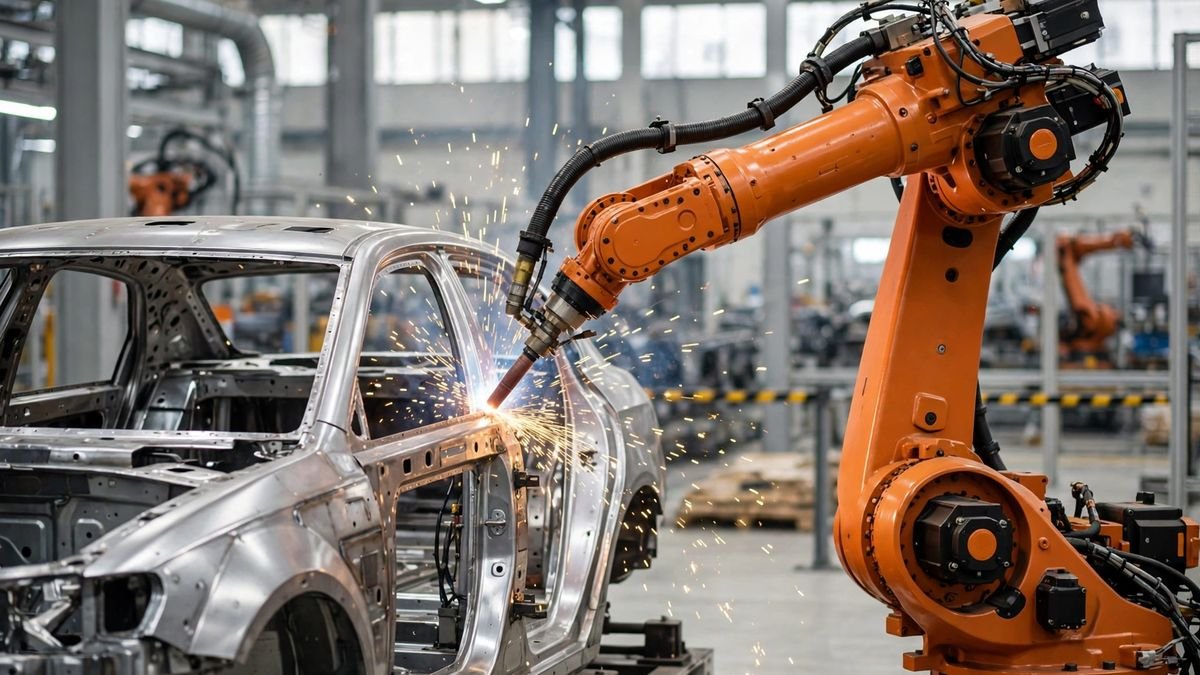
The change is not magic, and it is not total. Welding a seam on a car body is still best done by a fixed programme, because the seam is in the same place every time. AI earns its place where something varies: mixed parts, changing lighting, worn tooling or a human working nearby. For a practical view of what works on a real factory floor, see our guide to AI systems that actually work in manufacturing.
Vision-guided picking and bin picking
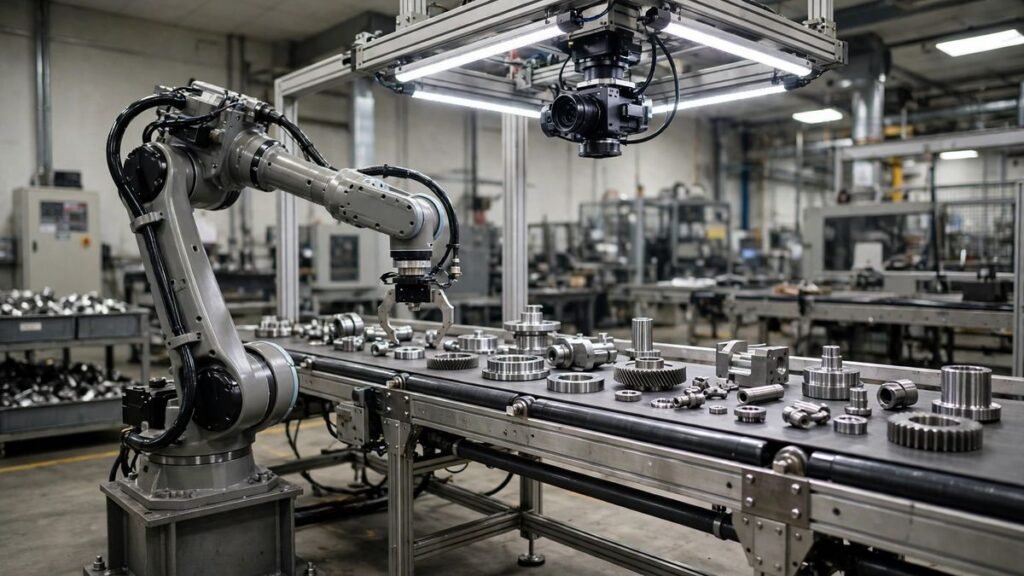
Bin picking is the classic AI robotics problem: a robot must reach into a container of jumbled parts, identify one, grasp it and place it correctly. A fixed programme cannot do this, because no two bins look the same. A vision system with a 3D camera builds a picture of the bin, a model identifies graspable parts, and the robot plans a path that avoids collisions.
Modern systems handle this well for rigid parts with clear shapes, and they are improving fast for shiny, transparent or flexible items, which are harder to see. The key measure is how many picks the robot completes per hour without a jam, and how often a human must intervene.
Best for: factories that handle mixed parts in bins or totes and need a robot to cope with variation rather than a fixed feed.
AI quality inspection
Machine vision inspection has existed for decades, but AI has changed what it can catch. Traditional vision checks fixed features against a template; AI models learn what a good product looks like and flag anything unusual, including defects nobody thought to programme for. That matters for products where defects are varied, such as castings, welds, textiles and assembled electronics.
The practical advantage is fewer false alarms. A template system rejects good parts when the lighting changes; a trained model is more tolerant of normal variation while still catching real faults. The catch is data: the model needs examples of good and bad parts, and for rare defects those examples may not exist.
Best for: quality teams inspecting varied products where defects are hard to describe as fixed rules.
Predictive maintenance for robots
Industrial robots are expensive, and an unplanned stop can halt a production line. Predictive maintenance uses sensor data from the robot itself, such as motor current, vibration and temperature, to spot the early signs of wear. A model trained on normal operation can warn that a gearbox is degrading weeks before it fails, so the repair can be scheduled during planned downtime.
The value is in the scheduling, not the prediction alone. A warning is only useful if someone acts on it, so predictive maintenance needs a maintenance workflow behind it: a named owner, spare parts on hand and a planned window to do the work.
Best for: plants running robots around the clock, where an unplanned stop costs more than the monitoring system.
Collaborative robots and safe human contact
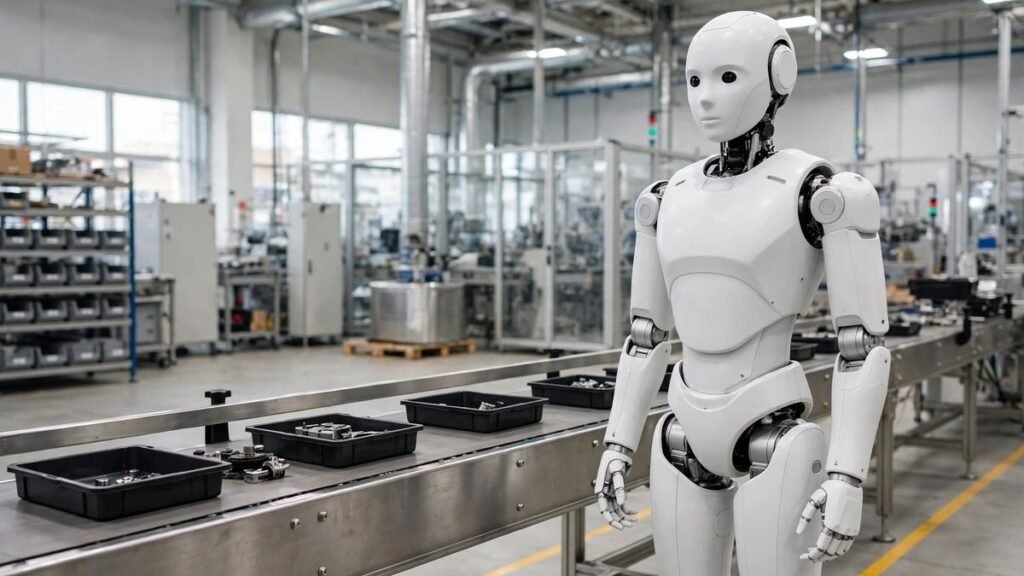
Collaborative robots, or cobots, are designed to share space with people, and AI makes that sharing safer and more useful. A cobot with vision can slow down when a person approaches, stop if the separation drops too low, and resume when the person leaves. Force sensing lets it detect contact and stop before it can cause injury, following the limits set out in ISO/TS 15066.
AI also changes what a cobot can do with a person nearby. Instead of a fixed sequence, the robot can hand a part to a worker, wait for the worker to finish, and then take the next part. That kind of turn-taking is only possible when the robot can perceive the person and adapt in real time.
Best for: assembly and packing stations where people and robots share the same workspace and the tasks are light and varied.
FANUC: the volume leader
FANUC is the world’s largest industrial robot maker by volume, and its robots are the default choice in automotive and electronics factories. Its AI features focus on practical gains: vision systems for picking and inspection, learning functions that reduce vibration and improve accuracy, and field systems that collect data from the robot fleet for maintenance analysis.
FANUC’s strength is reliability and the size of its installed base, which means spare parts, trained engineers and proven integration are easy to find. Its AI tooling works best inside the FANUC ecosystem, which suits factories that want one vendor to stand behind the whole cell.
Best for: high-volume automotive and electronics plants that want the largest installed base and the most proven support.
ABB: the integrated automation supplier
ABB supplies robots, controllers, software and the wider automation around them, and its AI work reflects that breadth. Its OmniCore controller platform runs AI vision and motion features, and its RobotStudio software lets engineers simulate and programme cells offline. ABB’s GoFa and SWIFTI cobots are aimed at collaborative work, while its large robots cover welding, painting and heavy handling.
ABB’s advantage is integration: a factory can buy the robot, the controller, the software and the safety system from one supplier, with one support contract. That matters for complex cells where the robot is one part of a larger line.
Best for: factories that want robots, software and safety from one integrated supplier.
KUKA and Yaskawa: precision and motion
KUKA, owned by China’s Midea Group, is known for precise, heavy-duty robots used in automotive body shops and for its LBR iiwa collaborative arm, one of the first sensitive robots designed to work beside people. Yaskawa, through its Motoman brand, is a leader in arc welding and motion control, and its AI features concentrate on seam tracking, adaptive welding parameters and quality monitoring.
Best for: KUKA where sensitive, force-controlled work matters; Yaskawa where welding quality and motion precision are the priority.
Comparing the leading industrial robot makers
| Maker | Known for | AI strengths | Best fit |
|---|---|---|---|
| FANUC | Volume and reliability | Vision picking, learning control, fleet data | High-volume automotive and electronics |
| ABB | Integrated automation | OmniCore AI vision, simulation, cobots | Complex cells from one supplier |
| KUKA | Precision and sensitivity | Force control, sensitive manipulation | Assembly and collaborative work |
| Yaskawa | Welding and motion | Seam tracking, adaptive welding | Welding-heavy plants |

Where AI robotics pays off first
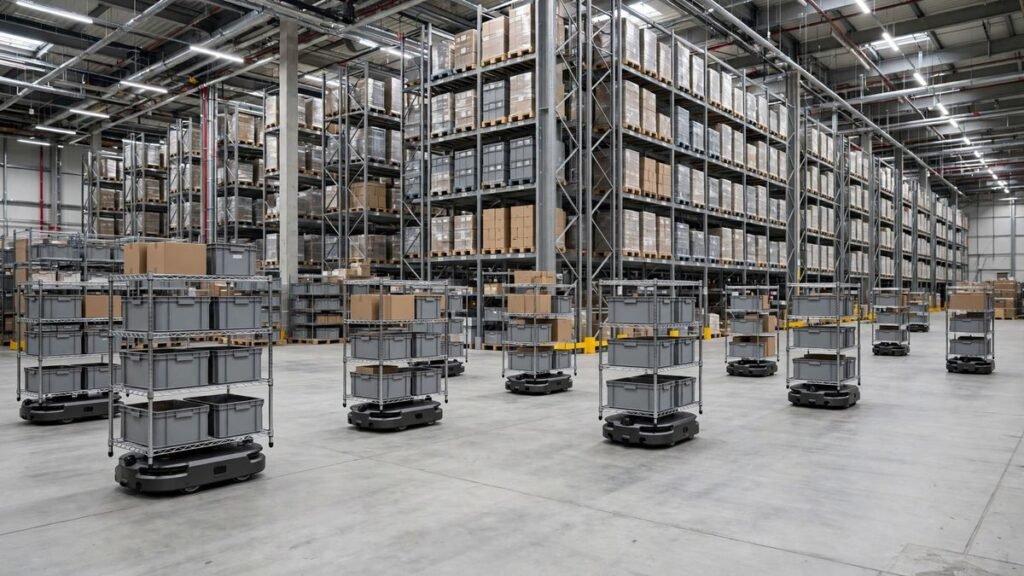
The best first projects share three features: the task varies, the volume is high enough to matter, and the failure mode is visible. Bin picking, inspection and machine tending fit that pattern. A pilot that runs for four weeks on one cell, with a written target such as picks per hour or defects caught, will tell you more than a year of vendor presentations. Supply-chain tasks such as moving goods between stations also benefit, as our guide to supply-chain automation beyond the hype explains.
Adopting AI robotics: a decision framework
Start with the task, not the technology. Pick one cell where variation causes manual work or rework, and write down the current cost of that variation. Then ask vendors for a pilot on that cell, with a written pass mark and a fixed duration.
Check the data and the people before the robot. AI vision needs images of real parts under real lighting; predictive maintenance needs sensor history; and the team needs someone who can maintain the system after the vendor leaves. The open-source Robot Operating System is a useful starting point for teams that want to prototype, and the safety standards are published by ISO.
AI industrial robotics checklist
- Pick one cell where variation causes manual work or rework, and write down its current cost.
- Agree a written pass mark for the pilot: picks per hour, defects caught or downtime avoided.
- Collect real images and sensor data from the cell before choosing a model.
- Confirm the safety case: risk assessment, guarding or collaborative limits, and trained staff.
- Plan maintenance: who updates the model, who fixes the robot and where spares come from.
- Run the pilot for at least four weeks and review it against the pass mark.
- Scale only the cells that passed; redesign the ones that did not before retrying.
Frequently asked questions
What is AI in industrial robotics?
It is the use of machine learning in industrial robots, so they can see, adapt and improve instead of repeating one fixed programme. The main applications are vision-guided picking, quality inspection, predictive maintenance and safe collaboration with people.
Do AI robots replace traditional industrial robots?
No. AI adds perception and judgement to the same machines. A welding robot still follows a fixed path where the seam is always in the same place; AI is used where something varies, such as mixed parts or changing lighting.
How much data does an AI robot need?
It depends on the task. A vision inspection model may need hundreds of images of good and bad parts, while a predictive maintenance model needs weeks of sensor data from normal operation. Vendors can often start from a pre-trained model and fine-tune it on your parts.
Are AI robots safe to work beside?
They can be, when the deployment follows the safety standards. Collaborative applications use speed and separation monitoring or power and force limiting, with limits from ISO/TS 15066, and every cell needs a risk assessment that covers the robot, the task and the shared space.
AI in industrial robotics is not a replacement for the robots factories already own; it is the upgrade that lets those robots handle the varied, messy work that was previously left to people. Pick one cell, set a pass mark, run the pilot, and let the results decide the next step.