Robotics and AI explained in plain terms starts with a simple idea: a robot is a machine that senses the world, decides what to do, and then acts. AI supplies the sensing and the deciding, while the robot body supplies the acting. The central question is how the two fit together, and the answer is a loop: sensors gather data, models interpret it, a planner chooses an action, and motors carry it out, repeating many times a second.
This loop is what separates a robot from a fixed machine. A conveyor belt does the same thing forever, but a robot adjusts to what it sees, whether it is a warehouse arm picking mixed products, a vacuum mapping a flat, or a humanoid learning to walk.
Key takeaways
- Robotics and AI explained simply: sensors perceive, models decide, and actuators act, in a loop that repeats many times a second.
- Perception, planning and control are the three layers of every robot, and AI mainly improves the first two.
- Industrial arms, mobile robots, humanoids and drones solve different problems and need different software.
- ROS 2 is the standard open software framework, and simulation is where most modern robots are trained.
- Safety and reliability matter more than raw capability when robots leave the laboratory.
The sense, decide, act loop
Every robot runs a loop of sensing, deciding and acting. Cameras, lidar, depth sensors and touch sensors feed perception models, which build a picture of the surroundings: where objects are, what they are, and how they move. A planner chooses the next action, and a controller turns that plan into motor commands.
The loop runs fast because the world changes fast. A mobile robot updating its position ten times a second can correct for a slipping wheel or a person stepping into its path, and an arm adjusting its grip as it lifts can avoid dropping the object.
AI enters mainly at the perception and planning layers. Classical control still handles the low-level work of keeping a joint steady or a wheel at the right speed, because it is precise and predictable. Machine learning handles the messy parts: recognising objects in clutter, predicting how a person will move, or choosing a grasp for an unseen object.
The best systems use each where it is strongest.
The main types of robot
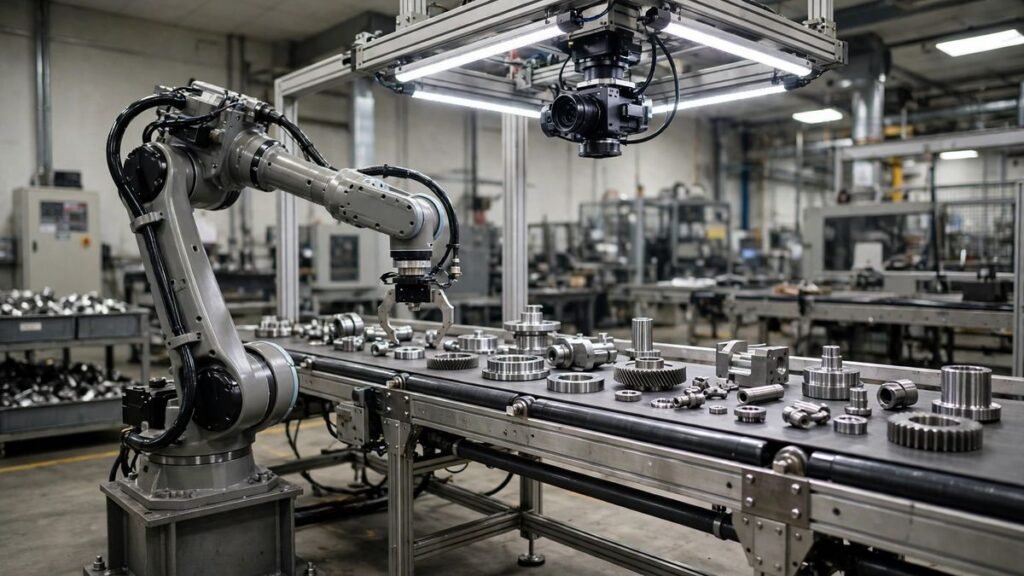
Industrial arms are the oldest and most common robots. A six-axis arm bolted to the floor welds car bodies, paints panels and assembles electronics with a repeatability no human can match. They traditionally followed fixed programmes, but vision-guided arms now pick mixed items from bins, adapting to each object’s position and shape.
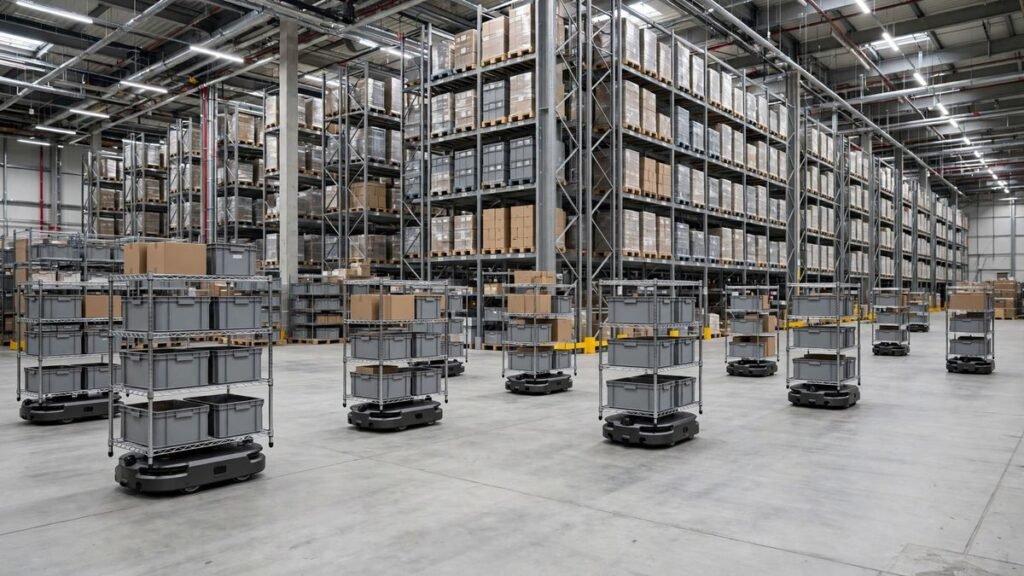
Mobile robots move through the world rather than staying in one place. Autonomous mobile robots, or AMRs, navigate warehouses and hospitals carrying shelves, totes and supplies, localising themselves with lidar and cameras and planning routes around people and obstacles. Their cousins, automated guided vehicles, follow fixed paths marked by magnets or wires, and are cheaper but far less flexible.
Best for: repetitive, precise work in structured settings, such as welding, painting and assembly.
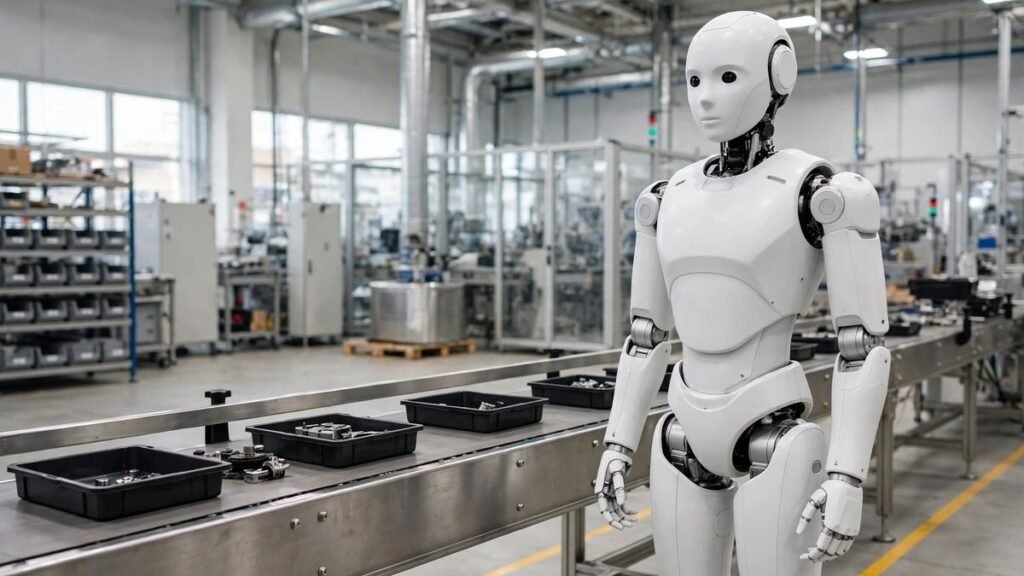
Humanoid robots are the newest and most ambitious category. Their two arms, two legs and human-like shape let them use tools, doors and stairs designed for people. Boston Dynamics’ Atlas began as a research platform and, in its electric form, is now aimed at factory work, while Figure AI, Agility Robotics and Unitree build humanoids for warehouses and logistics.
They remain early-stage and expensive, but they promise a general-purpose worker rather than a single-task machine. Best for: research and pilot deployments where a human-shaped machine can use existing infrastructure.
Drones and quadrupeds cover the remaining ground. Quadrupeds such as Boston Dynamics’ Spot, on sale since 2020, walk over rough terrain and stairs to inspect sites where wheels cannot go, while drones inspect roofs, power lines and crops from the air. Both rely heavily on AI for navigation.
Best for: inspection and monitoring in places that are dangerous, remote or hard to reach.
Perception: how robots see
Perception is the hardest part of robotics, because the real world is messy, cluttered and badly lit. A robot’s cameras see pixels, and its models must turn them into a usable understanding: which objects are present, where they are in three dimensions, and which matter. Depth cameras and lidar measure distance directly, while touch sensors tell a gripper how hard it is squeezing.
Object detection and segmentation are the workhorses. Detection draws boxes around objects, while segmentation labels every pixel, which is useful when a robot needs an object’s exact shape to grasp it. Pose estimation reads limb positions or a tool’s orientation.
These capabilities come from the same model families used in other vision applications, adapted to run fast enough for a moving machine.
Simulation is where perception models are increasingly trained. A simulator can generate millions of labelled images of a warehouse, kitchen or factory floor, including lighting and clutter that would take years to photograph, and the models are then fine-tuned on real data. This approach, called sim-to-real transfer, is now standard practice, and NVIDIA’s Isaac Sim is one of the main platforms for it.
Our guide to how modern vision systems are built covers the underlying architecture.
Planning and control: deciding and doing
Planning turns perception into action. A motion planner works out how an arm reaches a target without hitting anything, while a navigation planner finds a route across a warehouse that avoids people and other robots. Both replan continuously as the scene changes.
Reinforcement learning is reshaping planning. Instead of hand-coding every rule, a robot learns by trial and error in simulation, earning rewards for successful grasps or efficient routes. NVIDIA’s Isaac Lab runs thousands of simulated robots in parallel so a policy can be trained in hours rather than months, then deployed on the real robot with safety limits.
Control is the final layer, and the most conservative. A controller converts a planned trajectory into motor torques, keeping movements smooth and stable, and force control lets an arm push gently against a surface for tasks such as polishing. When a robot fails, a well-designed controller stops the arm before it damages itself or its surroundings.
Best for: tasks where the environment changes, such as picking mixed products or navigating shared spaces.

Robotics and AI: the software stack compared
The table below shows how the layers differ in what they do and how AI is used in each.
| Layer | What it does | AI’s role | Key tools |
|---|---|---|---|
| Perception | Turns sensor data into understanding | Object detection, segmentation, pose | Cameras, lidar, depth sensors |
| Mapping and localisation | Builds a map and finds the robot in it | SLAM, place recognition | Lidar, visual SLAM |
| Planning | Chooses routes and movements | Learned policies, search | Motion planners, reinforcement learning |
| Control | Turns plans into motor commands | Small role; mostly classical methods | PID, force and impedance control |
| Task and fleet level | Coordinates many robots and jobs | Scheduling, traffic management | Fleet managers, orchestration |
ROS 2: the framework most robots share
Most modern robots run on ROS 2, the Robot Operating System, an open-source framework maintained by Open Robotics and governed since 2024 by the Open Source Robotics Alliance (OSRA). Despite the name, ROS 2 is not an operating system; it is middleware, a set of libraries and tools that let a robot’s parts exchange messages. One process handles the camera, another handles navigation, and ROS 2 connects them.
ROS 2 is organised into distributions, released each May, with long-term support versions every two years. Humble Hawksbill arrived in May 2022 and is supported until May 2027, Jazzy Jalisco arrived in May 2024 and is supported until May 2029, and Lyrical Luth, released in May 2026, is supported until 2031. New projects should start on a long-term support release, and the first ROS generation reached end of life in May 2025.
The framework matters because it makes robots composable: a team can combine a navigation package from one group with a grasping package from another, without rebuilding either. That reuse is a large part of why robotics has accelerated. ROS.org is the project’s home.
A decision framework for adopting robots
Buying a robot is an operations decision, not a technology showcase. Work through this checklist before committing.
- Pick a task that is repetitive, well-defined and easy to measure, such as moving totes or inspecting a fixed route.
- Measure the baseline first: how long the task takes, how often it fails, and what it costs today.
- Check the environment honestly, including floor quality, lighting and doorway widths.
- Ask what happens when the robot fails, and who fixes it.
- Plan the human roles around the robot: who loads it, who supervises it, and who owns results.
- Run a pilot in the real environment for at least a month, with real staff and workloads.
- Confirm safety certification for the setting, including standards for collaborative robots near people.
- Budget for maintenance, software updates and retraining, not just the purchase price.
The checklist reflects a hard lesson: the robot is rarely the problem. The environment, the workflow and the support plan decide whether a deployment succeeds. A robot that works in a demonstration but fails on a wet factory floor is a demonstration, not a deployment.
Safety, jobs and the limits of today’s robots
Safety is the first constraint on every real deployment. Industrial robots have traditionally worked behind fences, but collaborative robots, or cobots, work beside people, with force limits and sensors that stop them on contact. Standards such as ISO 10218 and ISO/TS 15066 set the rules, and buyers should confirm compliance.
The jobs question deserves a direct answer. Robots take over tasks that are repetitive, heavy or dangerous, and they create new work in installation, maintenance, programming and supervision. The effect is mixed: some roles disappear, others change, and new ones appear.
Organisations that retrain staff rather than simply removing them get better results and less resistance.
Today’s robots also have clear limits. They struggle with soft, deformable objects, tasks that need fine touch, and environments that change unpredictably. A robot can pick a box reliably, but folding a towel or handling a ripe tomato remains hard.
These limits are shrinking, but they define what is sensible to automate today. Our guides to AI systems on the factory floor and agent orchestration show where robots already deliver and how fleets are coordinated.
Frequently asked questions
What is the difference between robotics and AI?
Robotics is the physical machine: sensors, motors and structure. AI is the software that lets it perceive, decide and adapt. A robot without AI follows fixed programmes, while AI without a robot cannot act in the physical world.
What is ROS 2?
ROS 2 is the open-source middleware most modern robots are built on, connecting parts such as cameras, navigation and control so they can exchange messages. It is maintained by Open Robotics, with long-term support releases every two years.
How do robots learn?
Mostly in simulation. A robot practices millions of times in a virtual environment, learning by trial and error, and the learned behaviour is transferred to the real machine and fine-tuned on real data. This is faster and safer than learning only on hardware.
Are humanoid robots ready for real work?
Not yet at scale. Humanoids from Boston Dynamics, Figure AI, Agility Robotics and Unitree are in pilots and early deployments, mainly in warehouses and factories. They are promising but expensive and less reliable than specialised robots for most tasks.
What jobs do robots do best?
Repetitive, heavy or dangerous tasks in structured settings: welding, painting, moving goods and picking known items. They struggle with soft objects, fine touch and unpredictable environments.
Is it safe to work alongside a robot?
Yes, when the system is designed and certified for it. Collaborative robots have force limits and stop on contact, and standards such as ISO/TS 15066 govern shared workspaces. Safety depends on the whole installation, not just the robot.