Humanoid robots explained simply, they are machines built in the shape of a human body, with two arms, two legs, a torso and a head, that use artificial intelligence to perceive their surroundings, decide what to do and carry out physical tasks. The central question is whether these robots are ready for real work, and the honest answer is that a small number now run supervised pilots in factories and warehouses, while home use remains experimental.
The human shape matters for a practical reason, not a cosmetic one. Factories, warehouses, offices and homes were all built for human bodies, so a robot shaped like a person can use the same stairs, doors, shelves and tools without the building being rebuilt. That is the bet every major humanoid programme is making.
Key takeaways
- Humanoid robots combine cameras, sensors, AI planning and electric actuators to do physical work in spaces built for people.
- They are ready for supervised factory and warehouse pilots, but not yet for unsupervised work or for the home.
- Tesla Optimus, Figure 02 and 03, Boston Dynamics Atlas and Agility Digit are the leading platforms, each aimed at a different first job.
- The hard problems are dexterous hands, reliable balance, battery life and safe operation around people.
- Judge a humanoid on proven pilot hours, not on demonstration videos.
What a humanoid robot actually is
A humanoid robot has three layers that must work together. The body is the mechanical layer: joints, actuators, hands and a power source that let it move and lift. The senses are the perception layer: cameras, depth sensors and force sensors that report what is around it. The brain is the software layer: models that turn sensor data into a plan, and control software that turns the plan into joint movements.
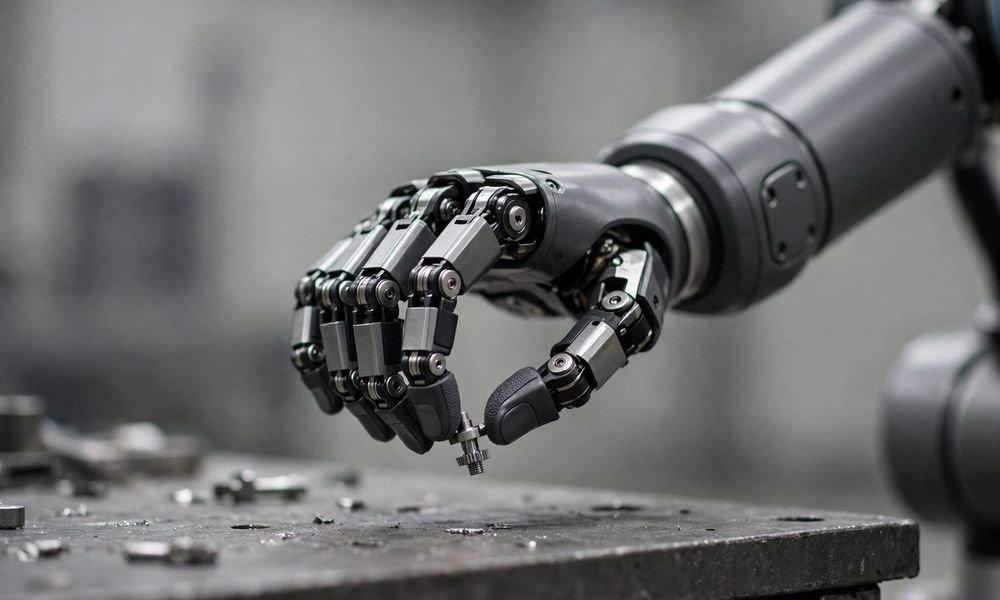
Most modern humanoids are electric rather than hydraulic. Boston Dynamics retired its hydraulic Atlas in 2024 and replaced it with an all-electric version, because electric actuators are quieter, cleaner and easier to maintain in a factory. Early humanoids had simple grippers; the newest generation has multi-fingered hands, because so much real work happens in the fingers, and hand dexterity is now the clearest dividing line between a demonstration robot and a working one.
How humanoid robots see, think and move
A humanoid typically carries stereo cameras and depth sensors in its head, plus force sensors in its joints. The vision system identifies objects, estimates their position in three dimensions and tracks people nearby. Force sensing tells the robot how hard it is gripping and whether it has made contact with something unexpected.
Vision-language models have changed what perception can do. Instead of recognising only the objects it was trained on, a robot can now respond to a spoken instruction such as “pick up the red box on the second shelf” and work out which object that means. That shift from fixed programmes to language-driven tasks is what makes general-purpose humanoids plausible at all.
Once the robot knows where things are, it must plan a sequence of actions: walk to the shelf, reach, grasp, carry and place. A high-level AI model decides the sequence, often from a natural-language instruction, while a lower-level controller handles balance and joint motion. Training depends on demonstration data, collected by teleoperation, where a human drives the robot through a task while the system records every sensor reading and movement. Walking on two legs is an unstable problem the robot must solve continuously, adjusting its steps dozens of times a second, and a stumble is a safety event, so balance control is treated as safety-critical.
Tesla Optimus: the scale bet
Tesla’s Optimus is a general-purpose humanoid designed to share the manufacturing and sensing technology of Tesla’s cars. It uses the company’s self-driving computer hardware and neural-network approach to perception, and its hands are designed for the fine manipulation that factory assembly requires. Tesla has said the robot will first work in its own factories before being sold to others.
Early production began at Tesla’s Fremont factory in October 2026, with the company describing the first units as production-quality robots built on high-volume lines. Tesla has set a target price of 20,000 to 30,000 dollars at scale, although that is a target for future volume production, not a current price. The key question for buyers is how many hours Optimus has actually worked unsupervised in a real factory.
Best for: organisations watching for a mass-produced, general-purpose humanoid at a consumer-scale price, once production volumes are proven.
Figure 02 and Figure 03: the factory pilot leader
Figure AI’s Figure 02 completed an 11-month pilot at BMW’s Spartanburg plant, where it worked on production tasks and helped build more than 30,000 vehicles. That long, single-site pilot is the most concrete evidence in the industry that a humanoid can do sustained factory work. Figure 03 took over at Spartanburg in June 2026, bringing a redesigned body and improved hands.
Figure’s approach pairs a vision-language model with a fast learned controller, so the robot can take spoken instructions and carry out multi-step tasks such as sorting parts and moving totes. The company has built its own manufacturing line, known as BotQ, to scale production, and it sells through enterprise agreements rather than a public price list.
Best for: manufacturers that want a humanoid with the longest proven factory pilot and are ready to run a supervised deployment.
Boston Dynamics Atlas: the most capable mover
Boston Dynamics’ Atlas is the most physically capable humanoid in the field, with continuous 360-degree joint rotation and a level of strength and agility no competitor matches. The all-electric Atlas, launched in 2024, is designed for real industrial work rather than research demonstrations. Its owner, Hyundai Motor Group, is deploying Atlas in vehicle manufacturing, and Google DeepMind is also an early deployment partner.
Atlas’s strength is mobility and manipulation in demanding environments: it can lift heavy loads, move through cluttered spaces and recover from disturbances that would stop a simpler robot. Its weakness, from a buyer’s point of view, is that it is an enterprise platform sold through commercial agreements, with no public price and no consumer version on the horizon.
Best for: industrial sites that need the strongest, most agile humanoid available and can support an enterprise deployment.
Agility Digit: the warehouse specialist
Agility Robotics’ Digit takes a different approach: it is built for one job, moving totes in warehouses and logistics centres. Digit has legs shaped for walking and carrying, arms for lifting totes, and a head with sensors for navigation. It is already working at customer sites, including logistics operator GXO, which makes it one of the few humanoids with real commercial deployments rather than pilots.
Digit’s narrower focus is its advantage. Because it does not try to be a general-purpose worker, its software can be tuned for the repetitive, structured work of a warehouse, where the environment is controlled and the tasks are predictable. That focus also makes its business case easier to calculate: totes moved per hour against labour cost.
Best for: warehouses and logistics operators that want a humanoid doing one repetitive job at commercial scale.
Comparing the leading humanoid robots
| Robot | Maker | First job | Status in 2026 | Strength |
|---|---|---|---|---|
| Optimus | Tesla | Factory assembly | Early production at Fremont | Scale and shared car technology |
| Figure 02 / 03 | Figure AI | Factory parts handling | Long BMW pilot, now Figure 03 | Proven pilot hours |
| Atlas (electric) | Boston Dynamics | Vehicle manufacturing | Deploying at Hyundai sites | Strength and agility |
| Digit | Agility Robotics | Warehouse tote moving | Working at customer sites | Focused, commercial deployments |
Where humanoid robots work today
The honest picture is that humanoids work in supervised pilots, not as unsupervised staff. In factories they move parts, sort components and carry totes between stations. In warehouses they shift containers and handle parcels. In every case a human team supervises, the robot works in a defined area, and the tasks are a small set of repeated jobs rather than general work.
That narrow start is sensible. A robot that does three tasks reliably for a full shift is more valuable than one that attempts thirty and fails at five. The companies that deploy successfully choose tasks that are repetitive, physically tiring for people and located in structured spaces. They measure success in hours worked without intervention, not in the number of different tasks attempted.
The home is a different problem. Homes are unstructured, cluttered and full of unpredictable people and pets, and the safety bar for a robot near children is far higher than for a robot in a fenced factory cell. Home pilots exist, but they are limited trials with supervision, and a general-purpose home humanoid is still years away. For a fuller picture of how AI is already working on factory floors, see our guide to how AI systems work in manufacturing.
Choosing a humanoid: a decision framework
Start from the task, not the robot. Write down the exact job, the weight involved, the hours per day and the environment, then ask vendors for evidence of that job being done, not a showreel. Check the support model before the specification sheet: maintenance, software updates, spare parts and recovery from a stoppage matter more than top speed or payload. Plan for the people as well: workers need training, the floor needs marked routes, and the safety case needs a risk assessment. Coordinating multiple AI agents raises the same question in software, since a fleet of robots needs the same supervision and handover design as a fleet of agents.
Humanoid robot checklist
- Define one task, with weight, hours and environment written down before talking to any vendor.
- Ask for pilot evidence of that exact task, measured in hours worked without intervention.
- Check battery life against a full shift, including charging and swap time.
- Confirm the safety case: risk assessment, speed limits and a stop procedure that workers understand.
- Agree the support model: maintenance, spares, software updates and recovery from a stoppage.
- Set a written pass mark for the pilot and a date to review it.
Frequently asked questions
What is a humanoid robot?
A humanoid robot is a machine built in the shape of a human body, with two arms, two legs, a torso and a head, that uses cameras, sensors and AI software to perceive its surroundings and carry out physical tasks in spaces built for people.
Can I buy a humanoid robot today?
Most leading humanoids are sold through enterprise agreements or pilots, not as off-the-shelf products. Research platforms are available to labs and universities, while factory platforms such as Figure and Atlas are deployed through commercial partnerships.
How much does a humanoid robot cost?
There is no standard price. Tesla has targeted 20,000 to 30,000 dollars for Optimus at scale, but that is a future volume target, and most other platforms do not publish prices. Enterprise deployments are priced as agreements that include the robot, software, support and integration.
Are humanoid robots safe to work beside?
They are designed to be, but safety depends on the deployment, not the robot alone. Safe deployments use risk assessments, speed and force limits, defined workspaces and trained staff, following standards such as ISO 10218 and ISO/TS 15066.
Will humanoid robots replace factory workers?
For now they take on repetitive, physically tiring tasks in supervised pilots, while human workers supervise, maintain and work alongside them. The realistic near-term picture is robots handling specific jobs while people do the varied, judgement-heavy work around them.
Humanoid robots are at the pilot stage: impressive in demonstrations, useful in a small number of real deployments, and still unproven as general workers. Judge them on hours worked, not on the showreel.