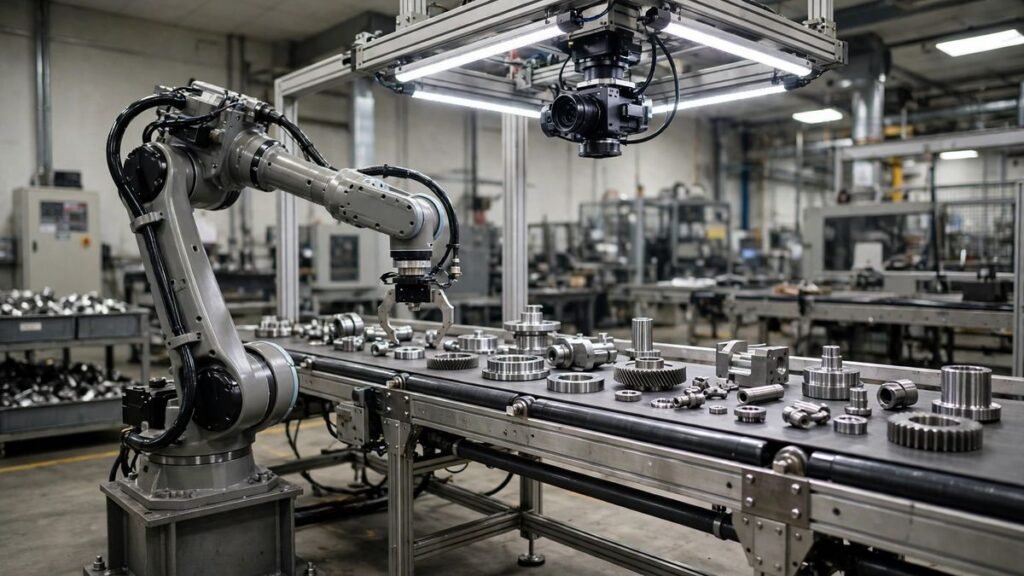
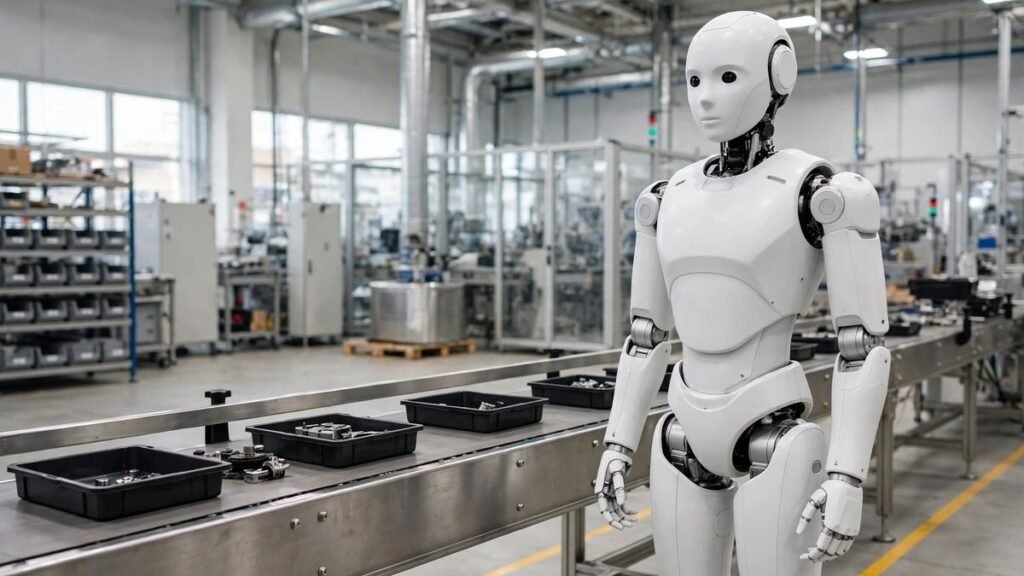
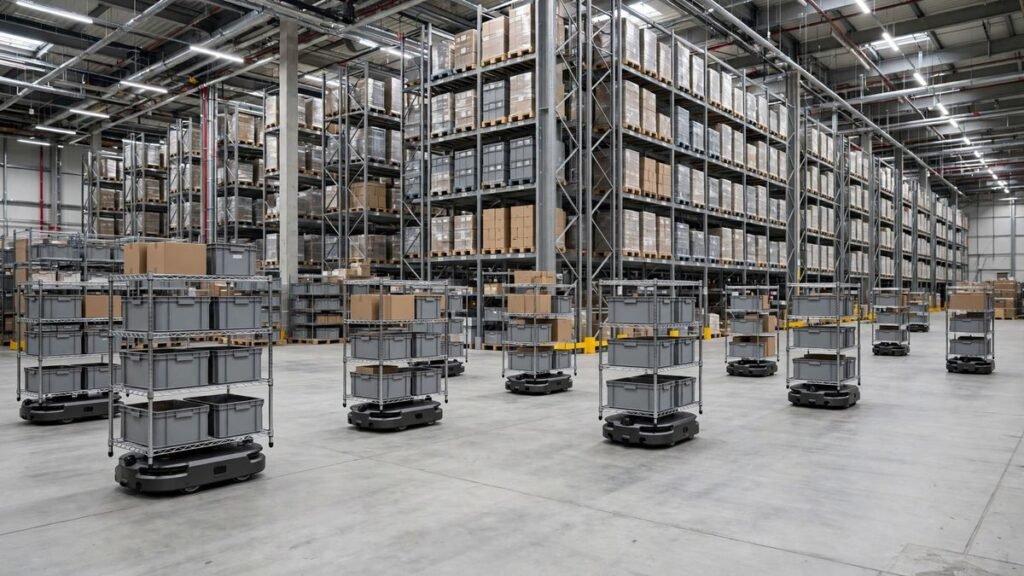
Embodied AI explained in one sentence means artificial intelligence that learns through a body interacting with the physical world. Instead of only reading text or looking at pictures, an embodied system moves, touches, drops things and learns from what happens. The central question is why a body matters at all, and the answer is that much of intelligence is about the physical world: gravity, friction, weight and timing, things a model can only truly learn by experiencing them.
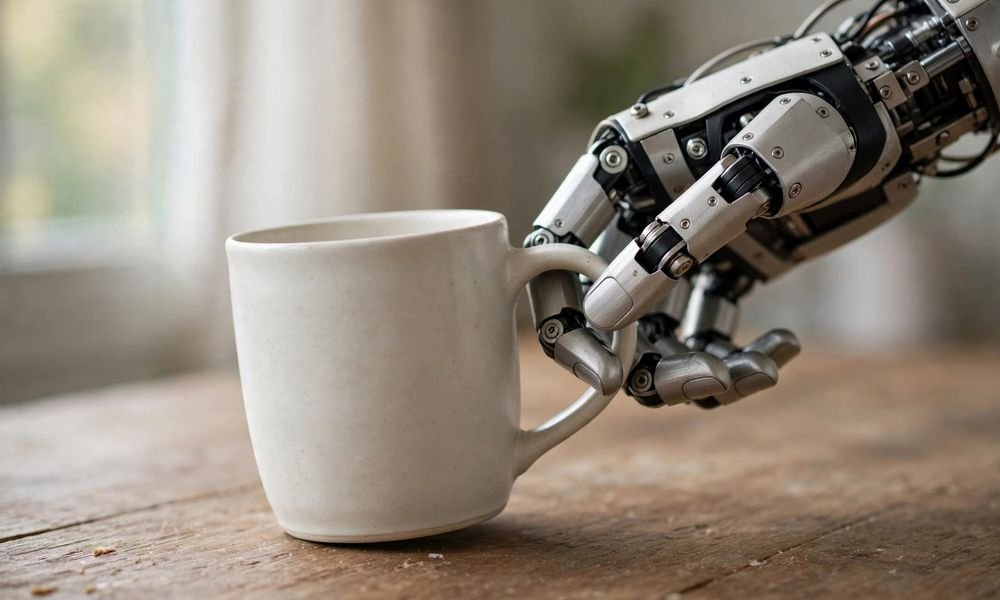
A language model can describe how to pick up a cup, but it has never felt one slip. A robot that has dropped a hundred cups knows how grip, weight and surface interact. That difference is the whole idea of embodied AI.
Key takeaways
- Embodied AI explained simply: intelligence that learns by acting in the physical world, not just by reading data.
- A body gives an AI direct experience of gravity, friction, weight and timing, which text and images cannot teach.
- Vision-language-action models turn instructions and camera images into robot movements.
- Simulation, teleoperation and human demonstration are the main ways embodied systems are trained.
- Humanoids, warehouse robots and home assistants are the first real deployments, and all are still early.
What embodiment means for intelligence
Embodiment is the idea that intelligence is shaped by the body that holds it. A human understands that a glass is fragile partly because of physics, and partly because of a lifetime of handling glasses. The knowledge is a set of expectations built from touch, weight and the sound of breaking glass.
Embodied AI applies the same idea to machines: give a model a body and a world to act in, and it develops understanding that no amount of text can provide.
The contrast with disembodied AI is stark. A chatbot can write a perfect recipe but cannot tell whether a tomato is ripe by squeezing it, or whether a pan is too hot by the sound of the oil. Those judgements come from senses and from the consequences of acting, and an embodied system learns them the same way a person does: by trying, failing and adjusting.
This is not a new idea: philosophers and cognitive scientists have argued for decades that the mind is shaped by the body. What is new is the scale. Foundation models, cheap sensors and fast simulation now let researchers build embodied systems that learn from millions of interactions rather than a handful.
Our guide to agentic AI architecture covers how autonomous systems are structured, which is the software side of the same story.
How embodied AI systems are built
An embodied AI system has four parts. Perception turns camera, depth and touch data into an understanding of the scene. A world model predicts what will happen next, such as whether a stack of boxes will topple if the bottom one is pulled.
A policy decides what to do, and a controller turns that decision into motor commands. The loop runs continuously, and every action produces feedback that improves the system.
The newest and most important component is the vision-language-action model, or VLA. A VLA takes a spoken or written instruction and camera images as input, and outputs robot actions directly. Tell a robot to put the red mug on the shelf, and the model interprets the instruction, finds the mug, plans the grasp and moves the arm.
These models are trained on large datasets of demonstrations, often gathered by humans operating robots remotely, a technique called teleoperation.
Simulation does the heavy lifting. A robot can practice a task thousands of times in a virtual kitchen or warehouse, failing safely and quickly, before ever touching the real thing. NVIDIA’s Isaac Sim and Isaac Lab are the main platforms for this, and the Isaac GR00T project, announced at GTC in March 2024, is NVIDIA’s foundation model for humanoid robots, designed to understand language and learn skills by observing human actions.
In 2025 NVIDIA released GR00T N1, an open version with a two-system design: a fast system for reflex-like actions and a slow system for deliberate planning.
The three ways embodied AI learns
Teleoperation is the most direct training method. A human operator drives a robot through a task, often using a headset or a handheld controller, and the robot records every sensor reading and motor command. Hundreds or thousands of these demonstrations become training data for a model that can then perform the task on its own.
The approach works well, but it is slow and expensive, because each demonstration needs a person and a robot.
Reinforcement learning is the second method. The robot practices in simulation, earning rewards for success and learning from failure, until it can perform the task reliably. Isaac Lab runs thousands of simulated robots in parallel, so a policy can be trained in hours.
The challenge is transferring what was learned in simulation to the real world, where friction, lighting and wear differ. Careful randomisation of the simulation, varying surfaces, weights and lighting, narrows that gap. Best for: tasks that can be practised safely in simulation, such as grasping, walking and navigation.
Learning from human video is the third method, and the most ambitious. Instead of robot demonstrations, the model learns from videos of people doing things: cooking, cleaning, assembling furniture. The model must translate what a human body does into what a robot body can do, which is hard because the bodies differ.
Early results are promising, and this approach could unlock far larger training datasets than teleoperation, since human video is abundant. Best for: general skills that people demonstrate naturally, such as tidying, sorting and simple assembly.
Embodied AI: the approaches compared
The table below compares the main approaches to building embodied intelligence, from classical robotics to the newest foundation models.
| Approach | How it learns | Strengths | Weaknesses | Typical fit |
|---|---|---|---|---|
| Classical robotics | Hand-coded rules and models | Reliable, predictable, provable | Brittle outside fixed tasks | Factory automation |
| Teleoperation learning | Human demonstrations | Learns real tasks quickly | Slow and costly to scale | Humanoid pilots, dexterous tasks |
| Reinforcement learning | Trial and error in simulation | Scales to millions of trials | Sim-to-real gap, needs tuning | Walking, grasping, navigation |
| Vision-language-action models | Large demonstration datasets | Follows language instructions | Needs huge data, still early | General-purpose robots |
| Learning from human video | Videos of people acting | Abundant training data | Body mismatch, hard to transfer | General household skills |
Where embodied AI works today
Warehouses are the most advanced deployment. Robots there pick, pack and move goods, and embodied AI helps them handle the variety of real products: different shapes, weights and packaging, all mixed together. Amazon’s Sparrow arm, introduced in November 2022, uses computer vision and AI to identify and handle individual products from bins, and its Vulcan arm adds touch sensing to judge grip force.
These are embodied systems in the practical sense: they learn from physical interaction, not from text.
Humanoid robots are the most visible deployment, if not yet the most useful. Boston Dynamics’ Atlas, in its electric form, is being developed for factory work, while Figure AI, Agility Robotics and Unitree are running warehouse pilots. The humanoid shape is the point: a robot that fits human spaces can use existing tools, doors and stairs.
The current reality is narrower than the ambition, with most humanoids performing a small set of tasks under supervision, but the pilots are real and growing.
Home assistance is the longest-term goal. A robot that can tidy a room, load a dishwasher or help an older person stand up would be transformative, but homes are the hardest environment: cluttered, unpredictable and full of fragile things. Progress here is slower, and the systems that exist are research prototypes rather than products.
Best for: warehouses and factories, where the environment is structured and the tasks are repeatable.
A decision framework for following the field
Embodied AI attracts bold claims, so a clear framework helps separate substance from hype. Use the checklist below when judging a product, a pilot or a research result.
- Ask what the system does without human help, and for how long, because supervised demos hide a great deal.
- Look for evidence in the real environment, not just in a laboratory or a video, and ask how many hours it has run.
- Check the failure rate and what happens on failure, because a robot that fails gracefully is far more useful than one that fails rarely but catastrophically.
- Ask how the system is trained and how much data it needed, since data hunger is the main cost driver.
- Distinguish a general skill from a scripted routine: can the robot handle a new object, or only the ones it was shown?
- Consider the safety case, including what the robot does when a person steps into its path.
- Watch for the gap between a research paper and a product, which is usually measured in years.
- Judge the company on its deployments and customers, not on its demonstration videos.
The framework matters because embodied AI is at the stage where demonstrations outrun deployments. A robot folding a shirt on stage is impressive, but the question is whether it can fold a thousand shirts in a real laundry without breaking anything.
The hard problems that remain
Dexterity is the hardest problem. Human hands have dozens of joints and thousands of touch sensors, and they handle soft, slippery and fragile objects with ease. Robot hands are improving, but they remain far behind.
A robot that can pick a box may still fail at picking a grape, and that gap matters for homes and hospitals more than for warehouses.
Generalisation is the second hard problem. A model trained to tidy one kitchen may fail in another, because the objects, lighting and layout differ. Humans generalise effortlessly; robots do not.
Foundation models help, because they bring broad knowledge from their training, but they still need grounding in the specific environment.
Safety is the third. A language model that makes a mistake produces a wrong sentence, but an embodied system that makes a mistake can break something or hurt someone. This raises the bar for testing, and it is why deployment is slower than research.
The field needs standardised, adversarial evaluation before a system is allowed near people. Our guide to AI reliability engineering covers how smart systems are kept stable, which is directly relevant here.
Frequently asked questions
What is embodied AI?
Embodied AI is artificial intelligence that learns through a physical body acting in the real world. Instead of only processing text or images, it moves, touches and manipulates objects, and learns from the results of its actions.
How is embodied AI different from robotics?
Robotics is the hardware and the classical control that moves it. Embodied AI is the learning approach: using AI models that develop understanding through physical interaction, rather than relying only on pre-programmed rules or disembodied data.
What is a vision-language-action model?
A vision-language-action model, or VLA, takes a spoken or written instruction and camera images as input, and outputs robot actions. It lets a person tell a robot what to do in ordinary language, and the robot works out how to do it.
What is NVIDIA Isaac GR00T?
Project GR00T, announced by NVIDIA at GTC in March 2024, is a general-purpose foundation model for humanoid robots, designed to understand language and learn skills by observing human actions. GR00T N1, released in 2025, is an open version with a two-system design for fast reflexes and slow planning.
When will humanoid robots work in homes?
Not soon at scale. Homes are cluttered and unpredictable, and dexterity and safety are still hard problems. Warehouses and factories will come first, with home assistance following years later.
Is embodied AI dangerous?
It carries real physical risks, which is why safety testing matters. A robot that makes a mistake can damage property or injure a person, so deployments need force limits, emergency stops and thorough testing before operating near people.