Computer vision models explained in plain terms are AI systems that take images or video as input and produce understanding as output: what is in the picture, where it is, and what is happening. The central question is how a machine that only sees numbers can recognise a face, read a sign, or spot a defect on a production line, and the short answer is that it learns patterns from millions of labelled examples, and then applies those patterns to images it has never seen.
Computer vision is one of the oldest branches of AI, and one of the most widely deployed. It checks products on factory lines, reads medical scans, tags photos, guides vehicles, and monitors public spaces. The technology has improved sharply in the last decade, driven by deep learning, but it still makes mistakes that a person would not, and understanding its limits matters as much as understanding its power. Our guide to neural networks explains the building blocks that vision models are made from.
Key takeaways
- Computer vision models turn images into understanding: what is in a picture, where it is, and what is happening.
- Convolutional networks learn visual patterns layer by layer, from edges and textures to shapes and whole objects.
- Vision transformers now rival convolutional models, treating image patches like words in a sentence.
- Different tasks need different models: classification, detection, segmentation and generation are not the same problem.
- Vision models can be fooled by small changes invisible to people, and they inherit biases from their training data.
What a computer vision model is
A computer vision model is a neural network trained to interpret visual input. To a computer, an image is a grid of numbers, one per pixel, describing brightness and colour. The model’s job is to turn that grid into something meaningful: a label, a location, or a description. It does this by learning patterns from training data, usually images that people have labelled with what they contain.
Training works by showing the model many examples and adjusting its internal parameters until its predictions match the labels. A model trained on photos of animals learns the patterns that distinguish a dog from a cat, not by being told the rules, but by finding the statistical patterns in the pixels. Once trained, the model can apply those patterns to new images, including ones very different from anything it saw during training, though its accuracy falls when the new images differ too much.
How convolutional networks see
The most widely used vision architecture is the convolutional neural network, or CNN. A CNN processes an image through layers, each of which looks for patterns at a different scale. The first layers detect simple features: edges, corners and colour changes. Later layers combine those features into textures and shapes. The deepest layers combine shapes into whole objects: a wheel, a window, a face.
Convolution is the operation that makes this work. A small filter slides across the image, and at each position it measures how much the local patch matches the pattern the filter is looking for. The same filter is used everywhere in the image, which means the model can recognise a pattern wherever it appears, and it needs far fewer parameters than a network that treated every pixel independently. Pooling layers then shrink the image, keeping the strongest signals and discarding detail, so that deeper layers see the bigger picture.

Vision transformers and newer designs
In recent years, vision transformers have become a serious alternative to convolutional networks. A vision transformer splits an image into patches, treats each patch like a word in a sentence, and applies the attention mechanism to work out how the patches relate to each other. The design comes from language models, and it has proved flexible enough to handle images well, particularly when trained on very large datasets.
Vision transformers have a different strength from CNNs. A convolutional network is good at local patterns, because each filter looks at a small patch. A vision transformer can connect distant parts of an image directly, which helps with tasks where the whole scene matters, such as understanding the relationship between objects. In practice, the best results often come from combining the two: convolutional layers for local detail and attention for the wider picture. The field is still moving quickly, and the best architecture for a given task depends on the data available and the accuracy required.
Comparing vision tasks
| Task | Main benefit | Main risk | Best for |
|---|---|---|---|
| Classification | Simple and fast | Says nothing about location | Sorting and tagging |
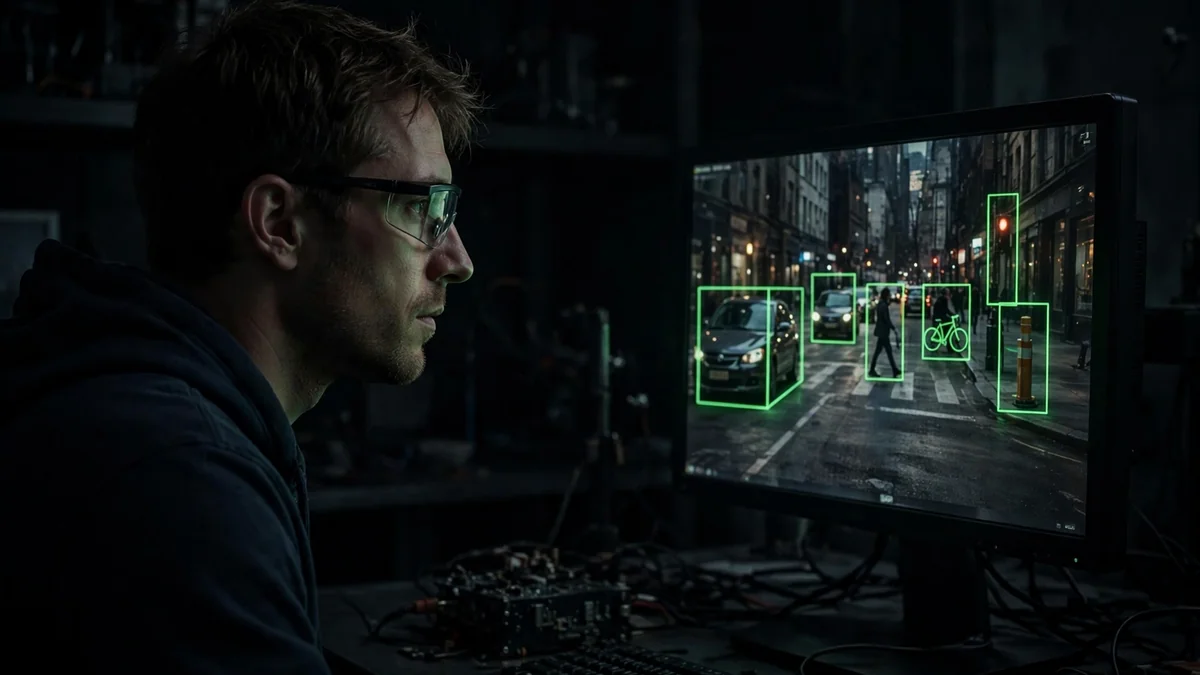
| Object detection | Finds and locates objects | Needs labelled boxes | Counting and tracking |
| Segmentation | Outlines objects precisely | Expensive to label | Medical imaging |
| Pose estimation | Tracks body positions | Fails on occlusion | Sport and health |
| Image generation | Creates new images | Can produce convincing fakes | Design and media |
Where vision models are used
Computer vision is used in factories, where models inspect products for defects faster and more consistently than people, and in warehouses, where they read labels and guide robots. In medicine, vision models help radiologists by highlighting suspicious areas in scans, though the final decision remains with a clinician. In agriculture, they spot disease in crops from drone photographs. In retail, they track stock on shelves and enable checkout-free stores.
Vision is also used in vehicles, where models detect lanes, pedestrians and other road users, and in security, where they recognise faces and flag unusual behaviour. That last use raises the sharpest questions, because face recognition and surveillance affect privacy and civil liberties in ways that a factory inspection system does not. Our guide to multimodal AI explains how vision models are combined with language models to build systems that can both see and describe what they see.
Limits, bias and adversarial images
Vision models have limits that users should understand. They can be fooled by adversarial examples: images changed in ways invisible to a person, but enough to make a model misclassify them. A small pattern added to a stop sign can make a model read it as a speed limit sign. These attacks are a real concern wherever vision models make safety decisions, and the defence is to test models against such examples and to avoid relying on a single model for a critical decision.
Vision models also inherit biases from their training data. A model trained mostly on photos of one group of people will perform worse on others, and a model trained on images from one country will struggle with scenes from another. These are not minor issues: they determine whether a system is fair and whether it works for everyone it serves. Testing on diverse data, and reporting performance separately for different groups, are the main ways teams catch these problems before deployment.
What good practice looks like
Good practice with vision models starts with the data. A model is only as good as its training images, so the dataset should cover the conditions the model will meet in real use: different lighting, angles, backgrounds and subjects. A model trained on clean studio photographs will fail on the messy images of the real world. Collecting and labelling representative data is usually the most valuable work in a vision project.
Good practice also means testing on real images, not only on benchmarks, and monitoring the model after deployment, because the world it sees will change over time. A model that worked well last year may struggle when a new product appears, or when the camera is replaced. Human oversight matters too: for high-stakes decisions, such as medical diagnosis or safety-critical driving, a model’s output should be checked by a person, not acted on blindly.
Computer vision checklist
- Choose the task first: classification, detection, segmentation or generation, each needs a different model.
- Collect training data that covers the real conditions the model will meet, not just clean examples.
- Test on real images from the deployment environment, not only on benchmarks.
- Test performance separately for different groups of people and scenes, to catch bias.
- Test against adversarial examples where the model makes safety-critical decisions.
- Keep a human in the loop for high-stakes output, such as medical or driving decisions.
- Monitor the model after deployment, because the images it sees will change over time.
- Be clear with users about where cameras and vision models are in use, and why.
- Review privacy and consent, especially for face recognition and surveillance uses.
Frequently asked questions
What is a computer vision model?
A computer vision model is a neural network trained to interpret images or video, turning a grid of pixels into understanding: what is in a picture, where it is, and what is happening. It learns patterns from millions of labelled examples and applies them to images it has never seen.
What is a convolutional neural network?
A convolutional neural network, or CNN, is the most widely used vision architecture. It processes an image through layers, each detecting patterns at a different scale, from edges and textures in the first layers to shapes and whole objects in the deepest layers.
What is the difference between classification and detection?
Classification assigns a label to a whole image, such as whether it shows a dog or a cat. Detection finds and locates objects within an image, drawing a box around each one. Detection needs more detailed training data, but it answers the question of where things are, not just what they are.
What is an adversarial example?
An adversarial example is an image changed in a way invisible to a person, but enough to fool a model into misclassifying it. A small pattern added to a stop sign can make a model read it as a speed limit sign. They are a real concern wherever vision models make safety decisions.
Can vision models be biased?
Yes. A model trained mostly on photos of one group of people performs worse on others, and a model trained on images from one country struggles with scenes from another. Testing on diverse data and reporting performance separately for different groups are the main ways to catch this.
What is a vision transformer?
A vision transformer splits an image into patches, treats each patch like a word in a sentence, and uses attention to work out how the patches relate to each other. It can connect distant parts of an image directly, which helps with tasks where the whole scene matters.
The bottom line
Computer vision models explained in one line is this: they are neural networks that learn visual patterns from millions of examples and apply them to new images, and they are powerful enough to inspect factories, read scans and guide vehicles, yet fragile enough to be fooled by invisible changes, so they work best with representative data, honest testing and human oversight.