Model monitoring explained in plain terms is the work of watching a deployed AI model after release, to catch it going wrong before users suffer for it. The central question is why a model that passed every test can still fail in production, and the short answer is that the world changes: users ask new questions, data shifts, and a model that was accurate on its training data can decay silently, without crashing or raising an error.
Testing before release cannot predict everything. Real users do things testers never thought of, and the data a model sees in production slowly stops resembling the data it was trained on. That slow change is called drift, and it is the main reason deployed models get worse over time. Monitoring exists to catch drift, along with the other ways a model can fail, while there is still time to fix them. Our guide to MLOps explains the wider practice that monitoring sits within, from data to deployment.
Key takeaways
- Model monitoring watches a deployed model in real use, because testing before release cannot predict everything.
- Drift is the main threat: the data a model sees in production slowly stops resembling its training data, and accuracy decays silently.
- Monitoring covers performance, data, predictions and the system around the model, not just whether the service is running.
- Good monitoring sets thresholds and alerts, so the team learns about problems from their dashboards, not from users.
- Monitoring feeds back into retraining: every failure found in production should become a new test.
What model monitoring means
Model monitoring is the continuous observation of a deployed model and the system around it. It tracks the basics that any service needs, such as latency, error rates and cost, and the model-specific signals that show whether the model itself is still doing its job. Those signals include the distribution of incoming data, the confidence of the model’s predictions, and the outcomes of the decisions it influences.
Monitoring differs from testing in an important way. Testing happens before release, on data the team chose, and asks whether the model meets its requirements. Monitoring happens after release, on data the team did not choose, and asks whether the model still meets them. A model can pass every test and still fail in production, because production is where it meets the real world. Monitoring is the discipline of watching that meeting closely, and acting on what it reveals.
Drift and why models decay
Drift is the gradual change in the data a model sees, or in the relationship between that data and the correct answer. Data drift happens when the inputs change: users start asking different questions, a new kind of customer appears, or the world the model describes moves on. Concept drift happens when the right answer changes: what counted as fraud last year may not count as fraud this year, and a model trained on the old definition will be wrong more often.
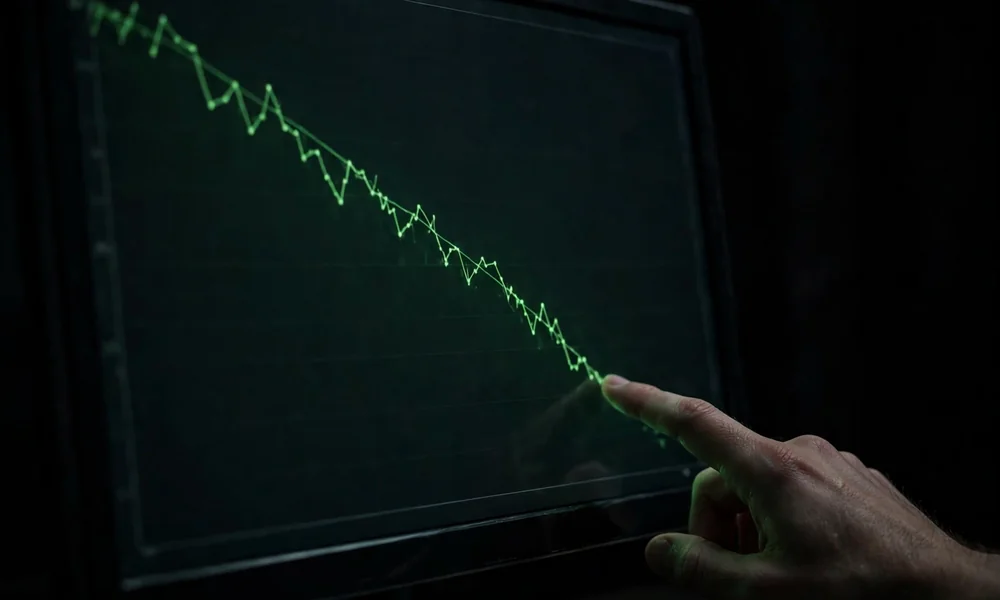
Drift is dangerous because it is silent. A model does not crash when it drifts; it keeps answering, just less accurately. The decline can be slow, a fraction of a percent at a time, so nobody notices until the damage is done. Catching drift requires watching the right signals: the distribution of incoming data compared with training data, the share of predictions the model is confident about, and the rate at which its decisions are overturned or corrected. When those signals move, the team knows the model needs attention, usually retraining on fresh data.
What to monitor
A monitoring setup usually covers four layers. The first is the service layer: latency, error rates, throughput and cost. If a model is slow or failing, users notice immediately, and these signals catch it first. The second is the data layer: the distribution of inputs, the share of missing or malformed values, and the appearance of values the model never saw in training. A sudden change here often explains a later change in performance.
The third layer is the prediction layer: the distribution of the model’s outputs, the confidence of its predictions, and how often its decisions are overturned by humans. A model that suddenly becomes very confident, or very uncertain, is telling the team something. The fourth layer is the outcome layer: whether the model’s decisions led to the results they were meant to produce. This is the hardest layer to measure, because outcomes often arrive late or are hard to attribute, but it is the one that matters most. Our guide to AI observability explains the instrumentation that makes these layers visible.
Comparing the main monitoring signals
| Signal | Main benefit | Main risk | Best for |
|---|---|---|---|
| Latency and errors | Catches outages fast | Says nothing about accuracy | Service health |
| Input distribution | Spots data drift early | Needs a training baseline | Detecting change |
| Prediction confidence | Shows when the model is unsure | Confidence can be miscalibrated | Quality warnings |
| Human overrides | Reveals real mistakes | Slow and partial coverage | Ground truth |
| Business outcomes | Measures what actually matters | Hard to attribute | Proving value |
Thresholds, alerts and dashboards
Collecting signals is only half the job; the other half is deciding when a signal means trouble. Teams set thresholds: a value beyond which an alert fires. A threshold that is too tight fires constantly, and the team learns to ignore it. A threshold that is too loose fires only after the damage is done. Good thresholds are set from the model’s own history, so that normal variation does not trigger them, and they are reviewed regularly, because what counts as normal changes as the model and its users change.
Alerts should go to the person who can act on them, with enough context to understand the problem. An alert that says only “accuracy dropped” is not useful; an alert that says accuracy dropped, the inputs shifted in a specific way, and the change began at a specific time gives the team somewhere to start. Dashboards show the same signals over time, so the team can see trends rather than single moments. The best monitoring setups make the normal state boring to look at, so that anything unusual stands out at once.
From monitoring to retraining
Monitoring is not useful if it does not lead to action. The most common action is retraining: when drift is detected, the model is trained again on fresh data that reflects the world as it is now, not as it was when the model was first built. Retraining should be a routine, not an emergency, and the monitoring setup should tell the team when it is time, rather than the team guessing.
Not every problem needs retraining. Sometimes the fix is in the data pipeline, which is sending malformed inputs. Sometimes it is in the product, which is asking the model a question it was never designed to answer. Sometimes the right action is to roll back to an earlier model version while the new one is investigated. The monitoring data should help the team tell these cases apart, so the response matches the cause. Our guide to AI model evaluation explains how to test a retrained model before it replaces the old one.
What good practice looks like
Good monitoring practice starts before deployment, with a clear statement of what the model must do and how its success will be measured. That statement shapes which signals are collected, what thresholds are set, and who receives the alerts. Monitoring that is added after a failure is better than none, but it is always weaker than monitoring designed into the deployment from the start.
Good practice also means keeping a record. Every alert, every investigation and every retraining should be documented, so the team can see patterns over time and learn from them. A model that drifted once will drift again, and the team that remembers how the last drift was caught and fixed will catch the next one faster. Monitoring is a loop, not a dashboard: observe, investigate, fix, and feed what was learned back into testing.
Model monitoring checklist
- Decide what success means for the model before deployment, and how it will be measured.
- Monitor all four layers: service health, input data, predictions and business outcomes.
- Keep a baseline of training data so input drift can be detected by comparison.
- Set thresholds from the model’s own history, and review them regularly.
- Send alerts to the person who can act, with enough context to start investigating.
- Track human overrides and corrections as a source of ground truth.
- Document every alert, investigation and retraining, so patterns become visible over time.
- Plan retraining as a routine response to drift, not as an emergency.
- Feed every genuine failure found in production back into the test set.
Frequently asked questions
What is model monitoring?
Model monitoring is the continuous observation of a deployed AI model, tracking its performance, its inputs, its predictions and its outcomes, so that problems such as drift are caught while there is still time to fix them.
What is model drift?
Drift is the gradual change in the data a model sees, or in the relationship between that data and the correct answer. It makes a model’s accuracy decay silently, without any crash or error, which is why it must be caught by monitoring rather than by waiting for a failure.
How is monitoring different from testing?
Testing happens before release, on data the team chose, and asks whether the model meets its requirements. Monitoring happens after release, on data the team did not choose, and asks whether the model still meets them. Both are needed, because testing cannot predict everything production will bring.
What should I monitor in a deployed model?
Monitor four layers: service health such as latency and errors, the distribution of incoming data, the model’s predictions and confidence, and the business outcomes its decisions produce. The first layer catches outages; the other three catch the model itself going wrong.
How do I know when to retrain a model?
Retrain when monitoring shows drift, when performance has declined, or when new data is available that would improve the model. The monitoring setup should tell the team when retraining is due, rather than the team guessing or waiting for users to complain.
What makes a good alert?
A good alert goes to the person who can act on it, and carries enough context to start an investigation: what changed, by how much, and when it began. An alert that only says something is wrong, without saying what, is not much help.
The bottom line
Model monitoring explained in one line is this: a model that passed its tests can still fail in production, because the world changes around it, so the teams that catch drift early are the ones that watch the model in real use, set alerts that mean something, and treat every failure as a reason to retrain and improve.