Transformer models explained in plain terms are AI systems built on an architecture that lets a model weigh the importance of every word in a passage at once, rather than reading it one word at a time. The central question is why one design from 2017 now powers almost all modern AI, from chatbots to translation tools, and the short answer is that transformers handle long passages better, train faster on modern hardware, and scale further than the architectures that came before them.
The transformer was introduced in a 2017 paper, “Attention Is All You Need”, written by researchers at Google. Before it, most language models processed text sequentially, which made them slow and forgetful over long passages. The transformer changed that by looking at a whole passage in parallel, and within a few years it had become the foundation of nearly every major language model. Our guide to neural networks explains the building blocks that transformers are made from.
Key takeaways
- Transformer models use an attention mechanism to weigh the importance of every word in a passage at once.
- The architecture was introduced in 2017, in the paper “Attention Is All You Need” from researchers at Google.
- Transformers read text in parallel, which makes them faster to train and better at long passages than older sequential models.
- The same design powers encoder-only models such as BERT, decoder-only models such as GPT, and encoder-decoder models used in translation.
- Transformers are powerful but not magic: they can be confidently wrong, they need large amounts of data, and they are expensive to train.
What a transformer model is
A transformer is a type of neural network designed for sequences, most often sequences of words. It takes a passage of text, converts each word or part of a word into a numerical representation, and then processes the whole passage at once. The key idea is attention: for each word, the model works out which other words in the passage matter most for understanding it, and gives those words more weight.
Consider the sentence “The animal did not cross the street because it was too tired.” To understand what “it” refers to, a model must connect it back to “the animal”, not to “the street”. Attention lets the model make that connection directly, however far apart the two words are. Older sequential models had to carry that information step by step, and the connection often faded along the way.
How attention works
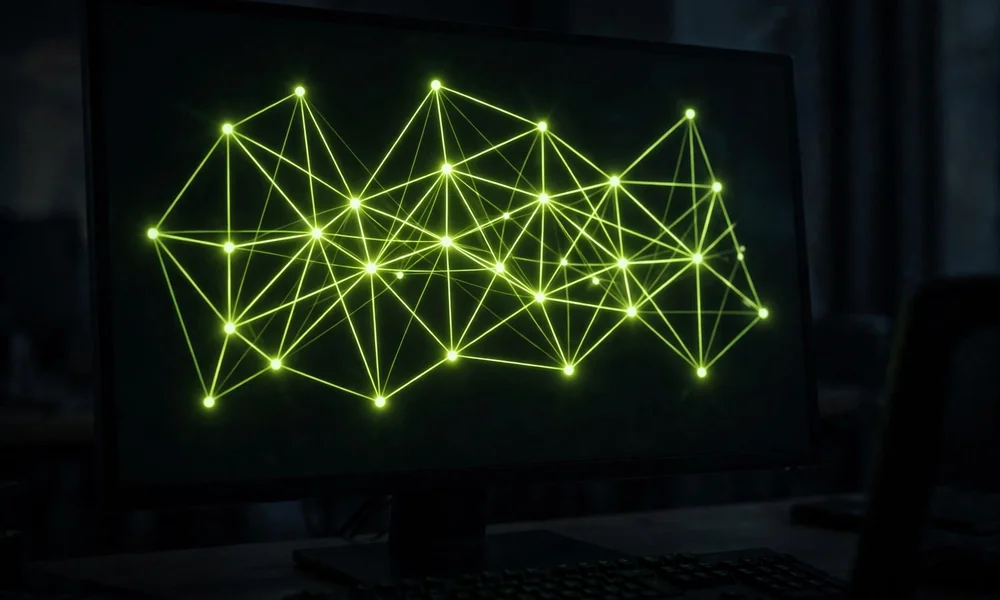
Attention works by comparing words with each other. For each word, the model creates three versions of its representation: a query, a key and a value. The query asks what the word is looking for, the key describes what each other word offers, and the value holds the information that word contributes. Words whose keys match a query strongly get more of their value passed on.
This happens in parallel across the whole passage, and it happens more than once. A transformer uses several attention heads, each of which learns to pay attention to different kinds of relationships: one head might track which words refer to the same person, another might track sentence structure, and another might track which words tend to appear together. The results of all the heads are combined and passed through further layers that refine them.
Encoder, decoder, and the three main shapes
The original transformer had two halves: an encoder that reads the input passage and builds a representation of it, and a decoder that generates an output passage from that representation. Translation used both halves, with the encoder reading the source language and the decoder writing the target language. Later models kept one half or the other, and the three resulting shapes now dominate different tasks.
Encoder-only models, such as BERT, which was introduced by Google in 2018, read a passage in both directions and build a rich understanding of it, but they do not generate text. They are used for classification, for finding answers in documents, and for judging whether two sentences mean the same thing. Decoder-only models, such as the GPT family, generate text one word at a time, predicting each next word from the ones before it. They are the shape behind chatbots and writing assistants. Encoder-decoder models remain the standard for translation and summarisation, where an input passage must be turned into a different output passage.
Comparing the main transformer shapes
| Shape | Main benefit | Main risk | Best for |
|---|---|---|---|
| Encoder-only | Deep understanding of a passage | Cannot generate text | Classification and search |
| Decoder-only | Fluent text generation | Can produce confident errors | Chatbots and writing assistants |
| Encoder-decoder | Turns one passage into another | More complex to train and run | Translation and summarisation |
| Vision transformers | Handles images with the same design | Needs very large datasets | Image classification |
| Small distilled models | Fast and cheap to run | Less capable than full models | Phones and everyday products |
Why transformers replaced what came before
Before transformers, the standard architecture for language was the recurrent neural network, which read text one word at a time and carried a memory of what it had seen. That design had two problems. The first was speed: because each word depended on the previous one, training could not be split across many processors, so it was slow. The second was memory: over long passages, the information from early words faded, so the model struggled with sentences and documents that depended on something said much earlier.
Transformers solved both problems at once. Because attention looks at the whole passage in parallel, training can be spread across many processors, and because every word connects directly to every other word, nothing fades with distance. The trade-off is cost: attention compares every word with every other word, so a passage twice as long takes roughly four times as much work.
Training a transformer
Training a transformer happens in stages. The first stage, pre-training, teaches the model on a vast collection of text, usually by hiding words and asking the model to predict them, or by asking it to predict the next word in a passage. This stage builds the model’s general grasp of language: grammar, facts, style and reasoning patterns. It is the expensive stage, requiring large datasets and long runs on specialised hardware.
Where transformer models are used
Transformers are now used far beyond the language tasks they were designed for. They power chatbots, search engines, translation services, code assistants and summarisation tools. The same architecture has been adapted to images, where vision transformers split a picture into patches and treat them like words, and to audio, where models transcribe speech and generate music.
The practical effect is that many products people use every day are transformers under the surface, even when the name never appears. A search result that understands the intent of a question, an email draft that continues in the user’s own style, or a document summary that captures the main points: each of these is a transformer doing what it was trained to do. Our guide to large language models explains how these models are trained at the scale needed to power such products.
What transformers cannot do
Transformers have real limits, and understanding them matters as much as understanding their strengths. They predict what sounds plausible, not what is true, so they can produce confident statements that are false. They have no reliable way to know when they are wrong, and they cannot check facts against the world unless a product gives them tools to do so. They also have no memory beyond the passage they are given, unless a product adds one.
Transformers are also expensive. Training a large one takes enormous computing power, and the cost of attention grows sharply with passage length, so very long documents remain a challenge. Finally, transformers learn from their training data, which means they can absorb the biases and errors in that data, and reproduce them in their output. These limits do not make transformers useless, but they do mean that any system built on them needs testing, monitoring and human oversight.
What good practice looks like
Good practice with transformer models starts with choosing the right shape for the task. A classification task needs an encoder, not a large generative model. A chatbot needs a decoder, not a translation model. Using a model far larger than the task requires wastes money and adds latency, while using one too small produces poor results.
Good practice also means testing the model on realistic examples, not only on benchmarks, and monitoring its output once it is in use. Teams that keep a human in the loop for high-stakes output, and that treat model output as a draft to be checked, get far more value from transformers than teams that trust them blindly.
Transformer models checklist
- Choose the transformer shape that fits the task: encoder for understanding, decoder for generation, encoder-decoder for translation.
- Check that the model handles passages as long as your real inputs, because attention costs grow sharply with length.
- Fine-tune on examples of the behaviour you actually want, not only on general language data.
- Test on realistic examples, including edge cases and inputs the model was not trained on.
- Treat model output as a draft and check any fact that matters before using it.
- Keep a human in the loop where the output affects people’s health, money or legal position.
- Monitor the model in real use and collect examples of failures to improve it.
- Consider a smaller distilled model when latency or cost matters more than maximum capability.
- Document what the model was trained on and what its known limits are, for users and stakeholders.
Frequently asked questions
What is a transformer model?
A transformer is a type of neural network that processes a whole passage at once, using attention to weigh how much each word matters to each other word. It was introduced in 2017 and now underlies most modern language models, including the GPT family and BERT.
What is attention in a transformer?
Attention is the mechanism that lets a transformer connect words across a passage. For each word, the model compares it with every other word and gives more weight to the ones that matter most for understanding it. This direct connection is what lets transformers handle long passages better than older models.
What is the difference between BERT and GPT?
BERT is an encoder-only transformer, introduced by Google in 2018, designed to understand passages deeply but not to generate text. GPT models are decoder-only transformers, designed to generate text one word at a time. BERT suits classification and search, while GPT suits chatbots and writing.
Why are transformers so expensive to train?
Training a large transformer needs vast amounts of text and long runs on specialised hardware, because attention compares every word with every other word. The cost grows sharply with passage length and model size, which is why training the largest models is within reach of only a small number of organisations.
Can transformers work with images?
Yes. Vision transformers split an image into patches and treat those patches like words, applying the same attention mechanism. They are used for image classification and related tasks, though they generally need very large datasets to perform well.
Do transformers understand language?
No, not in the human sense. A transformer recognises statistical patterns in language, but it does not have beliefs, intentions or understanding of the world. Its output can be fluent and sensible, but that fluency comes from patterns in its training data, not from comprehension.
The bottom line
Transformer models explained in one line is this: they are neural networks that look at a whole passage at once and weigh which words matter to each other, and that one idea, introduced in 2017, replaced older sequential designs because it trains faster, handles long passages better, and scales further, even though it remains expensive, data-hungry and capable of confident error.