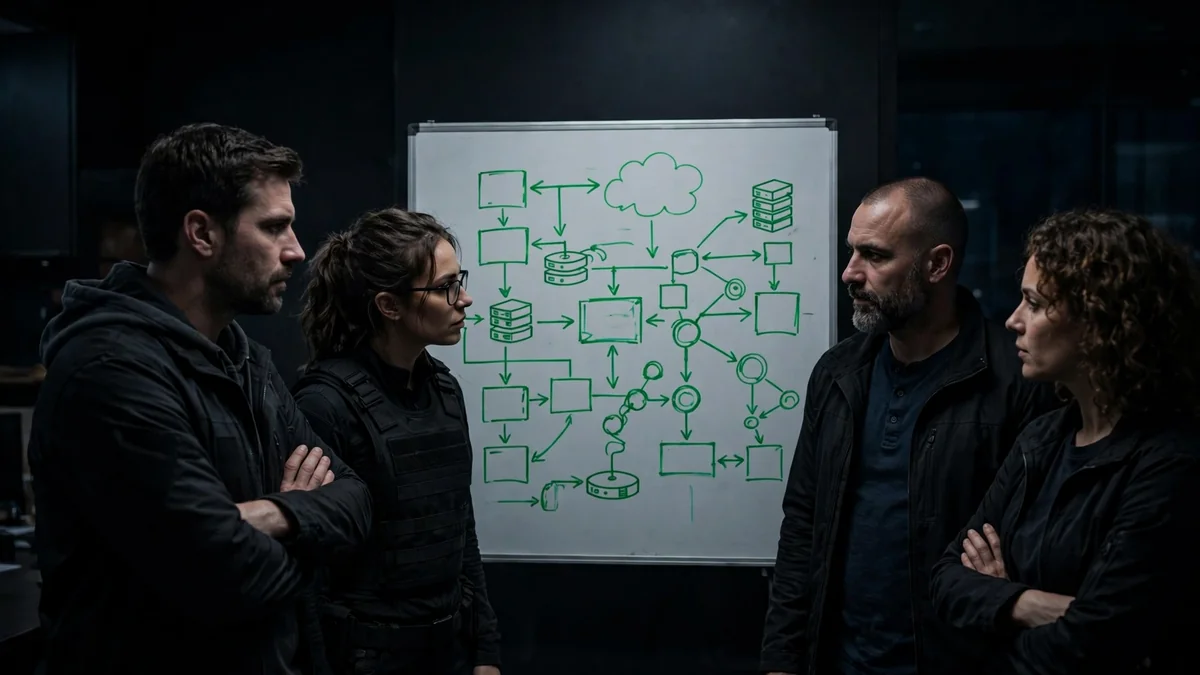
Threat modelling explained in plain terms is the practice of sitting down before building, or before changing, a system, and working out how an attacker could break it. The central question is why teams spend time imagining attacks instead of just building defences, and the short answer is that defences chosen without understanding the threat are guesses, while a threat model turns security from guesswork into a plan.
Every system has weaknesses, and attackers look for them systematically. A team that never asks how its system could be attacked will discover the answer from the attacker, at the worst possible time. Threat modelling asks the question early, when the answers are cheap to act on: a design flaw found on paper costs far less to fix than the same flaw found in a live system. Our guide to cloud security explains the controls that threat modelling helps a team choose between.
Key takeaways
- Threat modelling is the practice of working out how an attacker could break a system, before the system is built or changed.
- It turns security from guesswork into a plan, by mapping what the system is, who might attack it, and how.
- The four questions are: what are we building, what can go wrong, what should we do about it, and did we do a good job.
- STRIDE is the most widely used method for naming threats; attack trees show how steps combine into an attack.
- A threat model is a living document: it must be updated whenever the system changes, or it stops describing reality.
What threat modelling means
Threat modelling is a structured way of thinking about security during design. The team describes the system, identifies what is worth protecting, works out who might attack it and how, and decides what to do about each threat. The output is usually a diagram of the system with its trust boundaries marked, a list of threats, and a set of mitigations, each tied to a specific threat.
The practice is deliberately low-tech. It needs a whiteboard, or a diagram, and people who understand the system, not expensive tools. Its value comes from the conversation it forces: developers, architects and security specialists looking at the same picture and asking what could go wrong. That conversation often surfaces risks that no one person had seen, because each person understands a different part of the system, and the weaknesses live in the gaps between them.
The four questions
Most threat modelling follows four questions. The first is: what are we building. The team draws the system: its components, the data that flows between them, and the trust boundaries, the lines where data moves from a trusted area to one that is less trusted. A trust boundary might be the edge of an internal network, the point where a user supplies input, or the interface to a third-party service. Each boundary is a place where an attacker could act.
The second question is: what can go wrong. For each component and each boundary, the team asks how it could be attacked. The third question is: what are we going to do about it. For each threat, the team chooses a response: fix it, reduce it, accept it, or transfer it, for example through insurance. The fourth question is: did we do a good job. The team checks whether the model is complete, whether the mitigations were actually built, and whether new threats have appeared since the model was drawn. The four questions repeat whenever the system changes.

STRIDE and naming threats
Naming threats consistently helps a team find them all, and the most widely used naming scheme is STRIDE. Each letter stands for a kind of threat. Spoofing is pretending to be someone else, such as using stolen credentials. Tampering is changing data or code. Repudiation is doing something and denying it later, which matters when there is no audit trail. Information disclosure is leaking data that should stay private. Denial of service is making the system unavailable. Elevation of privilege is gaining more access than you should have.
STRIDE is a checklist, not a complete theory. For each component, the team asks whether each of the six threats applies, and writes down the ones that do. The scheme works because it is simple enough to remember and broad enough to catch most threats. Its weakness is that it can produce a long list of generic threats, and the team must still judge which ones matter for their system. A threat that is theoretically possible but would need an attacker to already control the network is less urgent than one a stranger on the internet could try.
Comparing threat modelling methods
| Method | Main benefit | Main risk | Best for |
|---|---|---|---|
| STRIDE | Simple, memorable categories | Can produce generic lists | Most software systems |
| Attack trees | Shows how steps combine | Takes time to build well | Complex, high-value targets |
| PASTA | Risk-focused, business aware | Heavier process | Regulated environments |
| LINDDUN | Covers privacy threats | Narrower focus | Systems handling personal data |
| Four questions | Lightweight and fast | Easy to do shallowly | Small teams starting out |
Attack trees and trust boundaries
Attack trees show how an attacker could reach a goal by combining steps. The goal sits at the top, such as stealing customer data, and each branch shows a way to get there, breaking down into smaller steps until the leaves are actions an attacker could take. A tree makes it clear that a single defence is rarely enough: an attacker who is blocked on one branch will try another, so the team needs defences across the branches that matter most.
Trust boundaries deserve special attention, because they are where the most serious threats live. A boundary is any place where data crosses from one level of trust to another: from a user to the application, from the application to the database, from the system to a third party. At each boundary, the team should ask what is checked: is the data validated, is the caller authenticated, is the response filtered. A boundary with no checks is an open door, and threat modelling is largely the work of finding those doors and deciding which ones to close.
From threats to defences
A threat model is only useful if it leads to action. Each threat should be tied to a mitigation, and each mitigation should be tracked until it is built. Some mitigations are design changes, such as splitting a service so that a compromise of one part does not reach another. Some are controls, such as adding authentication at a boundary that had none. Some are monitoring, such as alerting when an unusual pattern appears at a trust boundary.
Not every threat needs to be fixed. Some are unlikely, some would cost more to fix than the harm they could cause, and some are accepted deliberately, with the decision recorded. What matters is that the decision is made consciously, by someone with the authority to make it, and written down. An accepted risk that nobody recorded is not an accepted risk; it is a risk nobody noticed. Our guide to zero trust explains one design approach that follows directly from threat modelling: trust nothing by default, and verify every request.
What good practice looks like
Good threat modelling happens early, when the system is still a diagram and changes are cheap. A model drawn after the system is built can still find problems, but fixing them then is far more expensive. Good practice also means modelling little and often: a short session when a feature is designed, rather than a single large exercise once a year. Systems change constantly, and a model that is not updated stops describing reality.
Good practice also means involving the people who build the system, not just security specialists. Developers know how the system actually works, and their participation is what makes the model accurate. A threat model written by someone who has never seen the code is a work of fiction. The best sessions are short, focused, and produce a short list of concrete actions, each with an owner and a date.
Threat modelling checklist
- Draw the system, its components, its data flows and its trust boundaries, before building or changing it.
- Ask the four questions: what are we building, what can go wrong, what will we do about it, and did we do a good job.
- Use STRIDE to name threats consistently, and check each component against all six categories.
- Build attack trees for the highest-value targets, to see how steps combine into an attack.
- Pay special attention to trust boundaries, and check what is validated and authenticated at each one.
- Tie every threat to a mitigation, and track each mitigation until it is built.
- Record accepted risks consciously, with the decision and the person who made it.
- Update the model whenever the system changes, and review it regularly.
- Involve the developers who build the system, not only security specialists.
Frequently asked questions
What is threat modelling?
Threat modelling is a structured way of working out how an attacker could break a system, before it is built or changed. The team describes the system, identifies threats, and decides what to do about each one, producing a diagram, a threat list and a set of mitigations.
What is STRIDE?
STRIDE is a scheme for naming threats, with six categories: spoofing, tampering, repudiation, information disclosure, denial of service and elevation of privilege. For each component, the team asks whether each category applies, which helps ensure no kind of threat is overlooked.
What is a trust boundary?
A trust boundary is a line where data moves from a more trusted area to a less trusted one, such as from a user to an application, or from an application to a third-party service. Each boundary is a place where an attacker could act, so the team should check what is validated and authenticated there.
When should threat modelling happen?
Threat modelling should happen early, when a system or feature is being designed, because a flaw found on paper costs far less to fix than the same flaw in a live system. It should also be repeated whenever the system changes, in short sessions rather than one large annual exercise.
Do small teams need threat modelling?
Yes. Threat modelling needs a diagram and people who understand the system, not expensive tools, and a short session can surface risks that would otherwise be discovered by an attacker. Small teams benefit most, because they have the least capacity to recover from an incident.
What happens to threats that are not fixed?
Some threats are accepted deliberately, because they are unlikely or would cost more to fix than the harm they could cause. What matters is that the decision is made consciously, by someone with authority, and written down. An accepted risk that nobody recorded is a risk nobody noticed.
The bottom line
Threat modelling explained in one line is this: the cheapest time to find a security weakness is on paper, before the system is built, and the teams that stay safe are the ones that ask how they could be attacked, write down the answers, and fix what matters most.