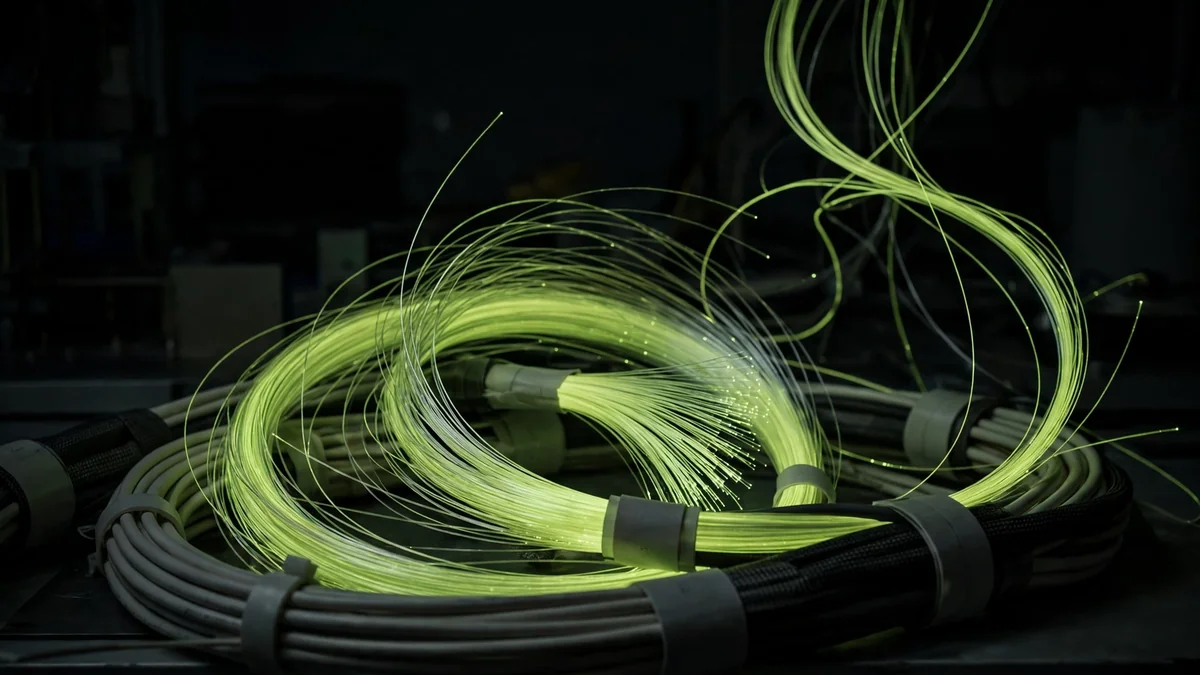
Quantum key distribution explained in plain terms starts with a remarkable promise: two people can share a secret key in a way that makes eavesdropping impossible to hide. The central question is how physics, rather than mathematics, can protect a secret, and the short answer is that quantum key distribution sends the key on individual particles of light, and any attempt to read them disturbs them in a way the sender and receiver can detect.
The idea matters because the codes that protect the internet today rest on mathematical problems that are hard for ordinary computers but may not stay hard forever. A powerful enough quantum computer could one day break them, and governments and banks are already planning for that day by exploring ways to share keys that do not depend on maths alone.
Quantum key distribution, usually shortened to QKD, is the most developed of those ideas. It has moved from laboratory experiments to real networks in cities, banks, and government offices, and it is the subject of serious investment from China, Europe, and the United States alike.
Key takeaways
- Quantum key distribution shares a secret key using single photons, and any eavesdropper who reads them disturbs them detectably.
- It does not send the message itself: it creates a shared key, which then encrypts ordinary messages sent over normal networks.
- Its security rests on the laws of physics, not on a mathematical problem that a future computer might solve.
- It needs special hardware and short, dedicated links, which is why it suits banks and governments more than home users.
- QKD is not a replacement for all encryption: it works alongside existing systems and does not protect against every kind of attack.
What quantum key distribution is
Quantum key distribution is a method for two parties to agree on a random secret key by exchanging photons, the particles of light, over an optical fibre or through open air. The key is a string of random bits, ones and zeroes, and once both sides hold the same string they can use it to encrypt messages with a method that is provably unbreakable, provided the key is used once and kept secret.
The physics behind it comes from quantum mechanics, the theory that describes how the smallest things in nature behave. A photon can be prepared in one of several states, such as polarised horizontally or vertically, and measuring it in the wrong way changes it. That disturbance is not a flaw in the equipment: it is a property of nature, and it is what makes eavesdropping detectable.
The first QKD protocol, called BB84 after its inventors Bennett and Brassard and the year 1984, remains the foundation of the field. In it, the sender picks a random bit and a random way of encoding it, and the receiver picks a random way of measuring it. Afterwards they compare only their choices, never the bits themselves, and keep the bits where their choices happened to match.
A second family of protocols uses entangled photons, pairs of particles linked so that measuring one instantly determines the state of the other, however far apart they are. If an eavesdropper touches one photon, the entanglement breaks in a way that shows up in the statistics, so the two sides know the key is compromised. Our guide to quantum computing explains the quantum ideas these protocols are built on.
How quantum key distribution works
A typical exchange begins with the sender, conventionally called Alice, generating a stream of single photons. For each photon she chooses a random bit, one or zero, and a random basis, a choice of how to encode it, such as horizontal or diagonal polarisation. She sends the photons one by one down a fibre to the receiver, conventionally called Bob.
Bob measures each arriving photon, choosing a basis at random for each one. When his basis matches Alice’s, his measurement gives her bit correctly; when it does not, his result is random and useless. Neither of them knows yet which measurements matched, so Bob tells Alice, over an ordinary public channel, which bases he used, without revealing his results.
Alice replies with the list of bases she used, and both sides discard every bit where their bases differed. The bits that remain, roughly half of the original stream, form a shared raw key. Both sides then compare a small sample of it, again over the public channel, to check for errors.
If the sample matches, the key is clean and can be used. If it shows too many errors, something has disturbed the photons, and the likely cause is an eavesdropper. The two sides then throw the key away and start again, and the eavesdropper gains nothing, because the key that was attacked was never used to encrypt anything.
Comparing quantum key distribution with ordinary encryption
Ordinary encryption and QKD protect secrets in different ways, and the difference is what each one trusts. Ordinary systems trust that a mathematical problem is too hard to solve, while QKD trusts that the laws of physics cannot be cheated. The table below sets out the contrast.
| Aspect | Quantum key distribution | Public-key encryption | Symmetric encryption |
|---|---|---|---|
| Security rests on | Laws of physics | Hard maths problems | Keeping the key secret |
| Eavesdropping detectable | Yes, it disturbs photons | No, it leaves no trace | No, it leaves no trace |
| Future quantum computers | Still secure | Many methods would break | Mostly secure, longer keys help |
| Hardware needed | Photon sources and detectors | Ordinary computers | Ordinary computers |
| Practical range | Tens to hundreds of kilometres | Unlimited, over the internet | Unlimited, over the internet |
The comparison shows why QKD is a specialist tool rather than a general replacement. It solves one problem, sharing a key securely, better than anything else, but it needs equipment and links that ordinary encryption does not.
Where quantum key distribution is used
The earliest users are governments. China has built a national QKD network linking Beijing and Shanghai, with a satellite that distributes keys to ground stations, and uses it for official communications. Europe is building its own cross-border network, and several countries run metropolitan QKD links between government buildings.
Banks are a second home. A bank that moves money between its data centres needs keys it can trust for decades, since an attacker could record encrypted traffic today and decrypt it years later, once a quantum computer exists. QKD protects against that harvest-now, decrypt-later threat, which is why financial centres in Switzerland, South Korea, and the United Kingdom have run trials.
Telecoms operators are a third user, since QKD runs over the optical fibres they already own. A carrier can offer quantum-secured links as a premium service, carrying keys for its largest customers alongside ordinary traffic, and several operators in Europe and Asia now sell exactly that.
Research networks and critical infrastructure are also adopting it. Power grids, election systems, and health services all depend on keys that must stay secret for years, and QKD gives them a way to refresh those keys with a guarantee that no eavesdropper went unnoticed. Our guide to cryptography explains the encryption these keys then protect.
Strengths and limits
The greatest strength of QKD is its guarantee. In ordinary encryption, security is a bet that nobody will find a faster way to solve a hard problem; in QKD, security follows from physics itself, and an eavesdropper cannot avoid leaving a trace. That guarantee also has no expiry date, since the laws of physics do not become obsolete the way algorithms do.
The limits are practical and serious. Photons are lost in fibre, so links are limited to a few hundred kilometres without trusted relay stations, and those relays must themselves be trusted, which weakens the guarantee. The equipment is expensive, delicate, and far slower than the internet, producing keys at thousands of bits per second rather than the gigabits ordinary networks carry.
There is also a scope limit that is often missed: QKD secures the key exchange, not the computers at either end. If an endpoint is hacked, the key is exposed regardless of how it arrived, and QKD cannot prove the identity of the person at the other end without ordinary authentication alongside it. It is one strong link in a chain, not the whole chain.
Quantum key distribution checklist
- Understand that QKD shares keys, not messages: the messages themselves still travel over ordinary networks.
- Remember that its security guarantee covers the link, not the computers at either end.
- Note that photon loss limits fibre links to a few hundred kilometres without relay stations.
- Check whether relay stations on a network are trusted, since they can see the keys passing through.
- Compare QKD with post-quantum cryptography, which hardens ordinary encryption without new hardware.
- Watch for the harvest-now, decrypt-later threat, which is the strongest reason to adopt quantum-safe keys early.
- Expect slow key rates: QKD produces keys far more slowly than ordinary networks move data.
- Keep authentication in place, since QKD alone does not prove who is at the other end of the link.
- Follow national standards work, as governments decide where QKD fits alongside other quantum-safe methods.
Frequently asked questions
Is quantum key distribution unbreakable?
The physics is sound, but real equipment is not perfect, and researchers have found ways to attack flawed detectors and photon sources. A well-built QKD system is far harder to attack than ordinary key exchange, yet no implementation should be called unbreakable without qualification.
Will QKD replace the encryption on my phone?
No, not in the foreseeable future. QKD needs dedicated photon hardware and fibre links, while your phone relies on ordinary encryption that works over any connection. Post-quantum cryptography is the technology expected to protect phones and laptops instead.
How far can quantum keys travel?
Over fibre, practical links reach a few hundred kilometres before photon loss makes the key rate too low to use. Satellites extend the range by sending photons through space, where there is less loss, and relay stations can join shorter links into longer networks.
What happens if someone tries to eavesdrop?
Reading a photon disturbs it, which introduces errors into the key that Alice and Bob can see when they compare a sample. If the error rate is too high, they discard the key and try again, so the eavesdropper learns nothing useful.
Is QKD the same as quantum computing?
No. Quantum computing uses quantum effects to perform calculations, while QKD uses them to share secret keys. The two fields share physics and some hardware, but they solve different problems and are built by different teams.
Why is QKD expensive?
It needs single-photon sources, extremely sensitive detectors, and precise timing equipment, all of which must be kept stable and cool. The links also need dedicated fibres, and the key rate is low, so the cost per key is far higher than for ordinary encryption.
The bottom line
Quantum key distribution explained in one line is this: a way to share secret keys on beams of light, in which the laws of physics themselves expose any eavesdropper. It is the most secure key exchange ever built, and also one of the most demanding to run.
For banks, governments, and operators of critical infrastructure, that trade is already worth making. For everyone else, the lesson is simpler: the keys that protect today’s traffic may not survive tomorrow’s computers, and planning for quantum-safe security has already begun.
This article is general information about how quantum key distribution works, not advice about choosing encryption or security measures for a particular organisation or system.