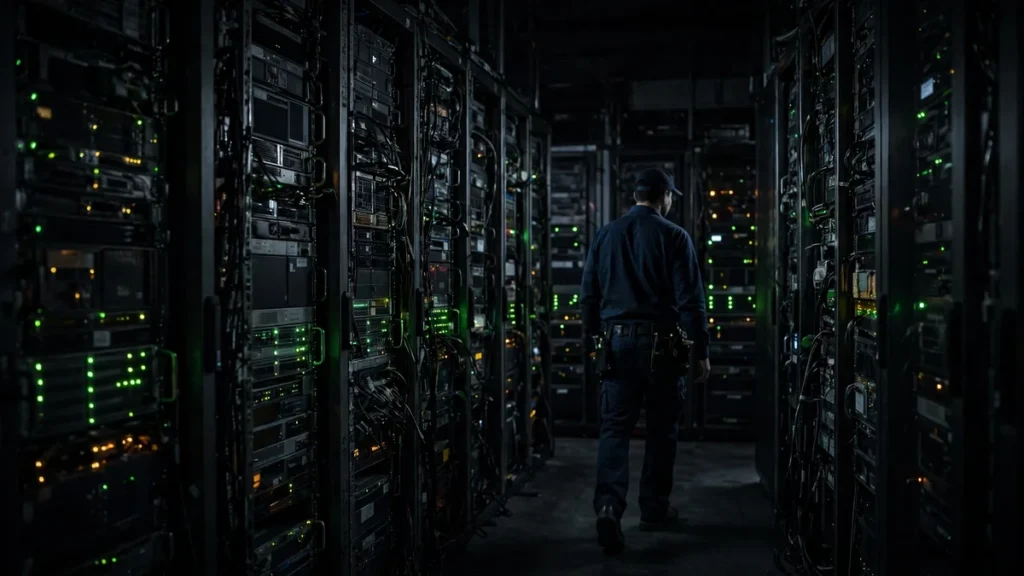
Edge computing trends point in one direction: more processing is happening close to where data is created, and less is making the round trip to a distant data centre. The reason is simple. Some decisions cannot wait for a network round trip, some data is too large or too sensitive to send away, and some places have no reliable connection at all. Edge computing answers all three problems by putting compute near the source.
The short answer to what is changing is that edge is growing up. It is moving from isolated pilots in factories and shops to a standard part of enterprise architecture, driven by AI inference, faster networks and better management tools. This guide explains the trends that matter, where edge genuinely helps, and how to decide what belongs at the edge and what belongs in the cloud.
Key takeaways
- Edge computing processes data close to where it is created, cutting latency and reducing the data that must travel to the cloud.
- AI inference at the edge is the biggest driver, from quality inspection in factories to driver assistance in vehicles.
- 5G and private networks make edge practical in places where wired connections are slow or absent.
- Managing hundreds of edge sites is the hard part, and centralised tooling is now essential.
- Edge and cloud are partners, not rivals: the edge handles fast local decisions, the cloud handles training, storage and coordination.
AI inference moves to the edge
The most important edge computing trend is the arrival of AI inference at the edge. Models that once needed a data centre now run on devices in factories, shops, vehicles and clinics, making decisions in milliseconds. A camera that spots a defect on a production line, a sensor that predicts a machine failure, or a voice assistant that answers without a network connection all rely on inference running locally.
Smaller, more efficient models are making this possible. Techniques such as quantisation and distillation shrink models so they fit on modest hardware, and specialised chips designed for inference keep power consumption low. The result is that edge AI is no longer limited to a few flagship use cases; it is becoming practical for ordinary equipment.
The trade-off is that edge models need careful management. They must be updated when a better version appears, monitored for drift as conditions change, and protected against tampering. Teams that treat edge models as software with a lifecycle, rather than firmware that is installed once and forgotten, get far better results. Our guide to edge AI inference architecture: designing models that run in the real world covers the design patterns in detail.
Best for: teams whose decisions must happen in milliseconds, or where a network failure must not stop the work.
Factories and industry lead adoption
Manufacturing remains the strongest edge market, and the reasons are practical. Factories generate huge amounts of sensor data, need instant responses to keep machines safe, and often have patchy connectivity on the shop floor. Processing that data locally keeps the line running even when the wider network is down.
Quality inspection is the classic example. A camera on a production line can check every item in real time, flag defects immediately, and feed the results back to the line controller without waiting for a cloud service. Predictive maintenance is another: vibration and temperature sensors can warn of a failing bearing hours before it breaks, and that warning is only useful if it arrives in time.
The pattern is spreading to other physical industries, including energy, mining and logistics. In each case the value is the same: local processing turns raw sensor data into action before the moment passes. The edge device is not a replacement for the cloud; it is the part of the system that cannot afford to wait.
Best for: industrial teams with safety-critical or time-critical processes and large volumes of sensor data.
5G and private networks open new ground
Faster wireless networks are expanding where edge computing works. Public 5G offers low latency and high bandwidth in covered areas, while private 5G and private LTE networks give factories, ports and campuses a dedicated network they control. Both make it practical to connect devices that could never be wired.
The combination matters because edge is often about mobility. A vehicle, a robot or a worker with a handheld device cannot be tethered to a cable, and a wireless network with predictable latency is what lets them participate in an edge system. Private networks add control over coverage, security and priority, which matters when a safety system shares the network with ordinary traffic.
Coverage is still uneven, and teams should test in their own locations rather than trusting a coverage map. But where the network is good, the pairing of 5G and edge is powerful: the network moves data fast, and the edge node acts on it fast. Together they enable applications that neither could support alone.
Best for: sites with mobile equipment, large outdoor areas, or a need for dedicated, predictable wireless coverage.
Managing the edge is the real challenge
Running one edge device is easy. Running hundreds, spread across factories, shops and vehicles, is the hard part, and it is where many edge projects stall. Each site needs software updates, security patches, monitoring and a way to recover when something fails, and doing that by hand does not scale.
The answer is centralised management with local autonomy. Edge nodes should be able to run on their own when the network drops, but they should be managed from one place: one dashboard, one update pipeline, one security policy. Container platforms and Git-based deployment, where the desired state is declared centrally and each node converges to it, have become the standard approach.
Observability is part of the same problem. A team needs to know which nodes are healthy, which are running old software, and which are failing, without logging into each one. The teams that succeed treat edge sites as a fleet, with the same discipline as a fleet of servers, rather than as a collection of one-off devices.
Best for: organisations planning more than a handful of edge sites, where manual management would quickly break down.

Sovereign and disconnected edge grows
Edge computing is also growing where the cloud cannot reach, either for legal or for practical reasons. Some data cannot leave a country or a site, some operations run in places with no reliable connection, and some systems must keep working when the network is cut. In all three cases the edge is not an optimisation; it is the only option.
Defence, energy and remote healthcare are the clearest examples, but the pattern appears in ordinary businesses too. A shop that must keep trading during an outage, a ship that spends weeks at sea, or a clinic in a rural area all need systems that work offline and sync later. Designing for disconnection changes the architecture: local storage, local decision making and careful conflict handling when the connection returns.
Sovereignty adds another layer. Edge processing can keep sensitive data on site, sending only summaries or anonymised results to the cloud, which satisfies regulators and customers who worry about where their data goes. That makes edge a compliance tool as well as a performance tool.
Best for: regulated, remote or safety-critical operations where connectivity or data rules limit what the cloud can do.
Comparing edge and cloud processing
| Factor | Edge computing | Cloud computing | What decides it |
|---|---|---|---|
| Latency | Milliseconds, local | Tens to hundreds of milliseconds | How fast the decision must be |
| Bandwidth | Processes data locally | Moves data to the data centre | Volume and cost of data transfer |
| Offline operation | Keeps working without a network | Stops when the connection drops | Whether uptime is safety-critical |
| Scale | Limited by local hardware | Nearly unlimited on demand | Size of the workload |
| Management | Many sites to maintain | Centralised and automated | Number of locations |
| Data control | Data stays on site | Data leaves the site | Regulation and privacy rules |
The table shows that edge and cloud are complementary. Edge wins where speed, offline operation and data control matter most; cloud wins where scale, central management and heavy computation matter most. The best architectures use both, with a clear rule for what runs where, and our guide to cloud load balancing explained: how traffic finds the right server covers how traffic is routed between them.
Retail, vehicles and healthcare follow
Beyond industry, edge is spreading into retail, transport and healthcare. Shops use edge to run checkouts, cameras and stock systems that must keep working during an outage. Vehicles use it for driver assistance, where a decision delayed by a network round trip is a decision made too late. Clinics use it to process scans and monitor patients locally, keeping sensitive data on site.
Each of these follows the same pattern as manufacturing: a local decision that cannot wait, data that is expensive or sensitive to move, and a need to keep working when the connection fails. The technology differs, but the reasoning is identical, and the teams that succeed are the ones that start from the decision that needs to be made rather than from the technology they want to use.
Healthcare deserves a special note, because the stakes are highest there. A monitoring system that warns of a patient deteriorating must work even if the hospital network is busy, and patient data must stay protected. Edge processing helps on both counts, but it also raises the bar for testing, validation and audit, which teams should plan for from the start.
Best for: any service where a delay or an outage has a direct effect on customers, safety or revenue.
Deciding what belongs at the edge: a checklist
- Does the decision need to happen in milliseconds, or can it wait for a cloud round trip?
- Must the system keep working when the network is down?
- Is the data too large, too costly or too sensitive to send to the cloud?
- Can the workload run on the hardware available at the site, within its power and cooling limits?
- How will the edge nodes be updated, monitored and recovered across all sites?
- What data goes to the cloud, and what stays local, and who decided that split?
- What happens when the connection returns after an outage: how are conflicts resolved?
Frequently asked questions
What is edge computing?
Edge computing means processing data close to where it is created, on devices or local servers near the source, instead of sending it to a distant data centre. It reduces latency, cuts data transfer and keeps systems working when the network fails.
Why is edge computing growing now?
AI inference at the edge, better 5G and private networks, and cheaper capable hardware have made it practical. The strongest demand comes from factories, vehicles, retail and healthcare, where decisions must be fast and local.
Does edge replace the cloud?
No. Edge and cloud are partners. The edge handles fast local decisions and offline operation, while the cloud handles training, large-scale storage, coordination across sites and heavy computation.
What is the hardest part of edge computing?
Management at scale. Running hundreds of sites needs centralised updates, monitoring and security, with nodes that can operate on their own when the network drops. Teams that treat edge sites as a fleet cope best.
Is edge computing more secure?
It can help, because sensitive data can stay on site, but it also adds risk: many more devices to protect, often in places with limited physical security. Edge security needs patching, monitoring and access control at every site.
How do I start with edge computing?
Start with one use case where latency, offline operation or data control clearly matters, and prove it at a single site. Build the management and monitoring tooling early, because that is what decides whether the project scales beyond the pilot.