AI in construction explained simply is this: artificial intelligence now helps builders plan projects, watch site safety, order materials and predict delays before they happen. The central question is whether it makes building safer and cheaper or simply more complicated, and the short answer is that it does both, cutting waste and accidents while raising questions about jobs, accountability and whether a model can really understand a building site.
Construction is one of the least digital industries, and one of the most dangerous. Projects run late, budgets overrun, materials are wasted and workers are hurt, often for reasons that were visible in the data long before they became problems. AI can read that data and act on it, and that is why builders are paying attention. This guide explains how AI works across construction, where it genuinely helps, and where it still needs a human on site.
Key takeaways
- AI improves project planning, predicting delays and cost overruns earlier than traditional methods.
- Site cameras and sensors spot safety risks, from missing helmets to workers in danger zones.
- Design tools test thousands of options, but a building still needs human judgement and taste.
- AI cuts material waste and energy use, which matters for both cost and carbon.
- Workers’ jobs will change, not vanish, and training matters more than the technology itself.
What AI in construction actually means
AI in construction covers several different tools, and they do different jobs. Some forecast a project’s schedule, some watch a site through cameras, some design a building’s layout, and some manage equipment and materials. A large project might use all of them at once, often without the workers on site ever seeing the analysis behind a changed schedule or a safety warning.
Most of these tools run on machine learning, trained on large amounts of project data. A scheduling model learns how long each stage of a build usually takes, a safety system learns what a dangerous situation looks like, and a design tool learns which layouts use materials efficiently. None of them understands a building site the way an experienced site manager does, but all can process far more information far faster than a human team.
Planning, scheduling and cost control
Planning is where AI saves the most money. Traditional schedules are built from experience and optimism, and they often assume everything will go right. AI models, trained on thousands of past projects, can predict which stages are likely to slip, which suppliers are likely to be late, and how weather will affect the programme. A project manager who sees those risks early can act before a delay becomes a crisis.
Cost control works the same way. By tracking spending against the plan in real time, AI can flag when a work package is running over budget while there is still time to fix it, rather than at the end of the month when the money is already gone. It can also compare quotes and materials, helping buyers choose the option that is genuinely cheapest over the life of the building, not just the cheapest today.
The limit is that no model knows a specific site. Ground conditions, a difficult neighbour, a delayed permit or a skilled worker leaving can all change a project in ways no dataset predicts. The best project managers use AI forecasts as a warning system, and keep their own judgement in charge of the plan.
Site safety and monitoring
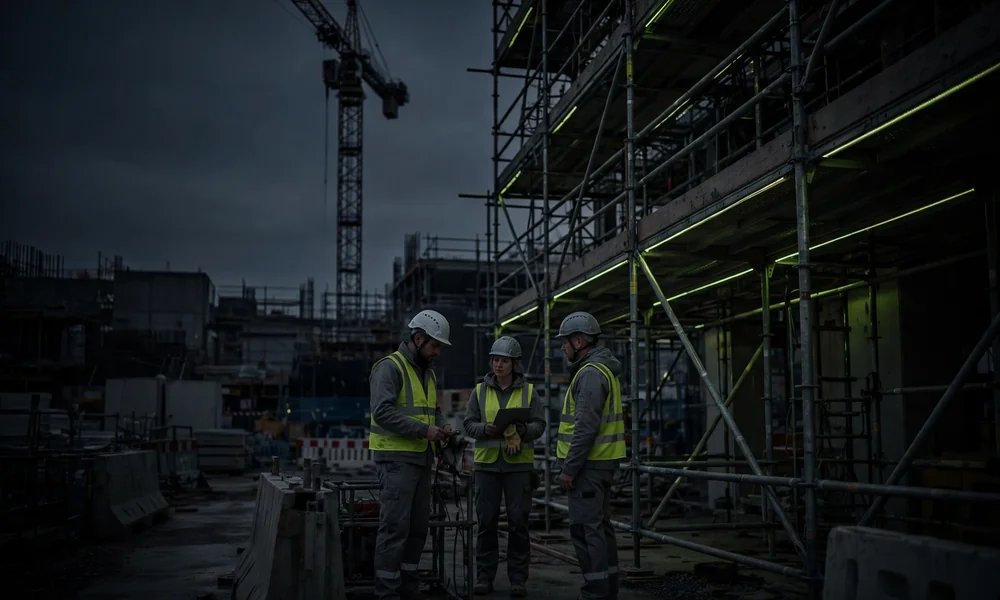
Safety is the most important use of AI in construction, and the one with the clearest moral case. Cameras and sensors can spot a worker without a helmet, someone entering a restricted zone, a crane load swinging over people, or a scaffold that has been altered. A system that flags those risks in seconds can prevent an accident that a human supervisor, watching a whole site, might miss.
Drones are the second tool. They can survey a site daily, compare progress with the plan, and spot problems such as water pooling, unstable stockpiles or work that does not match the drawings. That regular, accurate picture helps managers catch mistakes early, when they are cheap to fix, rather than late, when they are not.
The risk is surveillance. Workers who feel constantly watched, with every movement recorded and scored, will resent the system and find ways around it. Safety monitoring should be explained clearly, limited to safety, and agreed with workers and their representatives. A camera that protects people is welcome; a camera that polices them is not. Our guide to edge AI explains the on-site computing that makes much of this monitoring possible.
Design, materials and sustainability
Design is where AI is most creative. Given a site, a brief and a set of constraints, a design tool can generate and test thousands of layouts, comparing them for daylight, energy use, material cost and buildability. An architect can then choose from the best options and refine them, rather than starting from a blank page each time.
Materials are the second gain. AI can predict exactly how much concrete, steel and timber a project needs, reducing the over-ordering that wastes money and fills skips. It can also suggest lower-carbon alternatives, such as different mixes or recycled materials, and show the trade-off in cost and strength. Our guide to sustainable AI explains how these efficiency gains fit into the wider picture of energy and carbon.
The limit is taste and judgement. A building is not only a set of optimised numbers; it is a place where people live and work, and it needs light, proportion, character and a sense of belonging. AI can generate options, but it cannot decide what a building should feel like. That decision belongs to the architect, the client and the community that will use it.
Comparing the main uses of AI in construction
| Use | Main benefit | Main risk | Best for |
|---|---|---|---|
| Schedule forecasting | Delays spotted early | Cannot know a specific site | Large, complex projects |
| Safety monitoring | Risks flagged in seconds | Workers feeling watched | Busy sites and high-risk work |
| Drone surveys | Accurate daily progress picture | Data that nobody acts on | Large sites and remote work |
| Design generation | Thousands of options tested fast | Buildings without character | Early design and option testing |
| Material planning | Less waste, lower carbon | Wrong quantities from bad data | Ordering and procurement |
Jobs, skills and accountability
Jobs are the question every builder asks. AI will change construction work, but it is unlikely to replace the people who do it. Machines cannot lay bricks in a tight corner, fix a leaking joint, or judge whether a finish is good enough. What changes is the planning, monitoring and paperwork around the physical work, and the skills that matter shift with it.
The likely pattern is that site managers, planners and quantity surveyors spend less time on routine reporting and more on judgement, coordination and problem-solving, while site workers use AI tools to check their work and stay safe. That shift needs training, and companies that invest in it will keep their best people, while those that do not will lose them. Our guide to AI in manufacturing covers a similar shift in factories, where the same pattern is already under way.
Accountability is the second question. When an AI system approves a design, a schedule or a safety check, someone must still be responsible for it. A structural decision signed off by a model is not a decision at all, and regulators, clients and insurers will rightly ask who checked it. Every AI output that affects safety, structure or cost should be reviewed and signed by a qualified person.
What good practice looks like
Good practice starts with agreement. Workers should know what is monitored, why, and who sees the data, and they should have a say in how safety systems are used. A system imposed without agreement will be resisted, however good its intentions.
Testing is the second pillar. Scheduling, design and safety models should be tested on real projects, not just on past data, and corrected when they fail. A model that was accurate on one type of project may not be accurate on another.
Human sign-off is the third pillar. No AI output should approve a design, a safety check or a payment without a qualified person reviewing it. The person who signs is responsible, and they should understand what the system did before they sign.
Construction checklist
- Use AI forecasts as a warning system, and keep human judgement in charge of the plan.
- Agree safety monitoring with workers, and limit it to safety, not surveillance.
- Use drones and sensors to catch mistakes early, when they are cheap to fix.
- Test design and scheduling models on real projects, and correct them when they fail.
- Keep a qualified person responsible for every design, safety check and payment.
- Order materials with AI predictions, but check quantities against the real site.
- Invest in training, so workers gain skills rather than losing work.
- Protect workers’ data, and say plainly what is collected and why.
- Use AI to cut waste and carbon, and report the savings honestly.
Frequently asked questions
Will AI replace construction workers?
No. AI changes planning, monitoring and paperwork, but the physical work of building, fixing and finishing still needs skilled people. Jobs will change, with more emphasis on judgement, coordination and using AI tools well, and training matters more than the technology itself.
How does AI make construction sites safer?
By watching cameras and sensors for risks such as missing helmets, workers in danger zones and unsafe crane loads, and flagging them in seconds. It supports human supervisors, who still make the decisions and act on the warnings.
Can AI design a building?
It can generate and test thousands of layouts for daylight, energy use and cost, which helps architects explore options quickly. But a building also needs character, proportion and a sense of place, and those decisions belong to the architect and the people who will use it.
Why do construction projects run late?
Because schedules are often optimistic, and ground conditions, weather, suppliers and permits all cause delays. AI can predict which stages are likely to slip by learning from past projects, so managers can act earlier, though no model knows a specific site perfectly.
How does AI cut waste on site?
By predicting material quantities more accurately, suggesting lower-carbon alternatives, and catching mistakes early through drone surveys and progress tracking. Less over-ordering means less money spent and less material in skips.
Who is responsible when AI approves a design?
The qualified person who reviews and signs it. AI can generate and check options, but a structural or safety decision needs a human professional who understands the system and takes responsibility for the result.
The bottom line
AI in construction explained in one line is this: the technology makes projects easier to plan, sites safer to work on and buildings cheaper to run, but a building site is a human place, full of judgement, skill and risk, and no model can replace the people who understand it. Builders who use AI to see earlier and act faster will gain from it; builders who let it decide for them will learn the cost on site.