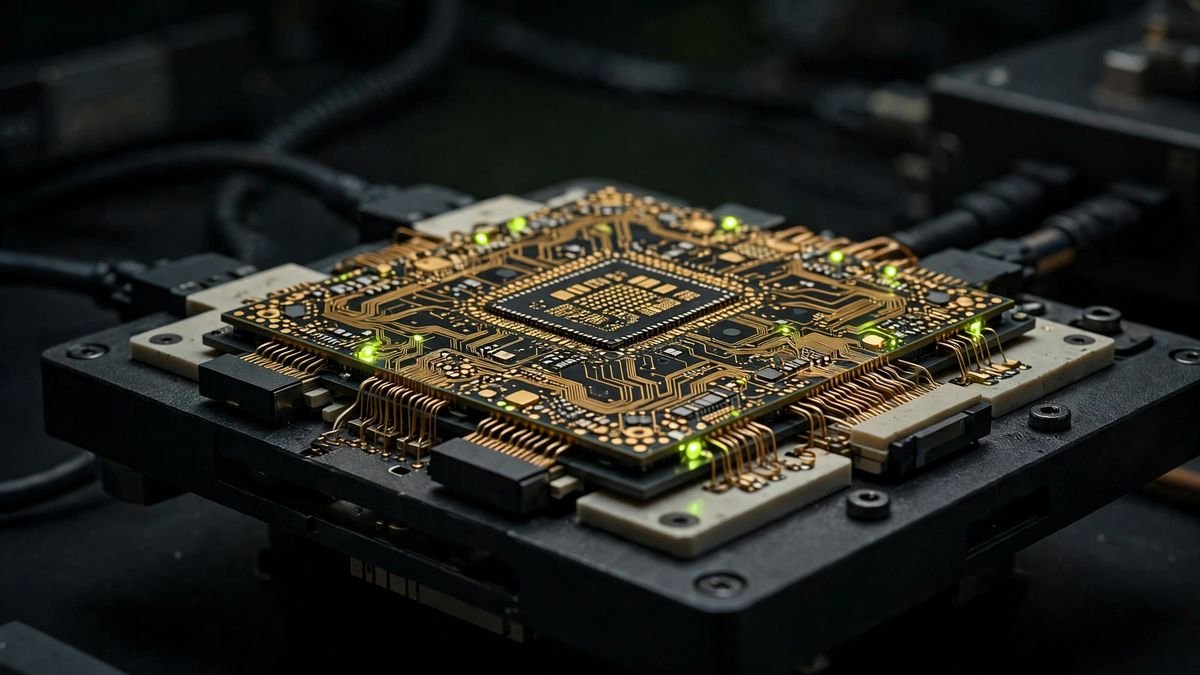
Quantum computing chips explained in plain terms: they are processors that store and manipulate information in quantum bits, or qubits, which use the rules of quantum mechanics to explore many possibilities at once, instead of the definite ones and zeroes of an ordinary chip. In short, a quantum chip is not a faster version of a normal processor. It is a different kind of machine that can solve a small set of problems, such as simulating molecules or factoring large numbers, in ways no classical computer can match.
The most important thing to understand is that quantum chips are still experimental. The largest machines have hundreds or just over a thousand physical qubits, and those qubits are fragile, error-prone and need to be cooled to temperatures colder than outer space. No quantum chip today can do useful work that a classical computer cannot do better, although recent results on error correction suggest that is changing.
This guide explains what a qubit is, how the main kinds of quantum chip differ, what the landmark machines have actually demonstrated, and how to tell genuine progress from hype. The aim is a realistic picture: a technology with extraordinary potential, a long road ahead, and a surprising amount of solid engineering already done.
Key takeaways
- A quantum chip computes with qubits, which can exist in a superposition of states, rather than the definite bits of a classical processor.
- Qubits are fragile: errors accumulate quickly, so error correction, which combines many physical qubits into one reliable logical qubit, is the central challenge.
- Superconducting circuits are the most advanced approach today, led by IBM and Google, while trapped ions, neutral atoms and photonics take different routes.
- Recent results, including Google’s Willow chip in 2024, show error rates falling as error-correcting codes grow, a milestone the field had chased for decades.
- No quantum chip yet beats classical computers on a useful real-world problem, and timelines for practical machines remain measured in years.
What a qubit is
A classical bit is either 0 or 1. A qubit is a quantum system, such as a tiny superconducting circuit or a single trapped ion, that can exist in a superposition of 0 and 1 at the same time. Superposition does not mean the qubit holds both values in the ordinary sense; it means the qubit’s state is a combination of the two, described by probabilities, and measuring it forces it to choose one outcome.
Qubits can also be entangled, which means the states of two or more qubits become linked so that measuring one tells you something about the others, even though neither had a definite value before the measurement. Entanglement is what lets a quantum computer explore combinations in a way that grows far faster than any classical machine can follow. A register of 300 entangled qubits has more possible states than there are atoms in the observable universe.
That scale is the promise and the problem. A quantum chip manipulates those combinations with quantum gates, operations that rotate and entangle qubits, and a well-designed sequence of gates can amplify the probability of the right answer and cancel out the wrong ones.
Best for: readers who want the core idea first, without the mathematics, before looking at the hardware that implements it.
How a quantum chip is built
Most quantum chips today are superconducting circuits, built on silicon wafers with techniques borrowed from ordinary chip manufacturing. The qubit is a tiny loop of superconducting metal interrupted by a Josephson junction, a thin insulating barrier that quantum effects can tunnel through. The circuit behaves like an artificial atom, with energy levels that can be controlled with microwave pulses.
Superconducting qubits must be kept extremely cold, close to absolute zero, inside a dilution refrigerator. At those temperatures the metal becomes superconducting, resistance disappears, and thermal noise drops low enough for quantum states to survive for tens or hundreds of microseconds.
Other approaches avoid the cold. Trapped-ion chips hold individual charged atoms in electromagnetic fields and manipulate them with lasers, which gives very accurate qubits but slower operations. Neutral-atom machines trap uncharged atoms with laser tweezers and excite them into Rydberg states to make them interact.
Control electronics are a growing part of the story. Every qubit needs wiring, microwave signals and readout circuits, and the number of wires grows with the number of qubits. Moving control electronics closer to the chip is one of the engineering challenges that will decide whether machines can scale from thousands to millions of qubits.
The landmark chips so far
Google’s Sycamore chip made headlines in 2019, when a 53-qubit processor performed a random sampling calculation in about 200 seconds that Google estimated would take a supercomputer thousands of years. The claim was disputed and the task had no practical use, but it showed that a quantum chip could do something classical machines could not easily reproduce, and it set the pattern for the years that followed.
IBM has taken a steadier, roadmap-driven path. Its Eagle processor, launched in 2021, has 127 superconducting qubits, and Osprey, announced in 2022, has 433. In 2023 IBM introduced Condor, with 1,121 qubits, and Heron, with 133 qubits but much lower error rates.
Google’s Willow, announced in December 2024, is the most significant chip of the current generation. It has 105 superconducting qubits, and in a result published in Nature, Google showed that a logical qubit’s error rate fell by roughly half each time the error-correcting code grew, from a three-by-three grid to five-by-five to seven-by-seven. That below-threshold result, with a logical error rate of about 0.143 percent per correction cycle at the largest code size, was the first clear demonstration that error correction can work as theory predicts.
Other builders add variety. IonQ and Quantinuum build trapped-ion machines with fewer but more accurate qubits, and both have reported high fidelities on their systems.
Best for: readers who want to know which machines matter and what they actually proved, rather than what their press releases claimed.
Quantum chips vs classical chips
| Feature | Classical chip | Quantum chip |
|---|---|---|
| Information unit | Bit: 0 or 1 | Qubit: superposition of 0 and 1 |
| Operations | Logic gates, exact and repeatable | Quantum gates, approximate and noisy |
| Error rate | Effectively zero | High, needs error correction |
| Operating temperature | Room temperature or warmer | Near absolute zero for superconducting types |
| Best problems | Almost everything | Simulation, optimisation, factoring |
| Maturity | Decades of mass production | Experimental, low volume |
The table explains why quantum computers will not replace classical ones. A quantum chip is a specialist accelerator for a narrow set of problems, and it needs a classical computer to control it, prepare its inputs and interpret its outputs. Our guide to how GPU infrastructure actually drives modern AI computing shows the classical accelerator that dominates AI today, and our comparison of CPU versus GPU for LLM inference explains how workload shapes hardware choice in general.
Error correction: the real race
Error correction is the problem that will decide whether quantum computing ever becomes useful. A single physical qubit is too unreliable to hold an answer, so the field builds a logical qubit out of many physical ones, spreading the information across a grid so that errors can be detected and fixed. The surface code, the most studied scheme, arranges qubits in a two-dimensional lattice and uses extra measurement qubits to check for errors without disturbing the data.
The catch is the overhead. A useful logical qubit may need a thousand or more physical qubits, and a useful machine may need thousands of logical qubits, which means millions of physical qubits in total. That is why the field talks about a threshold: below a certain physical error rate, making the code bigger makes the logical qubit better, and above it, making the code bigger makes things worse. Willow’s 2024 result was the first to show a superconducting chip operating clearly below that threshold.
There are other routes to the same goal. Some teams are building better physical qubits so fewer are needed per logical qubit, while others are designing codes that use fewer qubits for the same protection. Cat qubits, which encode information in a way that resists one kind of error, are one example being pursued.
Best for: anyone trying to judge quantum progress, since error rates and logical qubits are far more meaningful than the headline number of physical qubits.
What quantum chips might actually do
Simulating molecules is the most credible early application. Classical computers struggle to model the quantum behaviour of atoms and electrons, because the complexity grows exponentially with the size of the molecule. A quantum chip simulates that behaviour directly, and researchers hope it will help design better batteries, catalysts and medicines. The first useful results are likely to be in chemistry and materials science rather than in everyday software.
Optimisation is a second candidate, covering problems such as scheduling, logistics and portfolio design, where the number of possible solutions is enormous. Quantum algorithms may find better solutions faster, although classical methods keep improving too.
Cryptography is the application that worries governments. A large enough quantum computer could run Shor’s algorithm and break the public-key encryption that protects most of the internet, which is why standards bodies are already moving to post-quantum cryptography. That threat is still years away, since it needs a fault-tolerant machine with millions of physical qubits.
Judging quantum claims: a practical checklist
- Ask for the error rate, not just the qubit count, because a chip with fewer, better qubits can be more useful than one with more, noisier ones.
- Look for logical qubits and error correction results, since those show whether the machine can hold an answer reliably.
- Check whether the demonstrated task has any practical use, or whether it is a benchmark designed to show quantum advantage.
- Compare against the best classical method, not a straw man, since classical algorithms keep improving too.
- Be wary of timelines: roadmaps in quantum computing have slipped repeatedly, and promises of useful machines within a year or two have rarely held.
- Consider the whole system, including cooling, control electronics and software, not just the chip itself.
- Follow peer-reviewed results in journals such as Nature and Science, which carry more weight than press releases and vendor claims.
Frequently asked questions
What is a quantum chip?
A quantum chip is a processor that computes with qubits, quantum systems that can exist in a superposition of states, instead of the definite bits of a classical chip. It uses quantum effects such as superposition and entanglement to solve certain problems in ways classical computers cannot.
How is a quantum chip different from a normal chip?
A normal chip processes definite ones and zeroes with exact logic gates, while a quantum chip manipulates superpositions with quantum gates that are noisy and error-prone. Quantum chips need extreme cooling and error correction, and they suit only a narrow set of problems, whereas classical chips handle almost everything.
What is a qubit?
A qubit is the basic unit of quantum information. It is a quantum system, such as a superconducting circuit or a trapped ion, that can exist in a combination of 0 and 1 until it is measured. Qubits can be entangled, linking their states together, which is what gives quantum computers their power.
Can quantum computers break encryption?
In principle, yes. A large fault-tolerant quantum computer could run Shor’s algorithm to break widely used public-key encryption. That machine does not exist yet and would need millions of physical qubits, but the risk is taken seriously, and post-quantum cryptography standards are already being adopted.
When will quantum computers be useful?
Nobody knows for certain. The most optimistic estimates suggest useful machines for chemistry and materials science within the decade, while sceptics point to the enormous error-correction overhead and expect a longer wait. Progress on error correction, such as Google’s Willow result, is the best guide to how fast the field is moving.