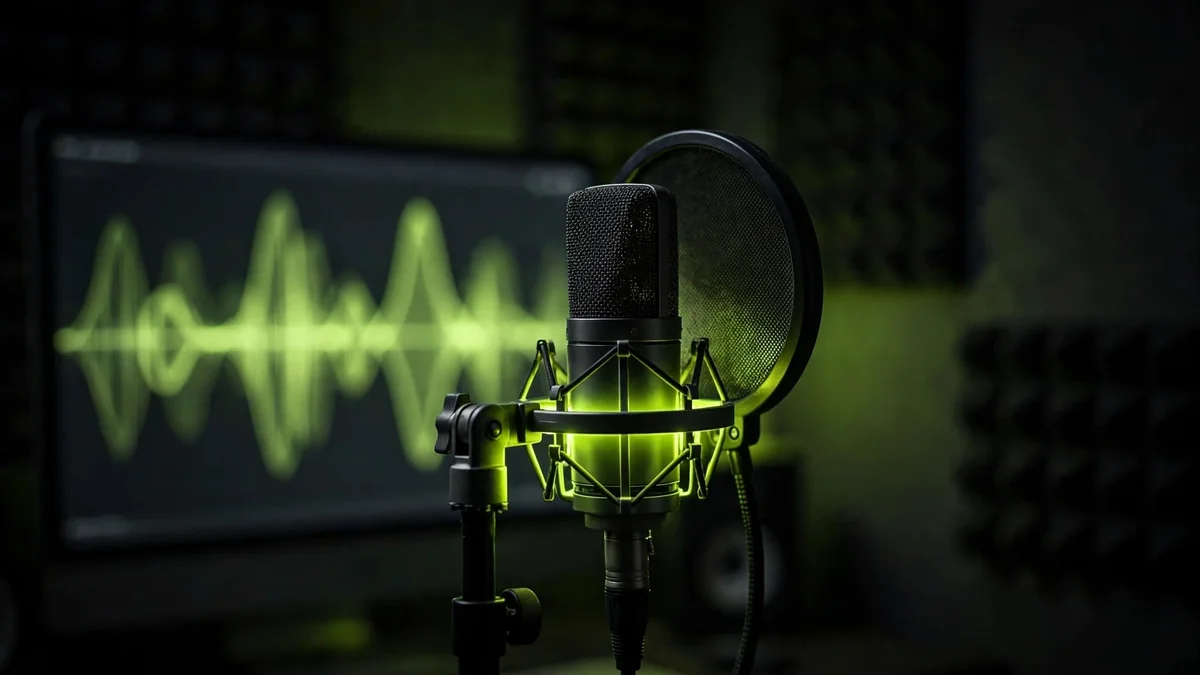
Speech recognition explained in plain terms means turning spoken words into written text, so that a machine can understand what was said and act on it. The central question is how a computer can listen to a stream of sound and pick out the words, and the short answer is that it breaks the sound into tiny pieces, matches those pieces to sounds it has learned, and then uses language knowledge to choose the most likely sequence of words.
Think of listening to a friend in a busy room. You do not hear each word in isolation; you hear a flow of sound, and your knowledge of language fills in the parts that are unclear. Speech recognition works in a similar way, combining what the sound suggests with what the language expects.
It is one of the most familiar forms of machine learning in everyday life. It powers voice assistants, transcribes meetings, captions videos, and lets people dictate messages instead of typing them. Behind that everyday convenience sits a chain of models, each solving one part of a difficult problem.
Key takeaways
- Speech recognition turns spoken sound into written text a machine can use.
- It works in stages: sound is broken into pieces, matched to speech sounds, and assembled into words.
- Language knowledge helps choose between words that sound alike.
- Accents, noise, and overlapping voices remain the hardest challenges.
- Modern systems learn from large collections of recorded speech, not from hand-written rules.
What speech recognition is
Speech recognition is the technology that converts spoken language into text. A microphone captures the sound, the system analyses it, and the output is a written version of what was said. That text can then be used directly, as a transcript, or passed on to another system that acts on it.
The task is harder than it sounds. Speech is a continuous stream, not a neat row of separate words. Sounds blend into one another, people speak at different speeds, and the same word can sound different depending on the speaker, the accent, and the words around it.
There is also no fixed boundary between words in sound. In writing, spaces separate words, but in speech, one word flows into the next, and the listener must decide where each word ends. That decision depends on the sounds themselves and on which words make sense together.
Our guide to natural language processing explains what happens once speech has become text, when a system must work out what the words mean. Speech recognition is the step before that: getting the words right in the first place.
How sound becomes words
The process begins with the raw sound wave, which is chopped into very short slices, each lasting only a few hundredths of a second. Each slice is turned into a set of measurements describing its frequencies, the ingredients that make up the sound at that moment.
The next stage is acoustic modelling. An acoustic model has learned, from many hours of recorded speech, what each speech sound looks like in those measurements. It examines each slice and estimates which sounds it could be, producing a set of possibilities with different likelihoods.
Those sounds are then assembled into words. A pronunciation guide, built into the system, says which sequences of sounds make up each word in the vocabulary. The system searches through the possibilities, looking for the sequence of words that best fits the sounds it heard.
That search is guided by a language model, which knows which words tend to follow one another. When the sound is ambiguous, and two words sound nearly alike, the language model tips the balance towards the word that makes sense in context. The final result is the sequence of words that best fits both the sound and the language.
The parts of a speech recognition system
The acoustic model is the part that knows about sound. It is trained on large collections of recorded speech, paired with transcripts, and it learns the relationship between the measurements of a slice of sound and the speech sound being produced. Modern acoustic models are deep neural networks, which learn these relationships from the data rather than from rules written by a person.
The pronunciation guide, sometimes called a lexicon, lists the words the system can recognise and how each one is pronounced. It bridges the gap between sounds and words, so that a sequence of sounds can be matched to a word in the vocabulary. Words missing from the guide cannot be recognised, which is one reason new names and terms can trip a system up.
The language model is the part that knows about words in sequence. It has learned, from large amounts of written and spoken text, which words commonly follow one another. It gives the system a sense of what is plausible, so that a garbled sound is more likely to be resolved into a sensible sentence than a nonsense one.
Our guide to large language models explains the powerful language models that modern speech systems increasingly draw on. A stronger language model means a system that understands context better, and therefore makes fewer mistakes when the sound alone is unclear.
Comparing speech recognition approaches
| Aspect | Older systems | Modern systems |
|---|---|---|
| Acoustic model | Hand-built sound patterns | Deep neural networks |
| Training data | Hours of speech | Thousands of hours of speech |
| Vocabulary | Limited and fixed | Large and adaptable |
| Handles accents | Poorly | Better, with varied data |
| Runs on | Specialist hardware | Phones and cloud servers |
Where speech recognition is used
Speech recognition is used wherever speaking is easier than typing. Voice assistants answer questions and control devices, dictation turns spoken notes into written text, and meeting tools transcribe conversations so that nobody needs to take notes by hand.
It is used to make content accessible. Captions on videos, generated from the soundtrack, let people follow along without sound, and transcripts of audio and video make spoken material searchable. For people who find typing difficult, it offers a different way to write.
In customer service, it routes calls by understanding what the caller asks for, and it transcribes conversations so they can be reviewed. In healthcare, it helps clinicians record notes by speaking rather than typing, although the result always needs checking, because a misheard word in a medical note can matter a great deal.
It is also used in cars, where a driver can send a message or choose music without taking their hands from the wheel, and in homes, where spoken commands control lights and other devices. In each case, the value is the same: the machine listens, so the person does not have to stop what they are doing to type.
What makes speech recognition hard
Accents are one of the hardest problems. The same word is pronounced differently in different regions, and a system trained mostly on one accent will struggle with others. The remedy is training data that covers many accents, but gathering it takes time and effort, and no dataset covers every way of speaking.
Noise is another challenge. A system that works well in a quiet room may fail in a car, a café, or a street, where other sounds compete with the voice. Background speech is especially difficult, because the system must separate the voice it should listen to from the voices it should ignore.
People also speak in ways that written language does not. They hesitate, repeat themselves, correct themselves mid-sentence, and trail off. A transcript that captures every false start is hard to read, while a transcript that cleans them up is no longer a faithful record. Deciding what to keep is a judgement the system must make.
Finally, some words simply sound alike, and only the context can separate them. A system must use the whole sentence, and sometimes the whole conversation, to choose between them. When the context is thin, even a good system will guess wrong.
Speech recognition checklist
- Speak clearly, at a natural pace, without rushing or mumbling.
- Use a good microphone, close to the speaker and away from noise.
- Reduce background sound before recording or dictating.
- Check the transcript: misheard words are common, especially names.
- Train or adapt the system to the accents it will actually hear.
- Keep the vocabulary up to date with new names and terms.
- Test in real conditions, not only in a quiet room.
- Remember that a transcript is a starting point, not a finished record.
- Protect recordings, because speech is personal data.
Frequently asked questions
What is speech recognition in simple terms?
Speech recognition is technology that turns spoken words into written text. It analyses the sound of a voice, works out which sounds and words were spoken, and produces a transcript that a computer can store, search, or act on.
How does speech recognition work?
It chops the sound into short slices, matches each slice to speech sounds using an acoustic model, assembles the sounds into words using a pronunciation guide, and uses a language model to choose the most likely sequence of words. The result is the wording that best fits both the sound and the language.
Why does speech recognition make mistakes with accents?
Because the same word sounds different in different accents, and a system learns from the speech it was trained on. If the training data covered one accent far more than others, the system will be less sure about the accents it rarely heard, and it will make more mistakes on them.
Can speech recognition work in noisy places?
It can, but less reliably. Background sound competes with the voice, and other voices are especially hard to separate out. A good microphone, close to the speaker, helps a great deal, as does training data that includes noisy recordings.
What is the difference between speech recognition and voice recognition?
Speech recognition works out what was said, turning speech into text, while voice recognition works out who said it, identifying a speaker from the sound of their voice. They are different tasks, although both start from the same recording.
Is speech recognition the same as understanding language?
No. Speech recognition produces the words, while understanding what the words mean is a separate step, handled by natural language processing. A system can transcribe a sentence correctly without knowing what it means, just as a person can repeat words in a language they do not speak.
The bottom line
Speech recognition explained in one line is this: a chain of models that turns the sound of a voice into written words, by matching sounds to speech and then choosing the wording that best fits the language.
It has moved from a specialist tool to an everyday convenience, because the models have learned from far more speech, and the language models behind them have grown far stronger. It still struggles with accents, noise, and words that sound alike, so the wise habit is simple: let the machine listen, and always check what it heard.