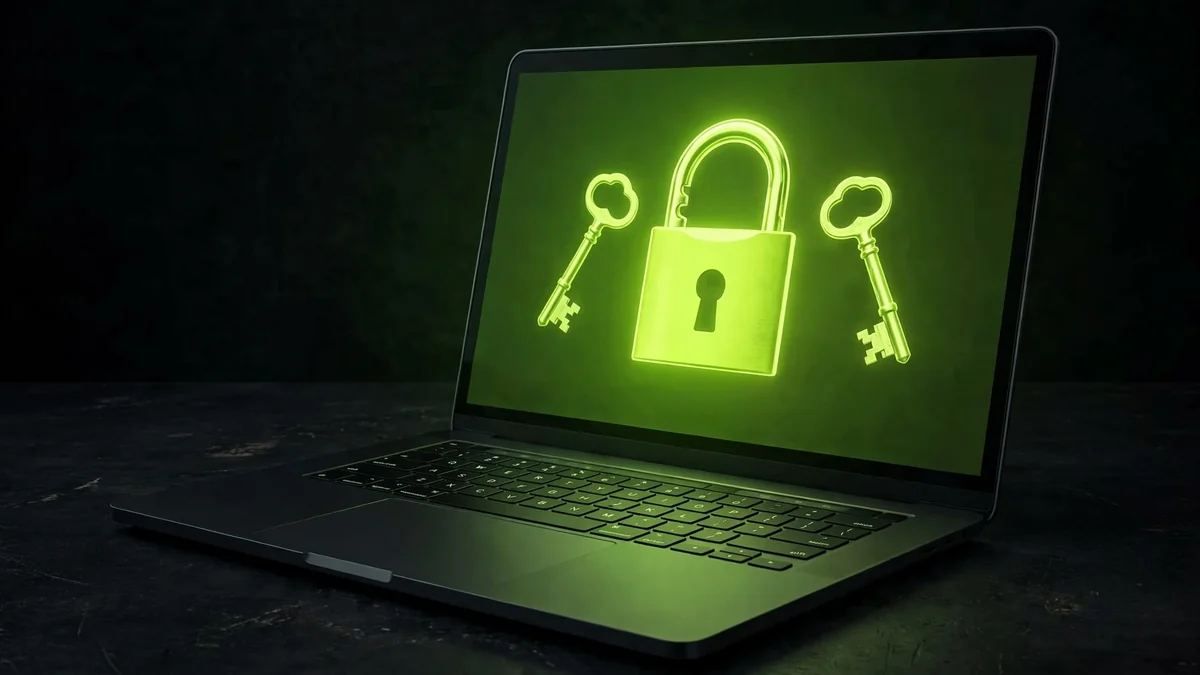
Asymmetric encryption explained in plain terms means understanding the two-key system that lets strangers exchange secrets over the open internet. The central question is how your browser and a website can agree on a private conversation when anyone can listen in, and the short answer is that each side has a pair of keys: one public, shared with the world, and one private, kept secret, where anything locked with one key can only be opened with the other.
Most people use asymmetric encryption every day without knowing it. Every time a browser shows a padlock, a message is sent securely, or a software update is verified, two keys are doing quiet work in the background.
That idea solved a problem that had troubled cryptographers for centuries: how to share a secret with someone you have never met, over a channel anyone can read. This article explains what asymmetric encryption is, how the two keys work, and how it differs from using a single key.
Key takeaways
- Asymmetric encryption uses a pair of keys: one public, one private.
- Data locked with the public key can only be opened with the private key.
- The private key proves identity, because only its owner can sign with it.
- It is slower than symmetric encryption, so the two are usually combined.
- The web, email, and software updates all depend on the two-key system.
What asymmetric encryption is
Asymmetric encryption, also called public-key encryption, is a method of scrambling data with a pair of mathematically linked keys. The public key can be shared freely with anyone, while the private key must be kept secret by its owner. Data encrypted with the public key can only be decrypted with the matching private key, and the private key cannot be worked out from the public one, at least not with any computer that exists today.
The idea was published in the 1970s by Whitfield Diffie and Martin Hellman, and the first practical system, RSA, followed soon after, named for Rivest, Shamir, and Adleman. Before their work, encryption always needed a shared secret, which meant the secret itself had to be exchanged safely, a problem that limited secure communication to people who had already met or shared a key in advance.
The two-key system broke that limit. Anyone can encrypt a message for you using your public key, but only you can read it, because only you hold the private key. The same pair works in reverse for signing: a message signed with your private key can be checked by anyone with your public key, which proves it really came from you. Our guide to symmetric encryption explains the single-key system this one is paired with, and our guide to public key infrastructure explains the system that distributes public keys safely.
How asymmetric encryption works
Generating a key pair starts with choosing two large prime numbers and combining them in a way that is easy to do in one direction and extremely hard to reverse. The public key is derived from that combination, and the private key from the original numbers. Multiplying the primes is quick, but factoring the result back into the original primes would take an ordinary computer longer than the age of the universe, and that one-way difficulty is what keeps the private key safe.
Encrypting a message uses the recipient’s public key. The sender scrambles the message with that key, and the result can travel over any channel, even one an attacker is watching, because only the recipient’s private key can unscramble it. The public key can be posted on a website or sent in an email without risk, since knowing it does not help anyone read the message.
Signing works the other way around. The sender creates a short fingerprint of the message, called a hash, and encrypts that fingerprint with their private key. Anyone can decrypt the fingerprint with the sender’s public key and compare it with a fresh fingerprint of the message, and if the two match, the message is genuine and unchanged. That is how a browser knows a website is who it claims to be.
In practice, asymmetric encryption is rarely used to encrypt whole messages, because it is slow. Instead, the two sides use it once, at the start of a conversation, to agree on a fast symmetric key, and then switch to symmetric encryption for the rest of the session. The two-key system opens the door, and the one-key system carries the conversation.
Key exchange is the classic use. When your browser connects to a secure website, the two sides use the server’s public key to agree on a session key without ever sending that key in the open. An eavesdropper sees the exchange but cannot work out the session key, because doing so would require the server’s private key.
Comparing asymmetric with symmetric encryption
Asymmetric and symmetric encryption solve the same problem in opposite ways. One uses two keys and solves the problem of sharing a secret, while the other uses one key and is far faster once the secret is shared.
The table below sets out the main contrasts between the two systems.
| Aspect | Asymmetric encryption | Symmetric encryption |
|---|---|---|
| Keys | A public and private pair | One shared secret key |
| Key sharing | Public key can be shared openly | Secret key must be exchanged safely |
| Speed | Slow, heavy mathematics | Fast, even for large data |
| Best for | Key exchange and signatures | Encrypting the bulk of the data |
| Identity | Proves who sent a message | Cannot prove who sent it |
| Key size | Large, thousands of bits | Smaller, hundreds of bits |
The practical result is that the two are used together, not as rivals. Asymmetric encryption sets up the conversation and proves who is speaking, and symmetric encryption carries the data quickly and efficiently once the conversation has begun.
Where asymmetric encryption is used
Secure websites are the most familiar use. When a browser connects over HTTPS, the server presents a certificate containing its public key, the browser checks that certificate, and the two sides use asymmetric encryption to agree on a session key. The padlock in the address bar is, in effect, a sign that this exchange has happened.
Email security relies on it too. Systems such as PGP let people encrypt messages for a recipient using the recipient’s public key, and sign their own messages with their private key, so the recipient can be sure of both secrecy and authorship. The keys are exchanged in advance, and the messages can then travel over any network.
Software updates depend on signatures. When a phone or a computer downloads an update, it checks the signature against the maker’s public key before installing anything. A forged update would fail the check, which is why this system is one of the most important defences against malicious software.
Digital currencies and messaging apps use the same mathematics. A cryptocurrency wallet is, in essence, a private key, and a transaction is a message signed with it. Secure messaging apps use key pairs to set up encrypted conversations between people who have never met in person.
Remote access and servers use key pairs for login. Instead of a password, an administrator stores their public key on the server and proves their identity by signing a challenge with the private key. The server never sees the private key, and no password travels over the network to be stolen.
Strengths and limits
The greatest strength of asymmetric encryption is that it solves the key distribution problem. Two strangers can communicate securely without ever having met, because the public key can be shared openly and the private key never leaves its owner’s hands. That single property is what made secure commerce on the open internet possible.
Signatures are the second strength. Only the holder of a private key can sign with it, so a valid signature is strong evidence of authorship. That is what makes certificates, software updates, and digital contracts trustworthy.
The limits are real, though. Asymmetric encryption is slow, so it cannot encrypt large amounts of data directly, and its security depends on key sizes that must grow as computers get faster. A private key that is stolen or lost is a disaster: whoever holds it can impersonate its owner, and the owner cannot decrypt anything sent to the old key.
The future brings a deeper concern. A sufficiently powerful quantum computer could factor the large numbers that RSA depends on, which would break the system entirely. That threat is why researchers are developing post-quantum algorithms, and why the migration to them is already being planned, even though practical quantum attacks are still years away.
Asymmetric encryption checklist
- Keep your private key private, and never share it or email it to anyone.
- Protect private keys with a strong passphrase and secure storage.
- Use a trusted certificate authority, so public keys can be believed.
- Check that websites use HTTPS before entering sensitive information.
- Revoke a key at once if you believe it has been stolen or copied.
- Use long keys, and follow current guidance on key sizes.
- Combine asymmetric and symmetric encryption, as the web already does.
- Back up private keys securely, since a lost key cannot be recovered.
- Watch for quantum-safe updates, as standards change over time.
Frequently asked questions
What is asymmetric encryption in simple terms?
Asymmetric encryption uses two linked keys: a public key anyone can use to lock a message for you, and a private key only you hold that can open it.
Why are two keys needed?
Because a single shared key has to be exchanged safely, which is hard with a stranger. Two keys let anyone encrypt for you using your public key, without ever needing to meet you or share a secret.
What is the difference between a public and a private key?
The public key can be shared with anyone and is used to encrypt messages for you or to check your signatures. The private key must stay secret and is used to decrypt messages and to sign them.
Is asymmetric encryption slower than symmetric encryption?
Yes, much slower. That is why it is used to exchange a fast symmetric key at the start of a session, and the symmetric key then encrypts the bulk of the data.
Can a public key be used to work out the private key?
Not with current computers. The mathematics makes reversing the process infeasible, although a future quantum computer could change that, which is why new algorithms are being developed.
What happens if I lose my private key?
Anything encrypted for that key becomes unreadable, and anything signed with it can no longer be proved to be yours. A new key pair must be created and distributed.
The bottom line
Asymmetric encryption explained in one line is this: a two-key system where a public key locks a message for one person only, and a private key opens it, letting strangers communicate securely over an open network.
It is the foundation of the secure web, of signed software, and of private messaging. Its mathematics is slow and its keys must be guarded carefully, but without it, the internet as we use it today would not exist.
This article is general information about how asymmetric encryption works, not advice about securing data or choosing encryption for a particular system.