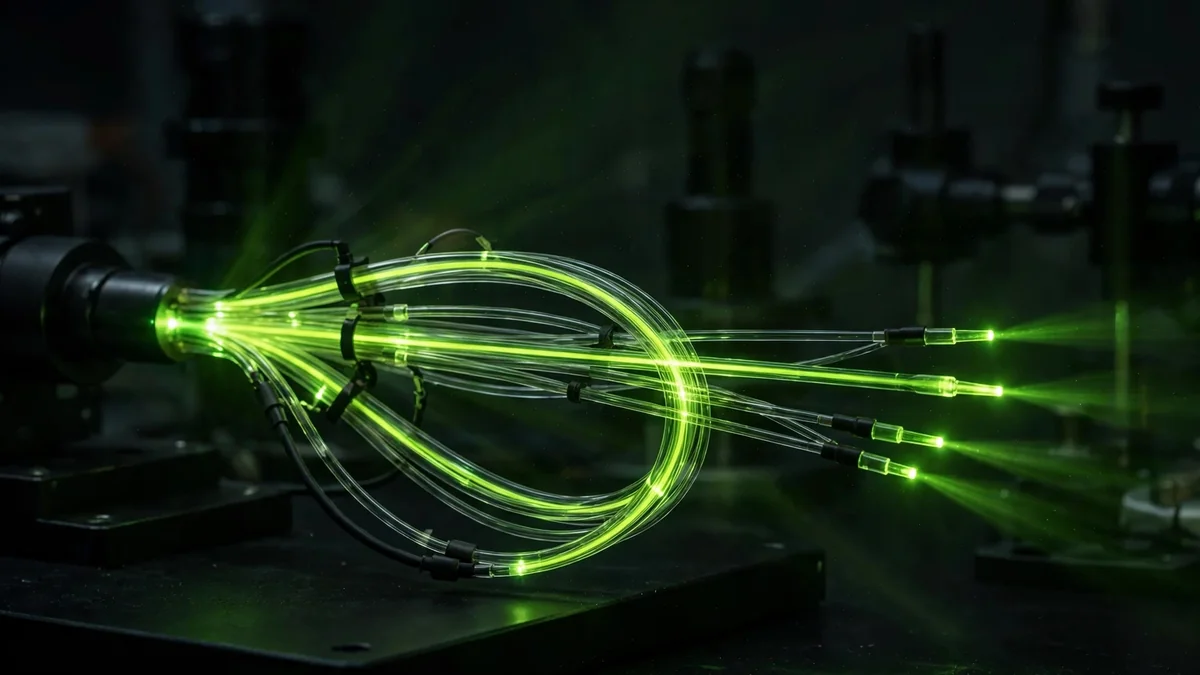
Photonic computing explained in plain terms means computing with light instead of electricity, using photons travelling through tiny glass channels rather than electrons moving along copper wires. The central question is whether light can really replace electricity inside a computer, and the short answer is that it already can for some tasks, because light moves data quickly and produces very little heat.
Every computer you use today is electronic. Its chips push electrons through metal wires, and that movement creates heat. Photonic computing takes a different path, sending information as pulses of light through waveguides, which are narrow channels etched into silicon that guide light much as a fibre optic cable does.
Understanding photonic computing matters because the demand for computing power keeps growing, especially for artificial intelligence, while the gains from shrinking electronic transistors keep slowing. Light offers a way around some of those limits, and research labs and chip companies are now turning laboratory ideas into working hardware.
Key takeaways
- Photonic computing uses light, not electricity, to carry and process information inside a chip.
- Light travels through waveguides, which are tiny channels that guide photons around a silicon chip.
- Photonic systems can move large amounts of data quickly while generating far less heat than electronic ones.
- The technology is already used in fibre optic networks and is moving into data centres and AI hardware.
- Fully optical computers are still some way off, because light is hard to store and control at small scales.
What photonic computing is
Photonic computing is a form of computing in which photons, the particles of light, carry information instead of electrons. In an ordinary chip, data is represented by the presence or absence of electric charge, and logic gates switch those charges to perform calculations. In a photonic chip, data is represented by pulses of light, and optical components such as lenses, mirrors, and interferometers shape and combine those pulses to perform calculations.
The field is often called silicon photonics, because most photonic chips are built on silicon, the same material used for ordinary computer chips. This matters because it means photonic components can be made in existing chip factories, using many of the same manufacturing steps. A silicon photonic chip typically combines electronic circuits, which handle control and memory, with optical circuits, which handle the movement and processing of data.
Light has several properties that make it attractive for computing. Different colours of light can travel through the same channel at the same time without interfering with each other. Light also travels at enormous speed and loses very little energy over distance, which is why fibre optic cables already carry internet traffic between continents.
The idea is not new. Scientists began proposing optical computers in the middle of the twentieth century, not long after the laser was invented, and early experiments showed that light could perform simple calculations. What changed in recent decades is manufacturing: engineers learned to etch optical channels into silicon at the scale of a few hundred nanometres, small enough to fit thousands of optical components onto a single chip.
How photonic computing works
The starting point is a light source, usually a laser built into the chip or attached to it, which produces a steady beam. A modulator then encodes data onto that beam, for example by switching it on and off rapidly or by changing its brightness, so that the pattern of light carries the same ones and zeros that an electronic chip would represent with voltage.
Once the data is encoded, the light travels through waveguides, narrow channels of silicon surrounded by material with a lower refractive index, which keeps the light trapped inside by reflection. Along the way it passes through optical components that change it in useful ways. A splitter divides one beam into two, a combiner merges two beams into one, and an interferometer lets two beams interact so that their waves add together or cancel each other out.
These interactions are the basis of optical calculation. A common task in artificial intelligence is matrix multiplication, where large grids of numbers are multiplied and added together, and photonic chips can perform this naturally: light passing through a network of interferometers is split, delayed, and recombined in ways that correspond exactly to the arithmetic. The calculation happens in parallel rather than step by step.
At the end of the journey, a photodetector converts the light back into an electrical signal, so the result can be stored in memory or passed to the rest of the computer. This conversion is one of the reasons most photonic systems are hybrids, with light handling the heavy movement and calculation of data while electronics handle control, storage, and the parts of a task where light has no advantage.
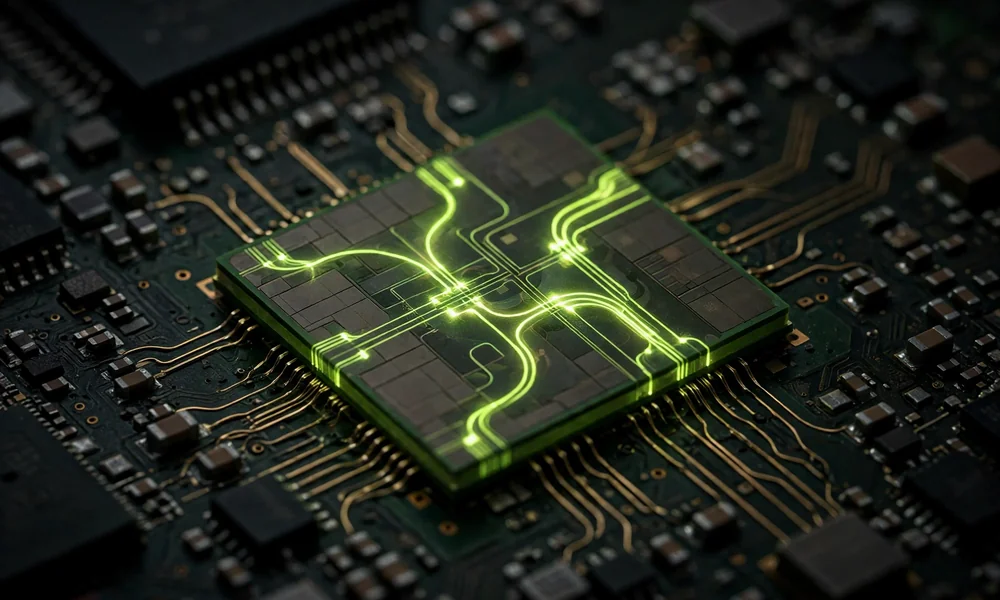
Our guide to GPUs describes the processors that currently do most AI calculation, and photonic accelerators are designed to work alongside them, taking over the matrix calculations where light is fastest while the GPU handles everything else. The two approaches are complementary rather than rivals, at least for now.
Comparing photonic and electronic computing
The difference between moving electrons and moving photons shapes everything from speed to heat. Electronic computing is mature, flexible, and good at almost everything, while photonic computing is specialised, fast at moving and combining data, and still developing. The table below sets out the main contrasts.
Neither approach wins on every measure, which is why the realistic future is a mixture of the two on the same chip.
| Aspect | Electronic computing | Photonic computing |
|---|---|---|
| Data carrier | Electrons moving through metal wires | Photons travelling through glass or silicon channels |
| Speed over distance | Signals slow and weaken over long wires | Light travels fast with very little loss |
| Heat | Moving electrons generates substantial heat | Moving light generates almost no heat |
| Parallelism | Parallel work needs many separate wires | Many colours of light can share one channel |
| Maturity | Decades of manufacturing and software | Working hardware, but a young ecosystem |
Where photonic computing is used
The most established use is in communication rather than calculation. Fibre optic networks already move data as light, and the transceivers that convert between light and electricity inside data centres are silicon photonic devices. As AI data centres grow, these optical links are becoming more important, because they move enormous amounts of data between servers without the heat and energy cost of copper cables.
Photonic accelerators for artificial intelligence are the next step. Several companies now sell chips that perform the matrix calculations at the heart of neural networks using light, and these speed up AI inference in data centres, the process of running a trained model on new data. The gains are largest for large models, where moving data between memory and processor is often slower than the calculation itself.
Research labs are also exploring photonic systems for other work, including scientific simulation and quantum computing. Our guide to quantum computing explains a different way of computing altogether, and some quantum computers use photons as their qubits, which means photonic hardware serves both fields at once. Photonic sensors, lidar for vehicles, and medical imaging devices use similar optical chips as well.
Strengths and limits
The greatest strength of photonic computing is bandwidth. Because many colours of light can share a single waveguide, and because light loses little energy over distance, a photonic link can carry far more data than a copper wire of the same size. This matters most inside data centres, where moving data between chips often costs more than the calculation itself.
Energy efficiency is the second strength. Electronic chips spend a large share of their power moving data and cooling the heat that movement creates, while light moves data with almost no heat. For large AI systems that run day and night, even a modest saving per calculation adds up.
The main limit is that light is hard to store and control at small scales. Electronics can hold a value in memory for as long as needed, and a transistor can switch with tiny amounts of energy, but there is no simple optical equivalent of a memory cell or a transistor. Photonic components are also larger than electronic ones, because light needs channels roughly as wide as its wavelength, so a photonic chip cannot pack in as many components as an electronic chip of the same size.
There are practical limits too. Manufacturing photonic chips requires precise control, the lasers and detectors add cost, and the software tools for designing optical circuits are far less developed than those for electronic chips. These are engineering problems rather than physical barriers, but they explain why photonic computing is arriving gradually, in specialised hardware first, rather than all at once.
Photonic computing checklist
- Start from the workload, and check whether moving data or calculating is the real bottleneck.
- Remember that most photonic systems are hybrids, with electronics handling control and memory.
- Look for bandwidth and energy savings first, not raw speed on a single small task.
- Check whether the software you need already supports photonic accelerators.
- Compare the whole system cost, including lasers, detectors, and cooling, not only the chip.
- Expect optical links between servers before optical calculation inside every device.
- Watch for manufacturing progress, since smaller optical components unlock more uses.
- Do not assume a photonic chip can replace a general purpose processor on its own.
- Keep an eye on standards, because common interfaces will decide how fast the field grows.
Frequently asked questions
What is photonic computing in simple terms?
Photonic computing is computing that uses light instead of electricity to carry and process information. Data travels as pulses of light through tiny channels on a chip, which can move large amounts of information quickly and with very little heat.
Is photonic computing faster than electronic computing?
It is faster at moving data and at certain parallel calculations, such as the matrix maths used in AI, but it is not faster at everything. Ordinary processors remain better at control, memory, and general purpose work, so most systems combine the two.
Why is light better than electricity for moving data?
Light loses very little energy over distance, generates almost no heat, and many colours can share the same channel at once. Copper wires lose signal strength over distance, generate heat, and carry only one stream of data per wire.
Can a photonic computer replace a normal computer?
Not yet, and probably not entirely. Photonic chips are excellent at specific tasks such as moving data and AI calculations, but they lack simple optical memory and general purpose logic, so they work best alongside electronic processors.
What is silicon photonics?
Silicon photonics is the technology of building optical components, such as waveguides, modulators, and detectors, on silicon chips using the same factories that make electronic chips. It is the main way photonic computing hardware is manufactured today.
When will photonic computers be widely available?
Photonic components are already widely used in fibre optic networks and data centre links, and photonic AI accelerators are now being sold. Fully optical general purpose computers are still a research goal, with no agreed arrival date.
The bottom line
Photonic computing explained in one line is this: use light instead of electricity to move and process data, and you gain speed, bandwidth, and energy efficiency, at the cost of larger components and a younger, less flexible technology.
The realistic future is not a computer made entirely of light, but a hybrid one, where photons carry data between and within chips while electrons handle control and memory, and that mixture is already taking shape in data centres today.
This article is general information about how photonic computing works, not advice about choosing or buying computing hardware for a particular organisation or project.