Side channel attacks explained in plain terms means understanding the most unsettling idea in security: your encryption can be perfect, your passwords can be strong, and your secrets can still leak, because the chip doing the work talks too much. The central question is how an attacker can steal a key without breaking any mathematics, and the answer is that they stop attacking the cipher and start listening to the machine instead.
A side-channel attack is an attack that recovers secrets not by breaking the encryption algorithm, but by measuring physical side effects of the computation, such as how long it takes, how much power it draws, how much heat it gives off, or even the sound it makes. The mathematics stays intact; the implementation gives the secret away.
The idea competes with every other kind of attack, and in practice it often wins, because real systems leak in ways their designers never imagined. This article explains what side-channel attacks are, how they work, and the defences that keep them out.
Key takeaways
- A side-channel attack measures timing, power, sound, or heat, not the cipher.
- It works against correct mathematics with a leaky implementation.
- Timing attacks exploit operations that take longer for some inputs.
- Power analysis reads keys from a chip’s electricity use.
- Constant-time code, masking, and shielding are the main defences.
What side-channel attacks are
Every computation has side effects, and a chip cannot hide them. When a processor compares a password, it may stop at the first wrong character, so a correct first character takes slightly longer to reject than a wrong one, and an attacker who measures those times, thousands of times, can guess the password one character at a time. When a smart card signs a message, its power draw rises and falls with the bits of the key it is using, and an oscilloscope on the power line can read the key off the trace.
The secret is not in the maths; it is in the physics.
The idea is older than computers. In the Second World War, analysts noticed that cipher machines made different sounds for different settings, and the first side-channel attacks were carried out with ears and stopwatches. The modern field began in earnest in 1996, when Paul Kocher published timing attacks against RSA and Diffie-Hellman, showing that the time taken by a private-key operation leaked the key, and in 1999 he followed with power analysis, showing that a chip’s electricity consumption leaked it faster.
Both papers changed the field overnight, because they attacked implementations, not algorithms, and every implementation was suddenly suspect.
The distinction that matters is between the algorithm and the implementation. AES, the standard encryption algorithm, has no known mathematical weakness, but an AES implementation that takes a different amount of time depending on the key bytes, or that draws different amounts of power, can be broken by measuring those differences. The cipher is a locked door; the side channel is the sound of the lock turning, and a careful listener can tell what is happening inside.
Our guide to threat modelling explains how to decide which leaks matter for your system, and our guide to AES encryption explains the algorithm these attacks work around rather than through.
How side-channel attacks work
Timing attacks are the simplest to understand, and the easiest to carry out over a network. An attacker sends many requests, measures how long each takes, and looks for patterns: a password check that returns faster when the first character is wrong, a decryption that takes longer for certain inputs, or a web request whose timing reveals whether a username exists. The differences are tiny, microseconds, but with enough samples the noise averages out and the signal emerges, and the attacker learns the secret one piece at a time.
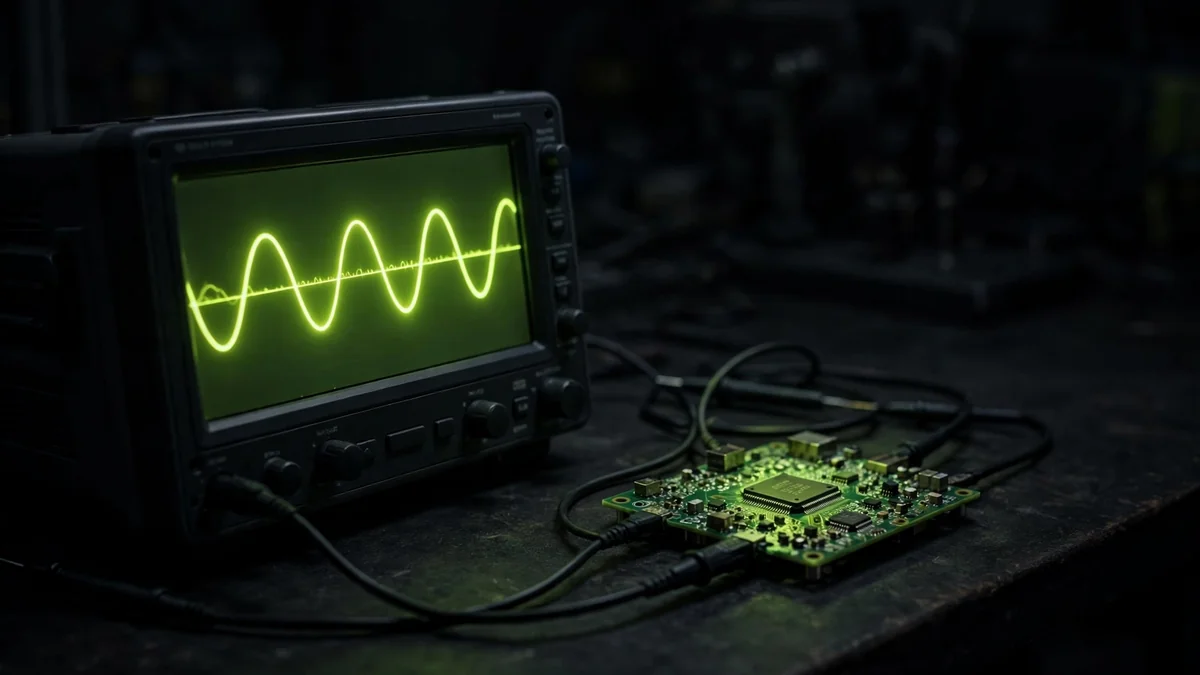
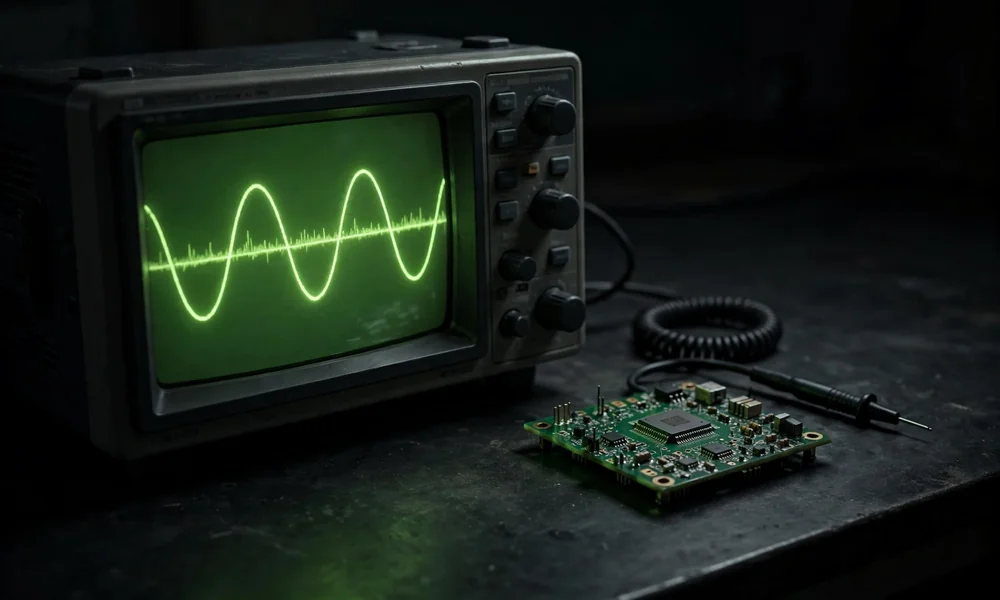
Power analysis needs physical access, and it is devastating. An attacker connects an oscilloscope to a smart card or an embedded device, records the power trace while it signs or decrypts, and analyses the trace statistically. Simple power analysis reads the key directly from the shape of the trace, while differential power analysis compares thousands of traces and finds the correlation between the power use and the key bits.
A key that would take centuries to brute-force can fall in minutes to a well-equipped lab.
Cache attacks exploit the processor’s own memory. Modern processors keep recently used data in a fast cache, and accessing cached data is quicker than fetching it from main memory, so an attacker who can run code on the same machine can measure which cache lines were used, and infer what the victim’s program was doing. Spectre and Meltdown, the processor flaws disclosed in 2018, were cache attacks at their most dramatic, letting one program read another’s memory through the side effects of speculative execution.
Acoustic and electromagnetic attacks listen from further away. Researchers have recovered RSA keys from the sound a laptop makes, using a microphone placed nearby, and from the electromagnetic radiation a chip emits, using an antenna. The signals are faint, but the statistics are powerful, and the lesson is that any physical effect correlated with the secret is a potential channel, whether the designer intended it or not.
The attacker model decides which channels matter. A remote attacker can only use timing and network behaviour, a local attacker sharing a machine can use cache timing, and a physical attacker with the device in hand can use power, sound, and radiation. The defence must match the attacker, because a defence against one channel does nothing against another.
Comparing side-channel attacks with other attack methods
Side-channel attacks are one of several ways to break a system, and each was built with a different emphasis. A mathematical attack breaks the cipher itself, a brute-force attack guesses the key directly, and a social engineering attack tricks a person into handing the secret over, and each approach trades access for effort in a different way.
The table below sets out the main contrasts between the leading approaches.
| Aspect | Side-channel attack | Mathematical attack | Brute force |
|---|---|---|---|
| What it breaks | The implementation | The algorithm | Nothing, it guesses |
| Access needed | Timing, power, or shared machine | Cipher text only | Cipher text only |
| Speed against strong keys | Minutes to hours | Impractical for AES | Centuries for 256-bit keys |
| Defence | Constant-time code, masking | Stronger algorithms | Longer keys |
| Best for | Leaky devices and software | Weak or old ciphers | Short, weak keys |
The practical result is that side-channel attacks are the right tool against a strong cipher on a leaky device, mathematical attacks suit weak algorithms, and brute force fits only the shortest keys.
Where side-channel attacks are used
Smart cards and payment terminals are the classic targets. A card that signs transactions in a shop is physically accessible to an attacker with an oscilloscope, and power analysis has been used to extract keys from cards, which is why modern cards use masking, shielding, and sensors that detect tampering and erase the keys.
Cloud servers face cache attacks from other tenants. When several customers share one physical machine, a malicious tenant can measure cache timing to learn what a neighbour’s program is doing, and the Spectre and Meltdown disclosures showed that this was not a theoretical risk but a practical one, affecting almost every processor in service.
Websites leak through timing. A login page that takes longer to reject a valid username with a wrong password than an invalid username tells an attacker which accounts exist, and a password check that compares character by character leaks the password one position at a time. These are side channels in software, and they are fixed with constant-time comparisons, which take the same time whatever the input.
Mobile phones leak through sensors. Researchers have shown that a phone’s accelerometer and gyroscope can reveal what is being typed on its screen, that its power use can reveal what apps are running, and that its microphone can pick up the sound of keystrokes. The sensors are there for legitimate features, and they are also, accidentally, microphones for the device’s own behaviour.
Encrypted messaging has faced timing attacks on its protocols. The time taken to decrypt a message can reveal whether it was valid, and the size and timing of packets can reveal who is talking to whom, which is why modern protocols pad messages, randomise timing, and treat metadata as carefully as content.
Strengths and limits
The greatest strength of a side-channel attack is that it bypasses the mathematics entirely. A cipher that would take centuries to break by analysis can fall in an afternoon to a power trace, because the attack does not care how strong the algorithm is, only how leaky the device running it happens to be.
It is also a strength that side channels are everywhere. Every computation leaks something, through time, power, heat, sound, or cache behaviour, so the attacker has many channels to choose from, and a defender must close all of them, while the attacker only needs one to stay open.
The limits are real, though. Most side-channel attacks need many samples, careful measurement, and often physical access, which limits them to high-value targets, and the defences are well understood: constant-time code, masking, shielding, and noise. A system built with side channels in mind from the start is hard to attack, which is why the field is a race between measurement and mitigation.
Side-channel attacks checklist
- Write security-critical code in constant time; never branch on secrets.
- Compare passwords and tokens with constant-time comparison functions.
- Mask sensitive values so power traces reveal nothing useful.
- Add noise and random delays to make timing measurements harder.
- Shield hardware and add tamper sensors to payment devices.
- Keep processors patched against Spectre and Meltdown variants.
- Pad messages and randomise timing in network protocols.
- Test implementations with timing and power analysis before shipping.
- Assume any shared machine leaks; isolate sensitive work where it matters.
Frequently asked questions
What is a side-channel attack in simple terms?
It is an attack that steals secrets by measuring physical side effects of a computation, such as how long it takes or how much power it uses, instead of breaking the encryption mathematics.
What is a timing attack?
It is a side-channel attack that measures how long an operation takes and uses the differences to infer secrets, such as guessing a password one character at a time from how quickly each guess is rejected.
What is differential power analysis?
It is a technique that records thousands of power traces from a chip while it operates, and uses statistics to find the correlation between the power use and the secret key bits.
Can side-channel attacks break AES?
They cannot break the AES algorithm itself, but they can break leaky implementations of it, by measuring timing, power, or cache behaviour, which is why implementations must be written carefully.
What are Spectre and Meltdown?
They are processor flaws disclosed in 2018 that let one program read another’s memory through the side effects of speculative execution, and they are among the most serious side-channel attacks ever found.
How do I defend against side-channel attacks?
With constant-time code, masking, shielding, noise, and patching, and by treating timing, power, and cache behaviour as part of the security design, not as an afterthought.
The bottom line
Side channel attacks explained in one line is this: the cipher is perfect, the chip is chatty, and the attacker listens to the chip instead of the cipher.
It is the reminder that security lives in the implementation as much as in the mathematics, and the reason the best cryptography in the world still needs careful engineering to hold.
This article is general information about how side-channel attacks work, not advice about choosing security measures for a particular system.