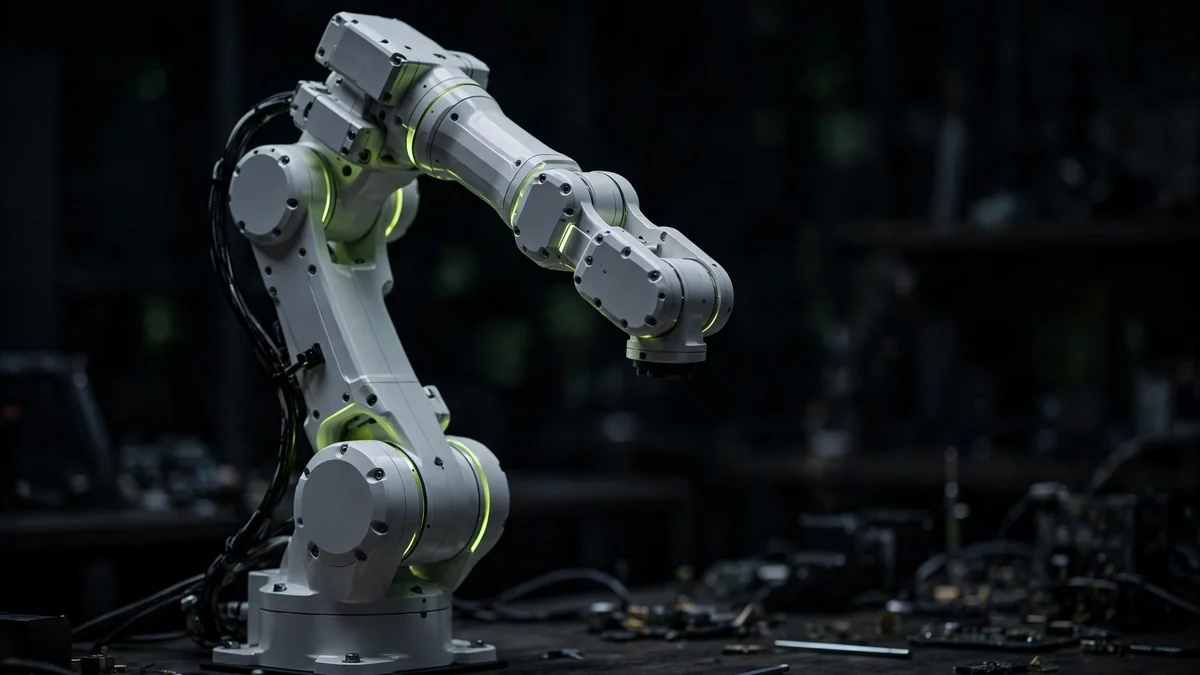
Robotics is the point where artificial intelligence stops being words on a screen and starts moving things in the real world, and this robotics explained guide covers how robots learn, where they work, and what still limits them. Embodied AI is the name for this meeting of AI and the physical world: a system with a body that senses its surroundings, decides what to do, and acts on that decision. The short answer: modern robots learn mainly by copying human demonstrations and by trial and error, and they are already useful in warehouses and factories, while homes and hospitals remain far harder.
For decades, robots were programmed step by step for one job in one fixed place, such as welding the same joint on a car body thousands of times a day. The modern approach is different: engineers train a neural network policy that maps what the robot senses to what it does, and that policy improves with data and practice.
Key takeaways
- Embodied AI means AI with a physical body that senses, decides, and acts in the real world.
- Robots learn mainly by imitation learning, copying human demonstrations, and by reinforcement learning, trial and error with rewards.
- Most training happens in simulation first, because real robots are slow, expensive, and can break.
- Warehouses, logistics, and manufacturing are where robots work best today; homes remain the hardest environment.
- The biggest limit is data: there is no internet-sized dataset of robot actions to learn from.
- Safety, dexterity, cost, and generalisation still limit what robots can do outside controlled settings.
What embodied AI actually means
Embodied AI is artificial intelligence that lives in a body and interacts with the physical world. A chatbot answers questions. An embodied system picks up a cup, navigates a warehouse aisle, or assembles a part, and it has to deal with everything the real world throws at it: friction, gravity, objects that slip, lighting that changes, and people who move unpredictably.
That physical grounding changes the problem completely. Language models learn from text, which is abundant and clean. Robots learn from physical experience, which is scarce, slow, and messy. A robot cannot read a million examples of picking up a cup the way a language model reads a million sentences. It has to try, fail, and try again, and each attempt takes real time.
The standard architecture is a loop: sensors such as cameras, depth sensors, and touch sensors observe the world; a learned policy decides what to do next; and motors, grippers, and wheels carry out the action. Modern systems often use a vision-language-action model, which takes in camera images and a spoken or written instruction, and outputs the robot’s next movements.
How robots learn: copying humans
The most common way to teach a robot a new task today is imitation learning. A person demonstrates the task, often by steering the robot remotely through teleoperation, and the robot learns to copy the demonstrated behaviour. This approach, known as behaviour cloning, fits a policy to the state-action pairs in the demonstrations: given this sensor reading, do this action.
Imitation learning works well for tasks that are hard to describe in rules but easy to show, such as folding cloth or handling delicate objects. In a widely reported 2023 study, a low-cost two-armed setup learned six fiddly tasks, such as opening a translucent condiment cup, with 80 to 90 percent success after about ten minutes of demonstrations.
The ceiling is obvious, though. A policy trained by imitation can only be as good as the people it copied, and it struggles when it meets a situation that never appeared in the demonstrations. It also inherits human mistakes. That is why the field has moved towards combining imitation with a second method that lets the robot improve on its own.
| Learning method | How it works | Strengths | Weaknesses |
|---|---|---|---|
| Imitation learning | Copies human demonstrations | Fast to start, good for delicate tasks | Limited by the demonstrator, fails on new situations |
| Reinforcement learning | Trial and error guided by rewards | Can beat the demonstrations | Slow, needs many attempts, can damage hardware |
| Simulation training | Practises in a virtual world | Fast, cheap, safe, parallel | Reality differs from the simulation |
| Foundation models | Pre-trained on many robots and tasks | Transfers knowledge across tasks | Needs large datasets, still unreliable |
| Hand programming | Engineers write every movement | Precise and predictable | Only works for fixed, repeated tasks |
How robots learn: trial and error
Reinforcement learning is the second main method. Here the robot tries actions, receives a reward signal when it does well, and gradually shifts its behaviour towards the actions that earned the highest rewards. The loop is simple, observe, act, reward, update, but running it on a real robot is slow and risky, so most practice happens in simulation, where thousands of virtual robots can train in parallel faster than real time.
The results can be remarkable. Researchers at UC Berkeley reported in January 2025 that their system, combining demonstrations, human corrections, and reinforcement learning from its own attempts, learned complex tasks such as assembling a computer motherboard within one to two hours, and achieved a perfect success rate on a delicate block-removal task. A human supervisor needed to intervene less and less as the robot learned.
Since late 2025, the leading labs have converged on a combined recipe: pre-train a large vision-language-action model on many robots and tasks, fine-tune it with imitation on demonstrations of the target task, and then improve it with reinforcement learning on the robot’s own attempts, while keeping some imitation in the mix so the policy does not forget what it already knew.
The data problem
The hardest problem in robotics is data. Language models train on text gathered from the internet, and image models train on billions of photos. Robots have no equivalent source of action data, because nobody has recorded the world at the scale of robot movements. Roboticist Ken Goldberg has called the difference a hundred-thousand-year data gap, and the field is still working out how to close it.
One answer is to pool data across labs and companies. The Open X-Embodiment collaboration gathered more than a million real robot trajectories from 22 robot types and 21 institutions, and models trained on the mix showed positive transfer across different robots. Another dataset, DROID, collected 76,000 demonstrations in 564 scenes across three continents.
Even so, robot data remains orders of magnitude smaller than text data, and it is far more expensive to collect. Every demonstration needs a robot, an operator, and a real environment, and the data only applies to the hardware it was collected on. This is the main reason robot progress looks slower than language model progress.
Where robots work today
Warehouses and logistics are the clearest success story. Mobile robots move shelves, sort packages, and carry goods across fulfilment centres, working alongside people in spaces designed for machines. Manufacturing is the older success: industrial arms have welded, painted, and assembled parts for decades, and they keep getting more flexible as AI improves their ability to handle variation.
Agriculture is growing fast, with robots that pick fruit, weed fields, and monitor crops. Healthcare uses robots for surgery assistance, rehabilitation, and delivering supplies inside hospitals. Exploration robots work where people cannot go: bomb disposal, deep-sea inspection, and space missions.
Homes are the frontier that remains mostly unconquered. A home is unstructured, cluttered, and different from every other home, and a robot that works in one kitchen may fail in the next. Humanoid robots are being developed for exactly this setting, and companies have begun limited trials, but a general-purpose home robot remains a research goal. Our guide to enterprise AI platform examples shows how businesses deploy AI today, and robotics is the physical extension of that trend.
The limits that still matter
Dexterity is the first limit. A human hand can pick up an egg without breaking it, tie a shoelace, and use a tool it has never seen before. Robot grippers are improving, but general manipulation of soft, slippery, or unfamiliar objects remains unreliable.
Generalisation is the second limit. A robot policy trained on one task in one place often fails when the lighting changes, the object moves, or the task varies slightly. Safety is the third: a robot that shares space with people must never hurt them, and proving that safety is far harder than proving a chatbot is safe. Cost is the fourth, since capable robots are still expensive to build, deploy, and maintain.
None of these limits is permanent, but none will disappear quickly either. Progress in robotics is real, and it is accelerating, yet the honest picture is that robots are excellent in controlled environments and still fragile outside them. Our guide to the future of software development makes a related point: AI improves fastest where the environment is structured and the feedback is clear.
Should you work in robotics?
Use this checklist to judge whether robotics is the right direction for you.
- You enjoy both software and hardware: robotics needs programming, maths, and an understanding of physical systems.
- You are patient with slow feedback: real robots take time to test, and a failed experiment can mean a broken part.
- You have strong Python and maths skills: the core tools are Python, PyTorch, and linear algebra.
- You can learn simulation, where most robot training happens.
- You want to build things people can touch: robotics is the most tangible branch of AI.
- You are comfortable with a longer road: robotics careers reward depth, and the field moves more slowly than pure software AI.
Frequently asked questions
What is embodied AI?
Embodied AI is artificial intelligence in a physical body that senses the world, decides what to do, and acts on that decision. A robot is the most common example: cameras and sensors observe the environment, a learned policy decides the next action, and motors carry it out.
How do robots learn new tasks?
Mainly in two ways. In imitation learning, a human demonstrates the task and the robot learns to copy it. In reinforcement learning, the robot tries actions, receives rewards for good ones, and improves through practice, usually in simulation first.
Why do robots train in simulation?
Real robots are slow, expensive, and can break, so most practice happens in a virtual world where thousands of simulated robots can train in parallel faster than real time. The challenge is the gap between simulation and reality, which engineers close by randomising the simulation and fine-tuning on the real robot.
Where are robots used most today?
In warehouses, logistics, and manufacturing, where the environment is structured and the tasks are repetitive. Agriculture, healthcare, and exploration are growing areas, while general-purpose home robots remain a research goal.
Will robots take over human jobs?
Robots are best at repetitive, physical, and dangerous work, and they are already changing those jobs. They are far less capable at work that needs judgement, dexterity, and dealing with unpredictable people, so the realistic picture is a shift in which tasks are automated rather than a wholesale replacement.
What is a vision-language-action model?
It is a model that takes in camera images and a language instruction, and outputs the robot’s next movements. It is the main architecture behind today’s general-purpose robot policies, connecting what the robot sees and is asked to do with what it should do next.
The bottom line
Robotics explained in one line: it is AI with a body, and the body is the hard part. Robots learn by copying people and by practising, first in simulation and then in the real world, and they are already excellent in warehouses, factories, and other controlled places. The data gap, dexterity, and generalisation still limit them outside those settings.
The field is moving faster than it has in years, driven by foundation models and the combined imitation-plus-reinforcement recipe. Expect steady progress in structured workplaces first, and treat promises of a general-purpose home robot with healthy scepticism.