AI in education explained simply is this: artificial intelligence is now tutoring students, marking work, planning lessons and personalising learning at a scale no teacher could manage alone. The central question is whether it actually helps students learn, and the short answer is that it can, when it supports good teaching rather than replacing it, and when schools manage the risks around accuracy, cheating and privacy.
AI entered classrooms gradually, through spelling checkers, adaptive quizzes and translation tools, then suddenly, when general-purpose chatbots arrived in late 2022. Teachers and students adopted them quickly, often faster than school policies. This guide explains what AI does in education today, where it helps and where it does not, and how schools can use it well.
Key takeaways
- AI tutors give every student instant, personalised feedback, but they still make mistakes and need human oversight.
- Teachers save the most time on planning, marking routine work and adapting materials to reading levels.
- Assessment is hardest: AI can draft and mark questions, but high-stakes decisions still need human judgement.
- AI detectors are unreliable, so schools should design assessments that are hard to fake rather than relying on them.
- Privacy, bias, over-reliance and unequal access are the risks schools must manage first.
What AI in education actually means
Most of these tools run on machine learning, trained on large amounts of text and other data. A chatbot predicts likely responses, an adaptive platform adjusts the difficulty of the next question based on the last answer, and a marking tool compares work against patterns it has learned. None understands a subject the way a teacher does, but all can process far more information far faster.
AI tutoring and personalised learning
Tutoring is the most celebrated use of AI in education. A good human tutor adapts to each student, spots misunderstandings and asks the right question at the right moment. AI tutors aim to do the same at a scale and cost that one-to-one human tutoring cannot match.
The best-known example is Khanmigo, the AI tutor built by Khan Academy, which guides students through problems with hints and questions rather than giving the answer. Language apps such as Duolingo adjust exercises to each learner in a similar way. Many school platforms follow the same pattern: the system notices where a student struggles, and offers extra practice or a different explanation.
The quality of that help varies widely. A tutor that walks a student through a problem step by step is genuinely useful; a chatbot that hands over a finished essay is not teaching at all. The difference is in the design: the best tools keep the student thinking, while the worst ones do the thinking for them.
Personalisation goes beyond tutoring. AI can rewrite a text at a simpler reading level, generate extension material for a fast finisher, translate materials for second-language learners, and summarise long texts for revision. Used well, this helps teachers meet a wider range of needs in one classroom.
How teachers are using AI
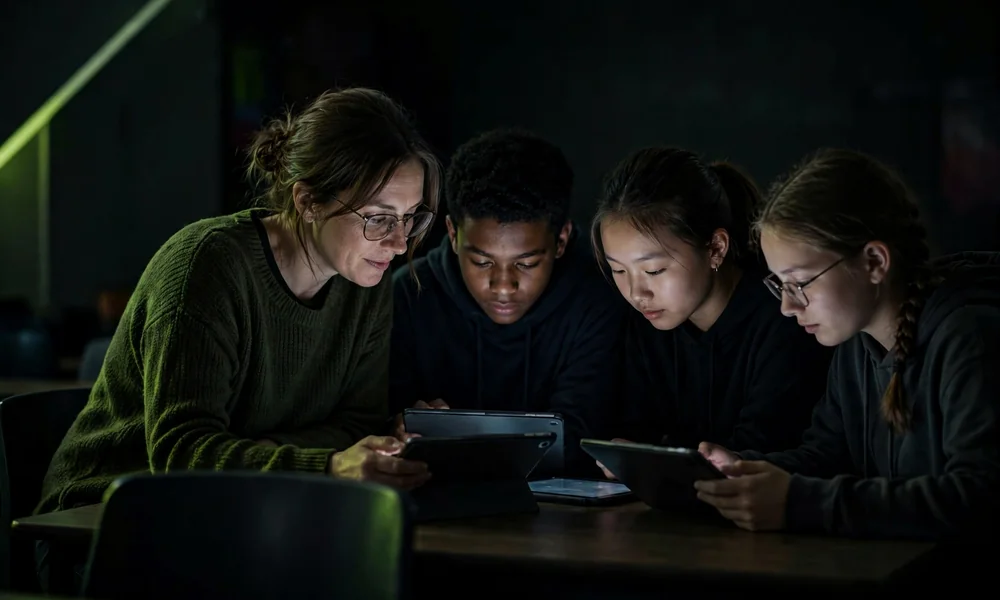
Teachers adopted AI early, for a practical reason: workload. Planning lessons, writing differentiated materials, marking routine work and answering parent emails take hours every week. AI can draft a lesson plan in seconds, generate questions at several difficulty levels, and draft a report comment a teacher then edits.
The time saved is real, but only when the teacher checks the output. AI-generated plans can include wrong facts, questions that miss the point, or activities that do not fit the age group. A teacher who pastes the output without reading it has not saved time; they have moved the risk into the classroom.
AI is also changing how teachers give feedback. A tool can mark short answers and multiple-choice questions instantly, freeing the teacher for the feedback that matters: the essay, the project, the work where a student’s thinking is visible. Some tools draft comments a teacher then personalises, which helps with thirty students.
Getting good results is itself a skill. Clear, specific prompts produce far better lesson plans and questions than vague ones, and our guide to prompt engineering explains the techniques that make the difference.
Assessment and the cheating problem
Assessment is where AI causes the most argument in schools. If a student can ask a chatbot to write an essay, what does the essay mark actually measure? Schools have answered in different ways, from banning AI outright to redesigning assessments so AI cannot do the work for the student.
AI detection tools were the first response, and they have proved unreliable. Detectors can flag human work, particularly by students using English as an additional language, and can miss AI work that was lightly edited. Relying on a detector to accuse a student of cheating is unfair, and several schools and universities have learned that the hard way.
The more durable answer is to change what is assessed. In-class writing, oral presentations, practical work and supervised exams are hard to fake with AI. Take-home essays can ask for personal reflection, local knowledge or a process log showing how the work developed. Some schools ask students to explain their reasoning aloud, which tests understanding in a way no chatbot can answer for them.
AI can also help with assessment itself: it can generate question banks, mark short answers consistently, and spot patterns across a class, such as a question most students got wrong. But the final judgement, especially where grades matter, should stay with a human who can weigh context no algorithm sees.
Comparing the main uses of AI in schools
| Use | Main benefit | Main risk | Best for |
|---|---|---|---|
| AI tutoring | Instant personal feedback | Wrong answers presented confidently | Guided practice with teacher oversight |
| Lesson planning | Drafts in seconds | Errors and poor fit for the class | Starting points a teacher reviews |
| Marking routine work | Fast and consistent | Missed nuance in open answers | Short answers and quizzes |
| Homework help | Available any time | Students copy instead of learning | Explaining concepts, not doing tasks |
| Accessibility | Translation and reading support | Unequal access to devices | Supporting diverse learners |
Research, revision and study skills
Students also use AI as a study tool. A chatbot can explain a difficult concept in simpler words, quiz a student on a topic, summarise a long chapter, or turn notes into flashcards. For revision, that interactive practice is genuinely useful at any hour.
The danger is that chatbots present wrong information confidently. A summary can invent a fact, a practice question can have the wrong answer, and a simplified explanation can leave out the very detail an exam requires. Students need to be taught to check AI output against their textbook or notes, and to treat a chatbot as a starting point rather than an authority. AI search tools that cite real sources are a better habit, and our Perplexity guide explains how one such tool works.
The risks schools must manage
Privacy is the first risk. AI tools often process student data, and schools must know where it goes, how long it is kept, and whether it trains future models. A free consumer tool with vague terms is a poor classroom choice: schools should use tools with clear education terms, data agreements and age limits.
Bias is the second risk. AI systems learn from data that reflects the world as it is, including its inequalities. A tool can give weaker feedback on writing in some dialects, or make assumptions about students based on their names or backgrounds. Teachers should watch for who the tools serve well and who they serve badly.
Over-reliance is the third risk, and it affects students and teachers alike. A student who always asks the chatbot first may never learn to struggle through a hard problem, and a teacher who always accepts AI-generated plans may stop thinking critically about what their class needs. Struggle is part of learning.
Equity is the fourth risk. AI can widen the gap between students who have good devices and fast internet at home and those who do not. The fairest approach is to provide AI access in school, where every student gets the same tools, and to design homework that does not depend on technology at home.
What good policy looks like
UNESCO published guidance on generative AI in education in 2023, and England’s Department for Education has published guidance for schools. Both point the same way: schools need a clear policy, staff need training, and students need to be taught how AI works and when its use is acceptable.
A good policy starts by saying what is allowed and what is not. Some schools allow AI for brainstorming and revision but not for assessed work. Others allow it everywhere, provided students declare what they used and how.
Training matters as much as policy. Teachers need time to try the tools, see where they fail, and share what works. Students need lessons on how AI generates text, why it makes mistakes, and how to cite its use honestly. A school that buys tools without training its people has bought a problem, not a solution.
Classroom checklist
- Write a clear AI policy for what students and staff may and may not do.
- Choose tools with clear education terms and data agreements, and check age limits.
- Teach students to verify AI output against textbooks, notes and trusted sources.
- Redesign assessments to test understanding, not the ability to copy an answer.
- Do not rely on AI detectors to accuse students of cheating.
- Use AI to draft and adapt materials, but always review the output first.
- Give every student access to AI tools in school, so homework does not depend on home technology.
- Watch for bias in AI feedback, and question results that treat students differently.
- Train staff regularly, and share examples of what works and what fails.
Frequently asked questions
Is AI allowed in schools?
It depends on the school and the country. Many schools allow AI for some purposes and restrict it for assessed work, while a few ban it entirely. Students should follow their own school’s policy and declare AI use when asked.
Can AI replace teachers?
No. AI can tutor, mark routine work and draft materials, but it cannot build relationships, read a room, or judge a student’s effort and circumstances. The strongest results come from AI supporting a teacher.
How can teachers tell if a student used AI?
There is no reliable way, since AI detectors are unreliable. Teachers are better served by assessments that are hard to fake, such as in-class writing, oral work and supervised exams, and by asking students to explain their reasoning.
Is student data safe with AI tools?
It depends on the tool. Schools should use tools with clear education terms and data agreements, avoid free consumer tools with vague terms, and check what data is collected and how long it is kept.
Does AI help students learn, or does it just do their work?
Both outcomes are possible, and the design of the task decides. A tutor that guides a student through a problem step by step supports learning, while a tool that hands over a finished essay does not. The difference is whether the student is still doing the thinking.
What should parents know about AI in school?
Parents should ask the school for its AI policy, which tools their child uses, and what data those tools collect. At home, the most useful habit is to ask a child to explain what the AI said, which tests understanding far better than checking the answer.
The bottom line
AI in education explained in one line is this: the tools are powerful, the benefits are real, and the risks are manageable, but only when schools treat AI as a support for good teaching rather than a substitute for it. The classrooms that gain most have clear policies, trained teachers, honest assessments and students who question what a machine tells them.