NVIDIA Blackwell is the GPU architecture behind the most powerful AI hardware NVIDIA has ever sold, and this NVIDIA Blackwell guide explains what it is, what it is for, and who actually needs it. NVIDIA announced Blackwell and its first GPU, the B200, at its GTC developer conference on 18 March 2024, presenting it as the successor to the Hopper architecture that powers the H100. The short answer: Blackwell is a data centre architecture built for training and running very large AI models, and unless you run AI at serious scale, you will meet it through a cloud service rather than by buying one.
Blackwell matters because it changed how NVIDIA builds a flagship GPU. Instead of one enormous chip, the B200 joins two silicon dies in a single package so that software sees them as one GPU with 208 billion transistors. That design, plus faster memory, a new low-precision maths format and a much faster interconnect, is what lets Blackwell systems train and serve models that Hopper systems struggle with.
Key takeaways
- Blackwell is NVIDIA’s data centre GPU architecture, announced on 18 March 2024 as the successor to Hopper.
- The B200 GPU packs 208 billion transistors across two dies linked at 10 terabytes per second, with 192 GB of HBM3e memory.
- Blackwell is the first NVIDIA architecture with FP4 tensor maths, aimed at faster and cheaper AI inference.
- The GB200 Grace Blackwell Superchip pairs a Grace CPU with two B200 GPUs, and the GB200 NVL72 rack links 72 GPUs in one system.
- NVIDIA claims up to four times the training performance and up to 30 times the inference performance of Hopper, though those are vendor figures.
- Most buyers should rent Blackwell through the cloud, and most readers will meet it in a GeForce RTX 50-series card.
What Blackwell actually is
Blackwell is a GPU architecture, which means it is a design blueprint rather than a single product. NVIDIA uses it for data centre accelerators such as the B200, for the Grace Blackwell Superchip, for whole rack-scale systems, and for consumer graphics cards in the GeForce RTX 50 series. The architecture is named after David Blackwell, the mathematician and statistician, continuing NVIDIA’s habit of naming architectures after scientists.
The idea behind Blackwell is scale. Modern AI models have grown so large that a single chip can no longer hold them comfortably, and training them means splitting the work across many GPUs that must constantly exchange data. Blackwell attacks that problem on three fronts at once: more transistors per GPU, much faster memory, and a faster connection between GPUs.
The B200 and the two-die design
The B200 is the flagship Blackwell GPU and the clearest expression of the architecture. It is made from two silicon dies, each at the largest size a chip factory can produce in one exposure, joined in the same package by a 10 terabyte per second chip-to-chip link. Because the link is so fast, software treats the two dies as a single GPU with 208 billion transistors, more than two and a half times the 80 billion in the H100.
The dies are manufactured on a custom TSMC 4NP process, a refined version of the 4-nanometre-class technology used for Hopper. Around them sit eight stacks of HBM3e high-bandwidth memory totalling 192 GB, up from 141 GB on the H200, with memory bandwidth of up to 8 terabytes per second. Memory matters here because large language models spend much of their time moving data in and out of memory, so more and faster memory directly speeds up both training and inference.
Power consumption is the trade-off. The B200 is rated at up to 1,000 watts per GPU, against 700 watts for the H100, which is why Blackwell systems are usually liquid-cooled and built for data centres rather than ordinary offices.
| Feature | Hopper H100 | Blackwell B200 |
|---|---|---|
| Announced | March 2022 | March 2024 |
| Transistors | 80 billion | 208 billion |
| Manufacturing process | TSMC 4N | Custom TSMC 4NP |
| Memory | 80 GB HBM3 | 192 GB HBM3e |
| Memory bandwidth | 3.35 terabytes per second | Up to 8 terabytes per second |
| Power | Up to 700 watts | Up to 1,000 watts |
| Lowest tensor precision | FP8 | FP4 |
| NVLink generation | Fourth generation | Fifth generation, 1.8 terabytes per second |
| Design | Single die | Two dies acting as one GPU |
The second-generation Transformer Engine and FP4
The most important Blackwell feature for AI work is its second-generation Transformer Engine, which introduces FP4 tensor maths. FP4 means floating-point numbers just four bits wide, half the width of the FP8 format Hopper introduced. Narrower numbers take less memory and less time to process, so a model can run faster and cheaper, provided the loss of precision does not damage the quality of its answers.
That proviso is where the Transformer Engine earns its place. It manages precision dynamically, choosing where a model can safely use four-bit maths and where it needs wider numbers to stay accurate. NVIDIA says this approach lets Blackwell deliver large inference speedups without a meaningful drop in quality, and it is the main reason the company quotes inference gains far larger than its training gains.
Blackwell also adds a dedicated decompression engine that speeds up database queries and data analytics, a reliability engine that watches the health of the GPU, and confidential computing features that help keep models and data secure while they run. None of these is the reason to buy Blackwell on its own, but together they show the architecture was designed for production data centres, not just benchmark charts.
NVLink, the GB200 and the NVL72 rack
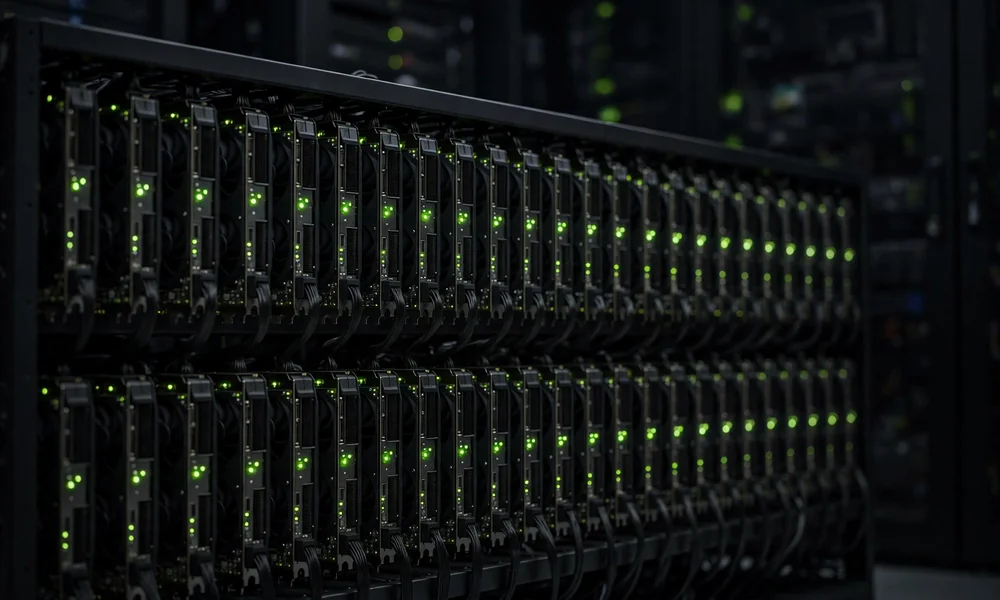
Blackwell’s fifth-generation NVLink interconnect moves data between GPUs at 1.8 terabytes per second in each direction, roughly double the bandwidth of Hopper’s NVLink, and it can join up to 576 GPUs in a single high-speed domain. That matters because the largest AI models are split across many GPUs, and the interconnect is often the bottleneck that decides how fast training actually runs.
The GB200 Grace Blackwell Superchip is the building block that uses this interconnect most directly. It combines one Grace CPU with two B200 GPUs in a single module, with the CPU and GPUs sharing fast memory access through NVLink. Our guide to quantum computing chips explains a different kind of accelerator, but the design lesson is the same: the connection between processors now matters as much as the processors themselves.
Scale up further and you reach the GB200 NVL72, a liquid-cooled rack that links 72 B200 GPUs and 36 Grace CPUs into one system. NVIDIA presents the NVL72 as a single giant GPU from the software’s point of view, which simplifies running very large models. If you are not running a frontier model or a very large inference service, this scale is far beyond what you need: the same architecture is available in smaller slices through the cloud.
Who needs Blackwell, and who does not
Blackwell is built for three groups. The first is the handful of companies training frontier AI models, where training runs last weeks and cost enormous sums, and where even a modest speedup is worth a great deal. The second is cloud providers and large enterprises running inference for millions of users, where FP4 and faster memory cut the cost of every answer. The third is research labs and national computing centres working on scientific problems, from weather modelling to drug discovery, that need the largest machines available.
Most organisations are not in any of those groups, and they do not need to buy Blackwell hardware. A small team fine-tuning an existing model, running a chatbot, or experimenting with AI will get further, faster, and far more cheaply by renting GPU time from a cloud provider, where Blackwell instances sit alongside older and cheaper options. Our guide to cloud computing for enterprises covers how to think about that choice: rent first, measure what you actually use, and only consider dedicated hardware when the monthly cloud bill justifies it.
Individuals meet Blackwell in a different form. The GeForce RTX 50-series graphics cards use the Blackwell architecture, bringing its design ideas to gaming and local AI work on a desktop. A 50-series card is not a B200, and it does not have HBM3e memory or NVLink, but it shares the architecture’s approach to AI-accelerated graphics, and for local experimentation a consumer card is the sensible way to get hands-on.
What to check before you rent or buy
Work through this checklist before committing money to Blackwell, whether you are renting cloud instances or buying hardware.
- Confirm your workload is actually GPU-bound: if your bottleneck is data preparation or network speed, a faster GPU will not help.
- Compare the cost per unit of work, not the headline speed: an older GPU at a lower hourly rate may be cheaper for your job.
- Check memory capacity first: a model that does not fit in GPU memory cannot run at all, whatever the speed.
- Ask whether FP4 is supported by your framework and model, since the biggest Blackwell gains depend on it.
- Confirm cooling and power if you are buying hardware: a B200 needs up to 1,000 watts and usually liquid cooling.
- Check software compatibility: your libraries and frameworks should already support Blackwell before you commit.
- Start with a small cloud test and measure real throughput on your own workload before scaling up.
Frequently asked questions
What is NVIDIA Blackwell?
Blackwell is NVIDIA’s GPU architecture for data centre AI, announced in March 2024 as the successor to Hopper. Its flagship GPU is the B200, and the architecture also powers the GB200 Superchip, the NVL72 rack system and the GeForce RTX 50-series consumer cards.
How is Blackwell different from Hopper?
The B200 uses two silicon dies acting as one GPU with 208 billion transistors, against 80 billion in the H100. It has more and faster memory, 192 GB of HBM3e at up to 8 terabytes per second, adds FP4 tensor maths, and doubles NVLink bandwidth to 1.8 terabytes per second.
What is the GB200 Grace Blackwell Superchip?
It is a module that combines one Grace CPU with two Blackwell B200 GPUs, connected by NVLink. The GB200 NVL72 rack links 72 of these GPUs and 36 Grace CPUs into a single liquid-cooled system.
Is Blackwell only for AI?
Mostly, but not entirely. Blackwell is designed for AI training and inference first, and also speeds up high-performance computing, data analytics and database work through features such as its decompression engine.
Can I buy a Blackwell GPU for my own computer?
You can buy a GeForce RTX 50-series card, which uses the Blackwell architecture, for a desktop. The data centre B200 is a different product that needs server power, cooling and networking, and is normally rented through the cloud.
Should I wait for the next architecture instead?
Probably not, unless your purchase is very large. NVIDIA refreshes its data centre architectures every couple of years, and a newer Blackwell Ultra refresh already exists. Renting in the cloud lets you move to newer hardware without owning the old kind.
The bottom line
NVIDIA Blackwell is the architecture that defines AI computing in the middle of this decade: a two-die B200 GPU with 208 billion transistors, 192 GB of fast HBM3e memory, FP4 maths for cheaper inference, and an NVLink fabric that can tie hundreds of GPUs into one system. Its headline performance claims are NVIDIA’s own figures, so treat them as a ceiling, not a guarantee.
For almost everyone reading this, the practical conclusion is simple. Do not buy Blackwell hardware. Rent it in the cloud when you need it, measure what your workload actually gains, and let the consumer RTX 50 series be your hands-on introduction. The silicon is remarkable, but the right question was never how fast it is: it is whether your work is big enough to need it.