Multimodal AI use cases by industry share one pattern: the work was already multimodal before the AI arrived, and the model simply joins what people were already doing. A radiologist reads notes and scans together. A shopper sends a photo and a description. A factory inspector looks at a part and checks a manual. The central question is where these models actually pay off, and the short answer is that they pay off wherever decisions already depend on combining text with images, audio or video, and wherever a human currently does that combining by hand.
This guide covers the industries where multimodal AI has moved past demos into production: healthcare, retail, finance, manufacturing, education, media and customer service. For each, it explains the concrete use, the model capability it relies on, and the check that decides whether it is safe to deploy.
Key takeaways
- Multimodal AI use cases by industry follow one pattern: the work was already multimodal, and the model joins text with images, audio or video that people already combined by hand.
- Healthcare uses vision-language models for scan description, report drafting and clinical documentation, always with a clinician in the loop.
- Retail uses visual search, product tagging and damage inspection; finance uses document reading and fraud review; manufacturing uses visual inspection and maintenance guidance.
- Education and media use multimodal models for tutoring, accessibility and content production.
- Every industry use needs the same checks: accuracy on your own data, a human review step for high-stakes output, and clear data governance.
Healthcare: scans, notes and documentation
Healthcare is the industry where multimodal AI is most valuable and most carefully controlled. Vision-language models help radiologists by drafting descriptions of X-rays, CT and MRI scans, flagging regions for review and summarising findings in plain language. They also read handwritten notes, lab reports and referral letters, and combine them with the images into a single summary for the clinician.
Clinical documentation is the quieter but larger use. Doctors spend a large share of their day writing notes. A multimodal system can listen to the consultation, look at the images discussed, and draft the record for the doctor to review and sign. The time saved is real, but the rule is absolute: the model drafts, the clinician decides. No multimodal system today is reliable enough to diagnose alone, and regulators in most countries treat these tools as assistive.
Best for: hospitals and clinics that want to cut documentation time and support radiology should start with assistive drafting and flagging, keeping a clinician as the decision maker.
The checks are strict. Accuracy must be measured on the hospital’s own scans and patient mix, not on a vendor benchmark. Patient data must stay inside the approved boundary, which usually means a private deployment or a compliant hosted service. And every output that affects care needs an audit trail showing what the model saw and what the clinician changed.
Retail and e-commerce: seeing what the customer sees
Retail was one of the first industries to deploy multimodal AI at scale. Visual search lets a shopper photograph a jacket on the street and find the same or a similar item in the catalogue. The model connects the image to product descriptions, colours, styles and prices, which text search alone cannot do. Marketplaces use the same capability to tag products automatically: upload a photo and the system fills in the category, colour, material and style.
Damage and quality inspection is the operational twin of visual search. A customer returns a product with a photo of the damage, and a vision model classifies the fault and routes the return. A warehouse system photographs parcels and checks that the contents match the label. These uses are lower risk than healthcare because a mistake costs a refund, not a life, but they still need accuracy testing on real product photos.
Best for: retailers with large catalogues and high return volumes should start with visual search and automated product tagging, where the return on investment is easiest to measure.
Finance: documents, fraud and advice
Finance runs on documents, and most of them arrive as images: scanned statements, identity documents, invoices, contracts and cheques. Multimodal models read these directly, extracting the numbers and the layout together, which is more accurate than extracting text first and reasoning about it afterwards. Lending teams use them to check application documents, and compliance teams use them to review contracts and flag unusual clauses.
Fraud review is a second use. A model can compare the photo on an identity document with a selfie, check that a document’s layout matches the expected template, and flag inconsistencies for a human reviewer. The model does not make the decision: it triages, and a person investigates the flagged cases.
Best for: banks and insurers with heavy document volumes should start with extraction and triage, where the model prepares work for a human rather than deciding it.
Governance is the hard part here. Financial decisions are regulated, and a model that cannot explain its reasoning is a liability. Teams should log the inputs, the model’s output and the human decision, and should test for bias across customer groups before deployment. Our guide to AI governance in practice covers the operating model in detail.
Manufacturing: inspection and maintenance
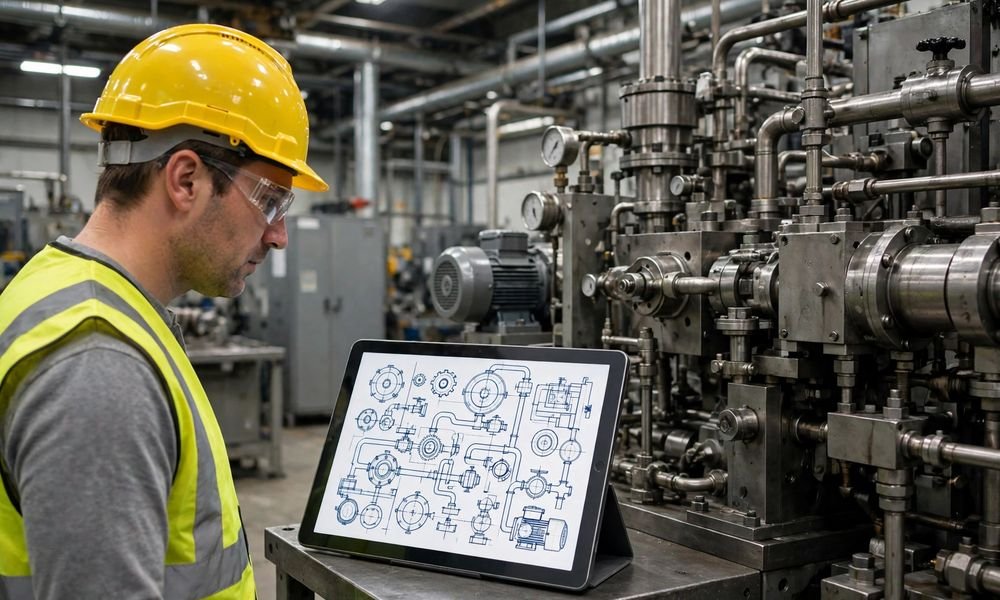
Manufacturing uses multimodal AI where human eyes already do the work. Visual inspection systems photograph parts on a production line and flag defects: scratches, cracks, misaligned components, missing parts. A vision-language model can go further than a traditional machine-vision system because it can describe the defect in words and link it to the relevant manual or work instruction.
Maintenance is the second use. A technician photographs a machine, and the model identifies the component, retrieves the manual page and suggests the next diagnostic step. Combined with audio, the same system can listen to a machine and flag sounds that suggest wear. This is the classic multimodal combination: image, text and sound together, each adding information the others lack.
Best for: manufacturers with high-volume lines and costly downtime should start with visual inspection of the most common defect types, then extend to maintenance guidance.
Education: tutoring and accessibility
Education is a natural fit because teaching is inherently multimodal: a teacher explains a diagram, a student sketches a solution, a textbook mixes figures and text. A vision-language model can look at a student’s handwritten working, find where the reasoning went wrong, and explain the correction. It can describe a chart for a student who cannot see it, or generate a diagram from a text description for a student who learns visually.
Accessibility is the use with the clearest benefit. Describing images, reading handwriting aloud and explaining charts in plain language all help students who would otherwise be excluded from visual material. These uses also carry the lowest risk, because the output is explanatory rather than decisive.
Best for: schools and training providers should start with accessibility and tutoring support, where the benefit is immediate and the risk is low.
Media and creative work: production at scale
Media companies use multimodal models across the production chain. A model can watch raw footage, write a summary, suggest cuts and draft captions. It can describe an image for alt text, tag an archive so it becomes searchable, and generate a thumbnail from a video’s key moment. Newsrooms use it to verify images, checking whether a photo matches its caption and flagging likely manipulation.
Content moderation is the large-scale use. Platforms screen uploaded images and video for policy violations, combining what the image shows with the text around it. A picture that is harmless alone can be a violation in context, and only a model that reads both can catch it.
Best for: media teams with large archives and high content volumes should start with tagging, captioning and moderation, where the work is repetitive and the volume is large.
Customer service: the photo plus the message
Customer service is where most people first meet multimodal AI. A customer sends a photo of a broken product and a written description, and the model identifies the product, diagnoses the fault from the image, and drafts a response with the next step. This is faster and more accurate than asking the customer to describe the fault in words, because a photo shows what words struggle to convey.
The same pattern works for insurance claims, travel disruption and technical support. The customer uploads evidence, the model reads it, and the agent gets a prepared case file. The agent still makes the decision and talks to the customer, but the preparation that used to take minutes takes seconds.
Best for: support teams handling physical products, claims or technical faults should start with photo-based triage, where the image carries information text cannot.
Multimodal AI use cases compared
| Industry | Leading use | Model capability | Risk level |
|---|---|---|---|
| Healthcare | Scan description and documentation | Vision-language reading | High — clinician review required |
| Retail | Visual search and product tagging | Image-to-text matching | Low — a mistake costs a refund |
| Finance | Document extraction and fraud triage | Document reading | High — regulated decisions |
| Manufacturing | Visual inspection and maintenance | Defect description and grounding | Medium — production quality |
| Education | Tutoring and accessibility | Image description and explanation | Low — explanatory output |
| Media | Tagging, captioning and moderation | Image and video understanding | Medium — reputational risk |
Choosing an industry use case: a decision framework
Use this framework to pick the first multimodal use case in your organisation. It favours work that is already multimodal, already repetitive and already measurable.
- Does the work already combine text with images, audio or video today?
- Is the work repetitive enough that automation pays for the build?
- Can the outcome be measured: time saved, errors reduced, cases handled?
- What happens when the model is wrong, and who catches it?
- Does the data need to stay inside your boundary, or can it go to a hosted API?
- Is there a labelled set of your own examples to test candidates against?
- Does the use need a human decision, or can the model act directly?
Start with the use case that scores highest on repetition and measurability and lowest on risk. Accessibility, tagging, captioning and triage are good first choices in most industries. Diagnosis, lending decisions and safety-critical inspection should come later, after the organisation has learned how these models fail.
For the architecture that supports these uses in production, see our overview of enterprise generative AI architecture and our guide to RAG chatbot architecture, which covers the retrieval pattern that grounds multimodal answers in your own documents.
Frequently asked questions
Which industry uses multimodal AI the most?
Healthcare, retail and media are the furthest along. Healthcare uses it for scans and documentation, retail for visual search and product tagging, and media for captioning, tagging and moderation.
Is multimodal AI safe to use in healthcare?
As an assistive tool, yes, with a clinician in the loop and accuracy measured on the hospital’s own data. No current multimodal model is reliable enough to diagnose or decide treatment alone.
What is the most common multimodal use case in retail?
Visual search: a shopper photographs an item and finds the same or a similar product. Automated product tagging from photos is a close second.
Can multimodal AI work in manufacturing without a cloud connection?
Yes. Open-weight vision models can run on local hardware at the edge, which suits factories where latency matters and connectivity is unreliable.
How do I measure whether a multimodal use case is working?
Measure time saved, error rate and case volume before and after deployment, on your own data. Vendor benchmarks do not measure your task.
What is the biggest risk when deploying multimodal AI?
Overtrust. The model sounds confident and the image feels like evidence, so people accept wrong answers. Keep a human review step for anything that affects money, safety or legal outcomes.