Vision language models explained in plain terms: they are AI models that take images and text together and produce text, so they can describe a photograph, read a chart, answer questions about a diagram or explain what is happening in a scene. A vision language model, usually shortened to VLM, is the most widely used kind of multimodal model. The central question is how a model built for words learns to see, and the answer is that an image encoder converts the picture into the same kind of representation the language model already understands, and the language model then reasons over the two together.
VLMs matter because so much knowledge lives in images. Medical scans, engineering drawings, receipts, whiteboards, maps, dashboards and product photos all carry information that text alone cannot capture. A text model can read the caption under a chart but not the chart itself. A VLM reads both, which is why these models have moved so quickly from research demos into real products.
Key takeaways
- A vision language model takes images and text as input and produces text, making it the most common type of multimodal model.
- The core design pairs a vision encoder, usually a vision transformer, with a language model, joined by an alignment layer or adapter.
- CLIP, released by OpenAI in January 2021 and trained on 400 million image-caption pairs, is the foundation for many VLMs.
- LLaVA showed in 2023 that a single learned projection layer can connect a CLIP encoder to a language model well enough to hold a visual conversation.
- VLMs are strong at description and document reading but weak at counting, precise measurement and fine spatial detail.
What a vision language model does
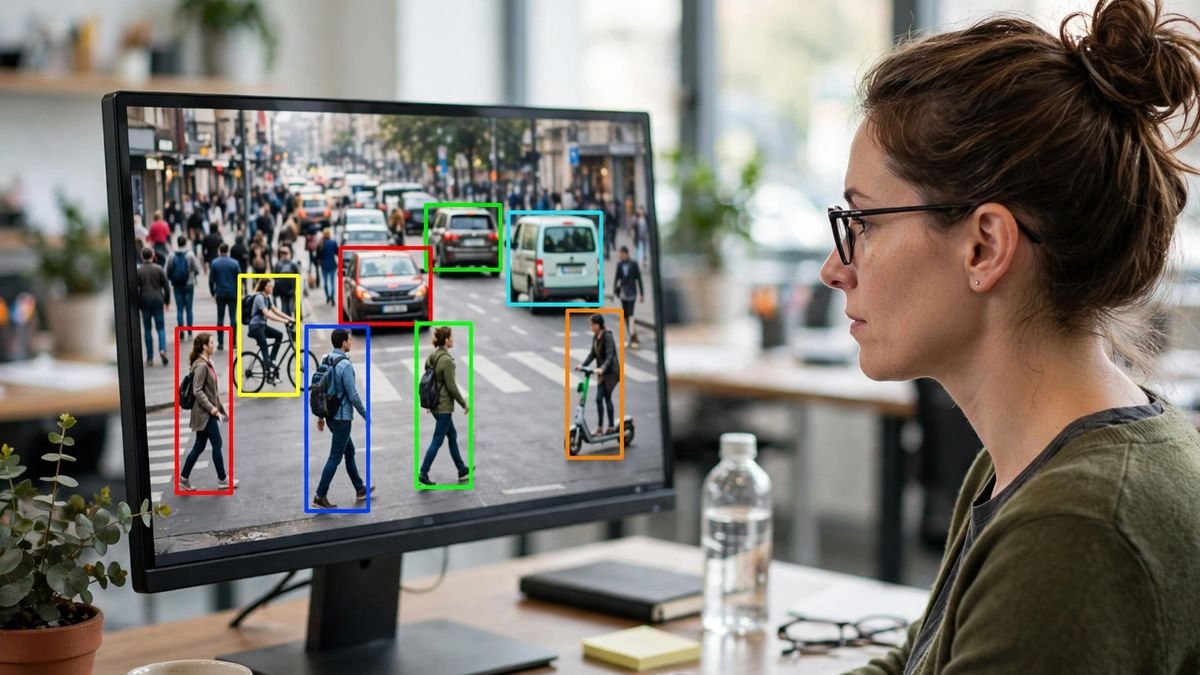
A VLM accepts an image and a text prompt, and returns text. The prompt can be a question, an instruction or a request for a description. Typical tasks include image captioning, visual question answering, optical character recognition, chart reading, document understanding and grounding, which means pointing to where an object is in the image.
The difference between a VLM and an image classifier is the range of what it can say. A classifier picks one label from a fixed list. A VLM answers in open-ended language, explains its reasoning, follows multi-step instructions and combines what it sees with what it knows from text. That flexibility is what makes it useful for real work rather than for benchmark tests alone.
How a VLM is built
Almost every modern VLM follows the same three-part design. First, a vision encoder turns the image into a sequence of vectors. Second, an alignment module maps those vectors into the language model’s space. Third, the language model reads the combined sequence and generates the answer.
The vision encoder is usually a vision transformer, or ViT. It slices the image into fixed patches, commonly 16 by 16 pixels, flattens each patch into a vector, and processes the sequence exactly as a language model processes words. CLIP’s vision encoder is the most reused component in the field: many VLMs start with a pretrained CLIP encoder because it already understands the relationship between images and text.
The alignment module is where designs differ. The simplest approach is a linear projection, as in LLaVA: one learned layer maps CLIP’s output into the language model’s embedding space. A more powerful approach is a cross-attention adapter, used by DeepMind’s Flamingo, which lets the language model attend to visual features at several layers. A third approach is a query transformer, used by BLIP-2, which compresses the image into a small set of learned query vectors before passing them to the language model.
Training usually happens in stages. The vision encoder is often frozen, so only the alignment module is trained at first, which is cheap and fast. Then the whole system is fine-tuned on visual instruction data: examples of images paired with questions and answers. LLaVA’s instruction data was generated by GPT-4 from image captions, which showed that a capable VLM could be built without a huge human-labelled dataset.
The leading vision language models
Proprietary models lead on general capability. GPT-4o, released in May 2024, handles text, images and audio in one network and is the benchmark most others are compared against. Google’s Gemini models were designed as multimodal from the start and handle long-context vision tasks well. Anthropic’s Claude models accept images and are widely used for document and chart analysis. All three are available through APIs and are the default choice for most commercial work.
Open-weight models have closed much of the gap. Meta’s Llama 3.2 Vision, released in September 2024, brought image understanding to the Llama family. Alibaba’s Qwen2-VL and Qwen2.5-VL are strong open alternatives with video support. Google’s Gemma 3 added vision to a smaller open model that runs on modest hardware. InternVL and the Idefics family are popular in research for their transparent training recipes.
| Model | Released | Access | Image input | Video input | Grounding |
|---|---|---|---|---|---|
| GPT-4o | May 2024 | Proprietary | Yes | Yes | Limited |
| Gemini 2.5 | 2025 | Proprietary | Yes | Yes | Yes |
| Claude Sonnet | 2025 | Proprietary | Yes | No | Limited |
| Llama 3.2 Vision | September 2024 | Open weights | Yes | No | Limited |
| Qwen2.5-VL | 2025 | Open weights | Yes | Yes | Yes |
| Gemma 3 | 2025 | Open weights | Yes | No | Limited |
Which VLM suits which job
Best for: general-purpose commercial use, where the widest capability and the best instruction following matter, should start with GPT-4o or Claude.
Best for: long video and very large multimodal context windows should look at Gemini, whose long-context design is its main advantage.
Best for: private deployment and on-device work should use Llama 3.2 Vision or Gemma 3, which run on hardware you control.
Best for: grounding, where the model must point to objects in the image, should evaluate Qwen2.5-VL, which supports grounding and video.
What VLMs are used for today
Document understanding is the largest commercial use. VLMs read scanned invoices, contracts, forms and handwritten notes, and answer questions about them. They handle layout, tables and handwriting that defeat traditional text extraction, because they see the page rather than reading a text dump of it.
Medical imaging is a high-value niche. VLMs help radiologists by drafting descriptions of scans, flagging regions for review and summarising findings. These systems are assistive, not diagnostic: a qualified clinician makes the decision, and the model must never be the last word on a patient’s care.
Retail and e-commerce use VLMs for visual search, product tagging and quality control. A shopper uploads a photo and finds the matching product. A warehouse system checks that a parcel matches its label. A marketplace screens listings for prohibited items. All three rely on the model connecting what it sees with a catalogue written in words.

Benchmarks, and what they do not tell you
VLMs are usually measured on benchmarks such as MMMU, which tests university-level questions across images, charts and diagrams, and MathVista, which tests visual mathematical reasoning. GPT-4o scored 69.1 per cent on MMMU at its release, a useful reference point for how far these models have come. Newer models score higher, but the numbers move fast and different vendors report them differently.
Benchmarks measure general capability, not your task. A model that tops a benchmark can still fail on your receipts, your floor plans or your product photos. The only reliable test is your own evaluation set: fifty to a hundred real examples from your work, with the correct answers written down before you test. Run every candidate against the same set and compare.
Where VLMs fail
Counting is the classic weakness. Ask a VLM how many people are in a crowded photo and it will often give a confident wrong number. The same applies to precise measurement, reading small print in low-resolution images, and telling apart objects that look similar. These failures are easy to miss because the answer sounds plausible.
Hallucination about images is a second weakness. A VLM can describe an object that is not present, misread a label, or invent a detail that fits the scene. Because the image feels like evidence, users trust these answers more than they should. Any output that affects money, safety or legal outcomes needs a human check.
Grounding remains uneven. Some models can draw a box around the object they describe, but the box is often loose or wrong. If your application needs precise locations, such as finding a defect on a production line, test grounding specifically rather than assuming it works.
Choosing and deploying a VLM: a checklist
Use this checklist before committing to a model. Each item is a decision, not a formality.
- Define the task precisely: description, question answering, OCR, grounding or some combination.
- Check whether the data can leave your network or must stay on your servers.
- Build an evaluation set of fifty to a hundred real examples with known answers.
- Test two or three candidates on that set and compare accuracy, not benchmark scores.
- Measure cost per thousand requests at your expected volume.
- Decide what happens when the model is wrong, and who checks the output.
- Plan for image preprocessing: resolution, cropping and format all affect accuracy.
- Log inputs and outputs so failures can be reviewed and the model can be re-tested.
Image preprocessing deserves emphasis. A VLM’s accuracy depends heavily on the resolution and quality of the image it receives. A chart that is too small to read will be misread, not refused. Resize, crop and sharpen before sending, and test the same image at different resolutions to find where accuracy drops.
For the infrastructure behind running these models in production, see our guide to LLMOps architecture. For the broader picture of how VLMs fit into enterprise AI, see our overview of enterprise generative AI architecture. If you need to run a VLM on limited hardware, the memory trade-offs in our QLoRA versus LoRA guide are directly relevant.
Frequently asked questions
What is a vision language model?
A vision language model, or VLM, is an AI model that takes images and text as input and produces text. It can describe a photo, read a chart, answer questions about a diagram or explain a scene.
How is a VLM different from an image classifier?
A classifier picks one label from a fixed list. A VLM answers in open-ended language, explains its reasoning and follows multi-step instructions, which makes it far more flexible.
What is CLIP and why does it matter?
CLIP is a model released by OpenAI in January 2021, trained on 400 million image-caption pairs. It learned to match images and text in a shared space, and its vision encoder is now the visual front end of many VLMs.
Can VLMs understand video?
Some can. Models such as GPT-4o, Gemini and Qwen2.5-VL accept video input, usually by sampling frames. Models such as Llama 3.2 Vision and Gemma 3 handle still images only.
Are VLMs accurate enough for medical use?
They are useful as assistants that draft descriptions and flag regions for review, but they are not reliable enough to diagnose alone. A qualified clinician must make the final decision.
Do I need a GPU to run a VLM?
For hosted APIs, no. For running open-weight VLMs locally, yes: even a small VLM needs a GPU with enough memory, and larger models need a data-centre card.