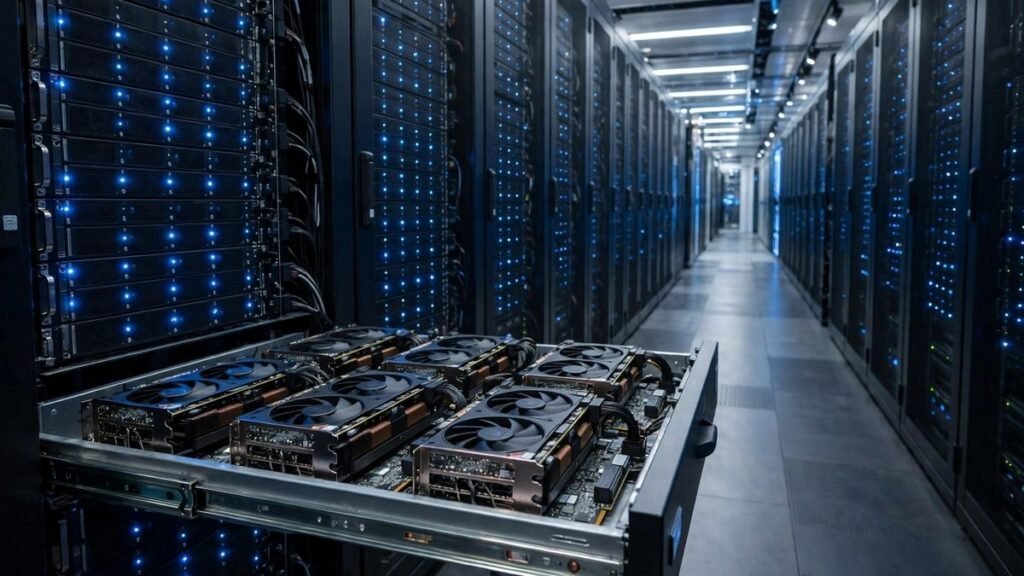
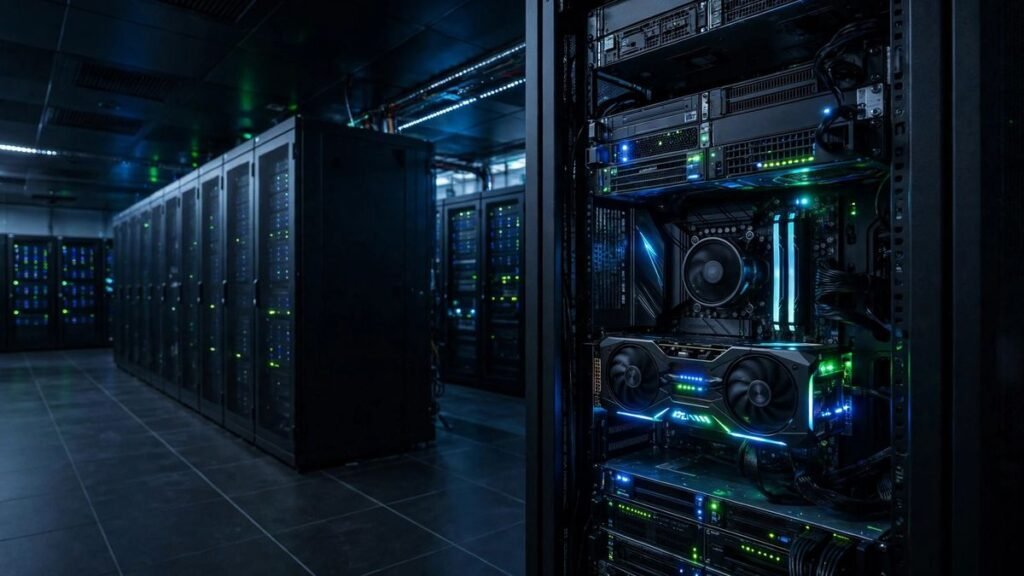
LLM inference energy consumption is the electricity a language model uses each time it answers a prompt, and it has become one of the largest running costs in AI. How much power does a single reply actually use? Far more than a web search, because every generated token requires a full pass through billions of parameters, and the graphics processors doing that work draw hundreds of watts each while they run.
The International Energy Agency estimated that data centres used about 415 terawatt-hours of electricity in 2024, roughly 1.5 per cent of global electricity use, and projected that figure would more than double to about 945 terawatt-hours by 2030, with AI as the main driver. Inference is a growing share, because training happens once while inference runs constantly.
Key takeaways
- LLM inference energy consumption comes mainly from GPU power draw during generation, plus cooling and facility overhead on top.
- An NVIDIA H100 SXM GPU draws up to 700 watts, against 400 watts for the A100, so a single eight-GPU server can draw around 10 kilowatts in total.
- The IEA estimated data centre electricity at about 415 terawatt-hours in 2024, roughly 1.5 per cent of global use, and projects about 945 terawatt-hours by 2030.
- Generating tokens one at a time is memory-bound, so the GPU often waits on memory while still drawing substantial power.
- The biggest savings come from batching, smaller or quantised models, shorter outputs and higher utilisation.
What drives LLM inference energy consumption?
Energy use in inference comes from three places: the compute itself, the memory system that feeds it, and the facility around the servers. The compute is the obvious part. Each token a model generates requires a forward pass through every layer, which means reading the model’s weights from high-bandwidth memory and multiplying them against the current activations.
That is a large amount of arithmetic for every token.
The memory system matters just as much. During generation, the model produces one token at a time, and each step reads the full weight matrix again. That makes decoding memory-bandwidth bound: the GPU spends much of its time waiting for weights to arrive from memory rather than computing.
The chip still draws substantial power while it waits, because the memory, the interconnect and the cooling all keep running.
The third piece is the facility. Cooling, power conversion and networking add overhead on top of the servers themselves, usually expressed as power usage effectiveness, or PUE. A PUE of 1.3 means that for every watt the servers use, the facility uses another 0.3 watts on cooling and other overheads.
How much power does a GPU use during inference?
The headline figure is the thermal design power, or TDP. NVIDIA’s A100 draws 400 watts in its SXM form, the H100 SXM up to 700 watts, and the B200 1,000 watts. Those are maximum sustained figures, and a busy inference server keeps its GPUs near them for most of the day.
The server total is what matters for the electricity bill. An eight-GPU H100 server draws about 5.6 kilowatts for the GPUs alone, and the full server, including CPUs, memory, networking and fans, draws around 10.2 kilowatts. A rack of four such servers needs more than 40 kilowatts of power and cooling.
These are the numbers that shape data centre design, because power and cooling capacity, not floor space, is usually the binding constraint.
It is also worth noting that power draw does not scale neatly with useful work. A GPU at 20 per cent utilisation still draws a large fraction of its peak power, because idle power on modern accelerators is high and memory stays powered. This is the core argument for sharing and batching: the cheapest energy per token comes from keeping GPUs busy.
Prefill versus decode: two different energy profiles
Inference has two phases with very different energy behaviour. The prefill phase processes the whole prompt at once, which is compute-heavy and uses the GPU well. The decode phase then generates tokens one at a time, which is memory-bound and uses the GPU poorly.
A short prompt with a long reply spends most of its energy in decode, while a long prompt with a short reply spends most of it in prefill.
This split explains several practical choices. Long system prompts and retrieved documents raise prefill cost, so caching them matters. Long outputs raise decode cost, so keeping replies concise and capping maximum output length are direct energy savings.
And because decode is memory-bound, techniques that shrink the memory traffic per token, such as quantisation and KV cache compression, cut energy as well as latency.
Where inference energy goes in practice
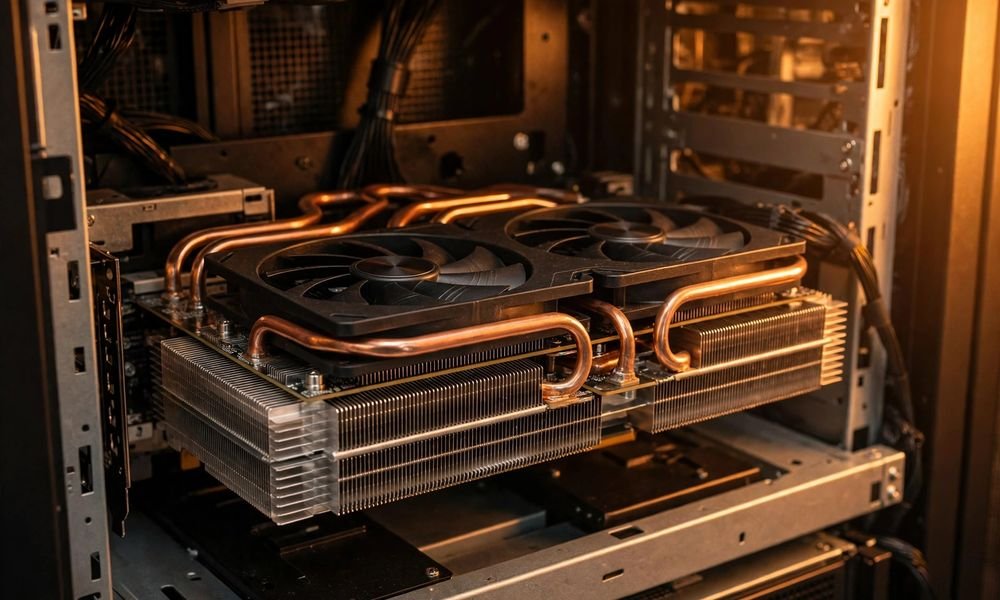
Not all inference workloads cost the same energy per request. A short classification or summarisation call uses far less than a long agentic run that calls the model dozens of times, and a chat service with long conversation histories pays a prefill cost on every turn as the history grows.
Three patterns dominate real energy bills. The first is long outputs: reasoning models and agents that generate thousands of tokens per task can use many times the energy of a single short answer. The second is repeated prefill, where the same long context is processed again on every turn because nothing is cached.
The third is low utilisation, where GPUs sit mostly idle between bursts of traffic but keep drawing power around the clock.
LLM inference energy compared across deployment choices
The table below compares the main deployment choices on energy. No option wins on every axis, and the right choice follows from your traffic pattern.
| Deployment choice | Energy per request | Main energy driver | Best for |
|---|---|---|---|
| Large model, single GPU | High | Full weights read per token | Highest quality, low volume |
| Small or quantised model | Low | Fewer weights, less memory traffic | High volume, latency-sensitive work |
| Large model, batched serving | Moderate | Shared weight reads across requests | Busy services with steady traffic |
| CPU inference, small models | Low per request | Lower power draw, slower throughput | Small models, bursty or edge use |
| Shared cloud endpoint | Moderate | Provider utilisation and overhead | Variable traffic, no hardware to run |
| Dedicated GPUs, low utilisation | High | Idle power with little useful work | Strict isolation or latency needs |
Best for: teams with steady, high-volume traffic, where batching and model choice cut energy per request far more than hardware upgrades alone.
How to reduce LLM inference energy consumption
The most effective step is usually to use a smaller model for the bulk of requests. Many tasks do not need the largest available model, and a well-chosen small model can use a fraction of the energy while answering just as well. Routing is the structured version of this: a small model handles routine requests and only the hard ones go to the large model.
Quantisation is the next lever. Reducing weights from 16-bit to 8-bit or 4-bit precision roughly halves or quarters the memory traffic per token, which is exactly the bottleneck in decode. Accuracy loss is usually small for well-tested quantisation schemes, but it must be measured on your own tasks rather than assumed.
Quantisation techniques vary in how they trade accuracy against size, so test before committing a production workload.
Batching and caching come next. Continuous batching keeps GPUs busy by filling every spare slot with waiting requests, which spreads the fixed power draw across more tokens. Prefix caching avoids reprocessing shared system prompts and retrieved documents on every request.
Both reduce energy per token without changing the model at all.
Finally, manage outputs. Long replies cost energy in direct proportion to their length, so sensible maximum lengths, concise system prompts and early stopping all help. Some teams also find that asking the model for a structured short answer, rather than free-form prose, cuts output tokens substantially on classification and extraction tasks.
Measuring energy per request
You cannot manage what you do not measure, and energy per request is the metric that makes the trade-offs visible. The practical way to get it is to combine GPU power telemetry, available through tools such as nvidia-smi, with request logs that record prompt tokens, output tokens and model name. Dividing total GPU energy over a period by the tokens produced in that period gives a tokens-per-joule figure that can be compared across models and configurations.
Keep the measurement honest. Include the facility overhead by applying your PUE, and include idle periods rather than measuring only during benchmarks, since idle power is part of the real cost. Report energy per request type, because an average across all traffic hides the expensive patterns that deserve attention.
Checklist: cutting inference energy without hurting quality
Work through this list in order, since the early items usually save the most.
- Measure energy per request by request type before changing anything, using GPU telemetry and request logs.
- Route routine requests to a smaller model and reserve the large model for the cases that genuinely need it.
- Test 8-bit and 4-bit quantisation on your own tasks and confirm accuracy before deploying.
- Turn on continuous batching and prefix caching.
- Cap maximum output length and trim system prompts to what the task actually needs.
- Raise utilisation before buying hardware: consolidate quiet services onto shared GPUs.
- Check your facility PUE and cooling, since a poor PUE taxes every other saving.
- Re-measure after each change and keep the comparison on the same request mix.
Frequently asked questions
How much energy does one ChatGPT-style reply use?
There is no single published figure, because it depends on the model, the prompt length, the output length and the hardware. A short reply uses far less than a long agentic run, and the only reliable number for your workload is one you measure yourself.
Does a bigger model always use more energy per request?
Usually, yes, because more parameters mean more memory traffic per token. The exception is when a bigger model answers in far fewer tokens. Measure per task, not per model in isolation.
Is training or inference the bigger energy cost?
Training a large model uses an enormous amount of energy in one burst, but inference runs continuously for every user over the model’s lifetime. For a widely used model, total inference energy eventually exceeds training energy, which is why serving efficiency matters so much.
Does quantisation always save energy?
Almost always in decode, because it cuts the memory traffic that dominates that phase. The saving is smaller in prefill, which is compute-bound. Test on your own tasks before deploying.
What is PUE and why does it matter?
Power usage effectiveness is the ratio of total facility energy to IT equipment energy. A PUE of 1.3 means 30 per cent overhead for cooling and other facility loads. It matters because it multiplies every GPU saving: a 10 per cent GPU saving is worth less where PUE is 2.0 than where it is 1.2.
Can renewable energy make inference carbon-free?
Renewable electricity reduces the carbon associated with inference, but it does not change the energy consumed, and the grid mix varies by location and time of day. Data centre power requirements vary widely by site, so check what your facility actually runs on before making carbon claims.
LLM inference energy consumption is not a fixed cost of doing business with AI. It follows from concrete choices: which model answers, how many tokens it writes, how busy the GPUs are, and how efficiently the facility runs. Measure it per request, fix the biggest waste first, and the savings will show up in the electricity bill and the cost per request.