In-memory computing explained in plain terms: it is a way of building chips that do their calculations inside the memory itself, instead of fetching data from memory to a separate processor, working on it, and sending it back. In short, in-memory computing attacks the oldest problem in computer design, the cost of moving data, by putting the arithmetic where the data already lives.
The problem it solves is large. In a conventional computer, memory and the processor are separate, and most of the energy and much of the time goes on shuttling data between them. For AI workloads the share is higher still, because a neural network must read its weights from memory every time it runs.
This guide explains how in-memory computing works, the different forms it takes, where it is already being used, and what still limits it. The focus is on the practical side: why AI inference is the workload that benefits most, how the technology differs from simply adding more memory, and how to judge the claims made about it.
Key takeaways
- In-memory computing performs calculations inside or next to memory arrays, instead of moving data to a separate processor.
- It attacks the von Neumann bottleneck: the energy and time wasted shuttling data between memory and compute.
- It suits AI inference best, because neural networks must read their weights from memory on every run.
- Forms include SRAM-based designs, analogue crossbars using resistive memory, and near-memory designs such as IBM’s NorthPole.
- Precision, device variation and immature software are the main limits, and the technology is a specialist accelerator, not a replacement for CPUs or GPUs.
The von Neumann bottleneck
Almost every computer built since the 1940s follows the von Neumann architecture, named after mathematician John von Neumann. It separates the processor from the memory, and the two communicate over a bus of limited width. The processor fetches an instruction and its data, executes it, and writes the result back, and it repeats that cycle billions of times a second.
That design worked well when processors and memory were both slow and the bus was not the limiting factor. It works less well now. Processors have become far faster than memory, and the gap keeps growing, so the processor spends much of its time waiting for data to arrive.
AI made the problem worse. A neural network is mostly a long series of multiply-and-accumulate operations, each of which needs a weight read from memory. A large model has billions of weights, and running it means reading all of them, again and again, for every input.
Best for: readers who want the core problem first, since everything else in in-memory computing is a response to it.
How in-memory computing works
The most elegant form is the analogue crossbar. Imagine a grid of wires, with rows carrying input voltages and columns collecting output currents. At each crossing sits a memory device whose electrical conductance stores a weight. When a voltage is applied to a row, the current through each crossing is the voltage multiplied by the conductance, which is exactly a multiplication, and the currents in a column add up, which is exactly an addition.
That means the whole grid performs a matrix-vector multiplication, the core operation of a neural network, in a single step, using the physics of the circuit rather than a long sequence of digital operations. The weights never leave the array, the inputs go in as voltages, and the outputs come out as currents.
Digital in-memory computing takes a different route. It keeps the data in ordinary SRAM memory cells and adds small amounts of logic inside the memory array, so simple operations such as addition or multiplication happen where the data sits. It is less radical than the analogue crossbar, but it is easier to build with standard manufacturing.
Near-memory computing is a third form, and it is less strict about doing the maths inside the memory cells. It places processing units very close to memory, on the same chip or the same package, so the distance data travels is short. IBM’s NorthPole chip, described below, is the best-known example.
The memory technologies behind it
SRAM is the most practical starting point. It is the fast memory used for processor caches, it is built with ordinary transistors, and it is reliable and well understood. SRAM-based in-memory designs add logic to the memory array and are the closest to commercial products, although SRAM cells are large, so an SRAM array holds fewer weights than other options.
Resistive memory, often called ReRAM or memristors, is the most promising device for analogue crossbars. A memristor is a device whose resistance can be set to different levels and stays there without power, so it stores a weight as a conductance and also performs the multiplication. Resistive memory is dense and non-volatile, but individual devices vary and drift over time, which makes accurate, repeatable computation harder.
Phase-change memory, or PCM, stores data in the state of a material switched between a disordered glassy state and an ordered crystalline state.
Best for: engineers weighing which memory technology fits a design, since the choice decides the precision, density and maturity of the result.

IBM NorthPole and other real chips
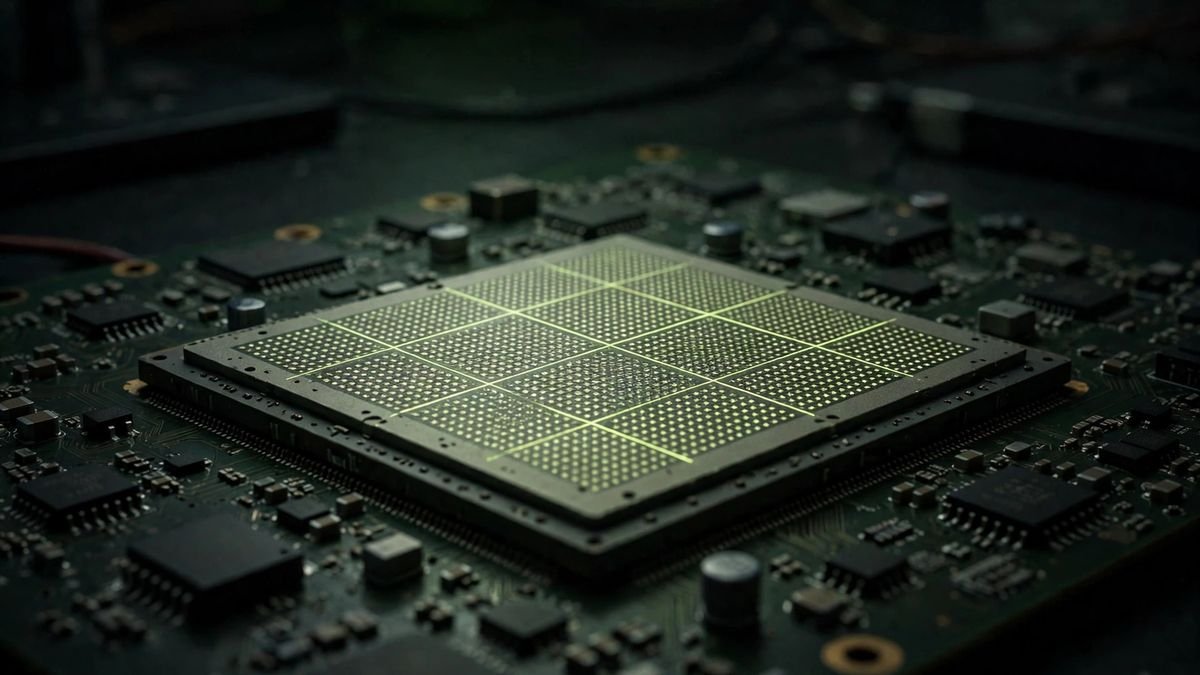
The most concrete demonstration of in-memory computing is IBM’s NorthPole chip, published in Science in 2023. NorthPole intertwines compute with memory on the chip, with 256 cores each holding its own memory, for a total of 224 megabytes of SRAM distributed across the die. It runs image recognition workloads, including ResNet-50, about 22 times faster and with about 25 times less energy than comparable commercial chips built on the same 12-nanometre process.
NorthPole is a proof of concept, not a product, and it has real limits. It is designed for inference, not training, and it cannot easily run the largest models, because its on-chip memory is finite and its precision is limited to 2, 4 and 8 bits.
Other efforts fill out the picture. Startups including Mythic and d-Matrix have built analogue and digital in-memory accelerators for AI inference, aiming at data centres and edge devices. Samsung and TSMC have demonstrated in-memory designs based on MRAM and SRAM, and university labs continue to publish crossbar prototypes using resistive memory.
Best for: readers who want evidence rather than theory, since NorthPole is the clearest proof that the idea works in silicon.
In-memory computing vs conventional computing
| Feature | Conventional computing | In-memory computing |
|---|---|---|
| Where data lives | Separate memory chip | Inside the compute array |
| Data movement | Constant, over a bus | Minimal, weights stay put |
| Energy use | Dominated by moving data | Dominated by the calculation |
| Best operation | General-purpose work | Matrix-vector multiplication |
| Precision | High, exact digital maths | Lower, especially in analogue designs |
| Maturity | Decades of mass production | Emerging, few commercial parts |
The table shows a specialist tool, not a general replacement. A conventional processor can do anything, while an in-memory accelerator does one operation, matrix-vector multiplication, extremely efficiently, and little else. That is why realistic systems pair the two, with the accelerator handling inference and a conventional processor handling everything else. Our guide to how GPU infrastructure actually drives modern AI computing explains the conventional accelerator that dominates AI today, and our guide to matching GPUs to your model covers the hardware that suits training and general AI work.
Where in-memory computing is used today
AI inference at the edge is the clearest use. A camera, a sensor or a wearable that runs a neural network locally needs to do so on a small battery, and reading weights from external memory is the main energy cost. An in-memory accelerator that keeps the weights on chip can run the same model for far less power, which is what makes always-on AI practical in devices that cannot be recharged often.
Data centre inference is a second use, and it is where the money is. Serving AI models to millions of users means running the same weights billions of times, and the energy bill for that is enormous. An accelerator that cuts the energy per inference by a large factor changes the economics of the whole service.
Scientific computing is a third area, although a smaller one. Some workloads in signal processing and optimisation are dominated by matrix operations, and in-memory designs can speed them up.
Best for: AI inference, at the edge and in the data centre, where the same weights are read over and over again.
What still limits in-memory computing
Precision is the first limit. Analogue crossbars are naturally approximate, because device variation, electrical noise and drift all change the result slightly. That is acceptable for many neural networks, which tolerate small errors, but it is a poor fit for work that needs exact answers.
Device variation is the second limit, and it is closely related. No two memristors are exactly alike, and their behaviour changes with temperature, age and use. A design that works in a lab may behave differently in a product, and compensating for that variation needs extra circuitry and careful calibration.
Software is the third limit. Conventional AI has mature frameworks that run on GPUs with a single command, while in-memory accelerators need specialised compilers that map a neural network onto a crossbar or a memory array.
Finally, capacity is a limit. An in-memory accelerator can only hold as many weights as fit in its on-chip memory, and large models do not fit. NorthPole, for example, cannot run the largest language models, and analogue crossbars face the same constraint.
Judging in-memory computing: a practical checklist
- Start from the workload: repeated matrix-vector multiplication, such as AI inference, is the fit, while general computing is not.
- Check whether your model fits in the accelerator’s on-chip memory, since a model that does not fit loses most of the advantage.
- Ask for accuracy figures on your task, not just speed, because analogue designs trade precision for efficiency.
- Compare the energy per inference against a GPU baseline, measured on the same model and the same precision.
- Test the software tools on a real model before committing, since immature compilers are the most common reason projects stall.
- Consider a hybrid system, with an in-memory accelerator for inference and a conventional processor for everything else.
- Watch for commercial availability, since many in-memory designs are still research chips rather than products you can buy.
Frequently asked questions
What is in-memory computing?
In-memory computing is a way of building chips that perform calculations inside the memory itself, instead of fetching data to a separate processor. It reduces the energy and time spent moving data, which is the main cost in modern computing and especially in AI.
What is the von Neumann bottleneck?
The von Neumann bottleneck is the limit imposed by separating memory from the processor. Data must travel between them over a bus of limited width, and that movement costs energy and time. In-memory computing attacks the bottleneck by putting the calculation where the data already lives.
How does in-memory computing help AI?
AI inference is dominated by matrix-vector multiplication, where a neural network’s weights must be read from memory on every run. In-memory computing keeps the weights in the array and does the multiplication there, so the weights never have to travel, which saves energy and time.
What is IBM NorthPole?
NorthPole is a research chip from IBM, published in Science in 2023, that intertwines compute with memory on a single die. It has 256 cores with 224 megabytes of distributed SRAM, and it runs image recognition about 22 times faster and with about 25 times less energy than comparable chips on the same process node.
Is in-memory computing the same as having more RAM?
No. Adding more RAM gives a conventional processor more memory to fetch from, but the data still has to travel to the processor. In-memory computing changes where the calculation happens, so the data does not travel at all, which is a different and larger change.