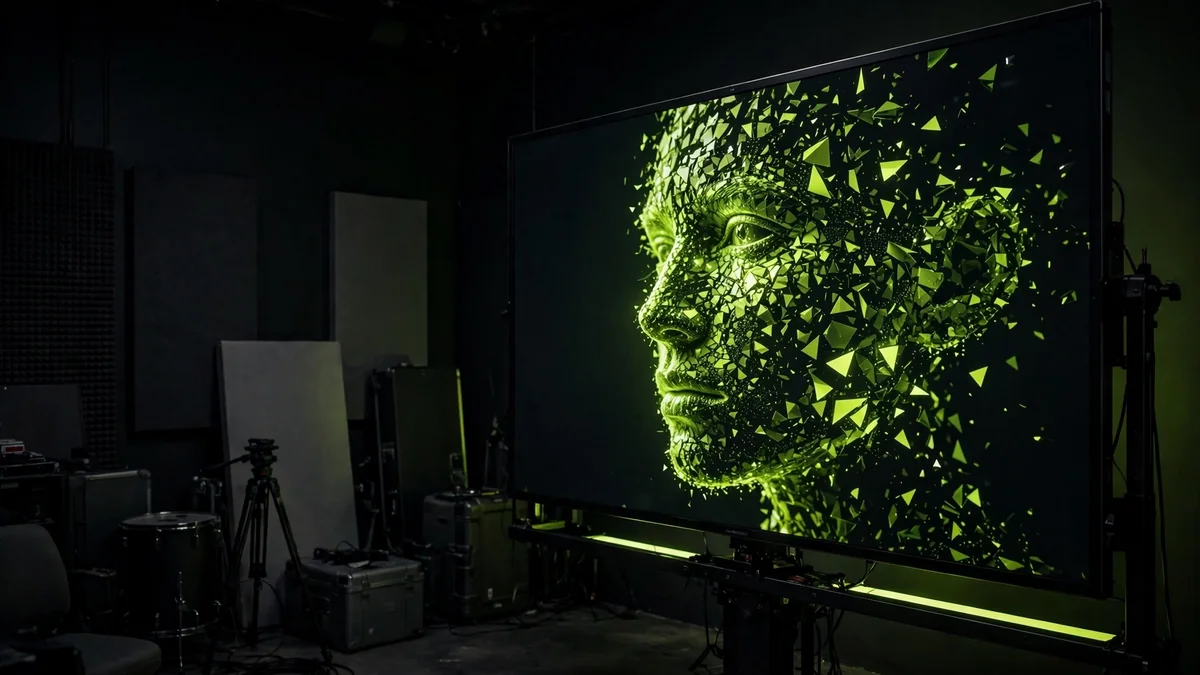
Deepfakes explained in plain terms means video, audio, or images created by artificial intelligence that show a real person doing or saying something they never did. The central question is how a computer can produce a fake so convincing that people believe it, and the short answer is that AI models learn the patterns of a person’s face and voice from many examples, then generate new footage that follows those patterns closely enough to fool the eye and the ear.
Think of a skilled impressionist who studies someone’s voice until they can mimic it well enough to fool a listener over the phone. A deepfake does the same thing with mathematics: it studies hours of footage, learns the shape of a face, the movement of lips, and the tone of a voice, and then performs new lines in that person’s style.
Deepfakes have moved from a curiosity to a serious issue. They appear in scams, where a fake voice convinces an employee to transfer money, in misinformation, where a fake video spreads a false claim, and in harassment, where a person’s face is placed into imagery they never agreed to. Understanding how they work is the first step in spotting them.
Key takeaways
- Deepfakes are AI-generated video, audio, or images of real people.
- They are made by models that learn a person’s face and voice from examples.
- They can be convincing enough to fool people in video calls and recordings.
- Common misuses include scams, misinformation, and non-consensual imagery.
- Detection uses technical clues and verification, not just looking closely.
What deepfakes are
A deepfake is synthetic media created with deep learning, a branch of AI that uses large neural networks. The name combines deep learning with fake. The most common form is face swapping: taking the face of one person and placing it onto the body of another in a video, with expressions and lip movements matched to new words. Voice cloning does the same for sound, producing speech in a person’s voice from a written script.
Early deepfakes needed powerful computers and technical skill, and the results were often easy to spot: odd blinking, blurred edges, or a face that did not quite fit. Modern tools need far less: a few minutes of video or a short voice sample can be enough, and the output is often smooth enough to pass a casual viewing, especially on a small phone screen.
The same technology has legitimate uses. Filmmakers use it to de-age actors or to finish scenes when reshooting is impossible, museums use it to let historical figures speak, and accessibility tools use voice cloning to restore speech for people who have lost theirs. The technology itself is neutral; the harm comes from how it is used.
Our guide to generative AI explains the wider family of AI that creates new images, text, and video. Deepfakes are one of its most controversial applications.
How deepfakes are made
The classic method uses two neural networks working against each other, a setup called a generative adversarial network. One network creates the fake, and the other tries to tell it apart from real footage. Each round, the creator improves, and the detector gets sharper, until the fakes become hard to distinguish from the real thing.
Making a face swap starts with collecting examples: photos and video of the target person from many angles and expressions, and footage of the person whose body and movements will be used. The model learns to map one face onto the other, matching lighting, skin tone, and head movement, and then renders the result frame by frame.
Voice cloning follows a similar pattern. A model studies recordings of a person’s voice, learning its pitch, rhythm, and pronunciation, and then generates new speech from text, in that voice. Short samples can produce a rough copy, while longer samples produce a voice that can fool people who know the person well, especially over a phone call.
Newer methods use diffusion models, the same technology behind AI image generators, to produce video directly from a description or a reference image. These tools are becoming faster and easier to use, which is why deepfakes are appearing more often and in higher quality than ever before.
Comparing deepfakes with traditional editing
| Aspect | Deepfakes | Traditional editing |
|---|---|---|
| How it is made | AI learns and generates new footage | A person cuts and alters existing footage |
| Skill needed | Low, tools do most of the work | High, needs editing expertise |
| What it can show | Someone saying or doing anything | Only what was filmed, rearranged |
| Speed | Minutes to hours | Hours to days for a convincing result |
| Detection | Needs technical analysis | Often visible as cuts or mismatches |
Where deepfakes are used
Scams are the fastest-growing misuse. Criminals clone the voice of a company executive and call an employee with an urgent request to transfer money, or they join a video call as a fake colleague. These attacks work because they exploit trust, not technology, and a familiar voice or face is enough to override caution.
Misinformation is another use. A fake video of a public figure making a false claim can spread widely before anyone checks it, and even after it is debunked, many people remember the claim, not the correction. Elections and breaking news are the most sensitive moments for this kind of abuse.
Non-consensual imagery is the most common harm of all. Faces, often of women, are placed into explicit imagery without consent, causing serious personal damage. Many countries have made this a criminal offence, and platforms are under pressure to remove such content quickly. Our guide to AI in media explains how newsrooms and publishers are learning to verify footage in an age of convincing fakes.
Strengths and limits
The strength of deepfake technology is its realism and accessibility. A convincing fake can be made with modest equipment and a short sample of the target, which puts powerful media manipulation within reach of almost anyone. That same accessibility is what makes the technology so hard to control.
Detection is improving, but it is a race. Detectors look for clues such as unnatural blinking, inconsistent lighting, odd teeth, or traces left by the generation process, and forensic tools can analyse the digital fingerprint of a file. But each improvement in generation removes a clue, and detectors must constantly learn new ones.
Technical fixes are emerging. Content credentials and watermarking let cameras and AI tools mark genuine or generated media at creation, so a video can carry proof of where it came from. These systems help, but only when they are widely adopted, and a determined faker can strip or forge markings.
The most reliable defence is not technical at all: it is verification. A surprising video call should be confirmed through a second channel, an urgent money request should be checked with the person directly, and extraordinary claims should be confirmed by trusted sources before they are believed or shared.
Deepfakes checklist
- Pause before believing or sharing surprising video or audio.
- Verify urgent requests through a second, separate channel.
- Check whether a trusted source has confirmed the claim.
- Look for odd blinking, lighting, or lip movement, but do not rely on it.
- Use reverse image search to see where footage first appeared.
- Be wary of video calls from unfamiliar numbers asking for money.
- Report non-consensual imagery to the platform immediately.
- Support watermarking and content credentials in tools you use.
- Talk to staff and family about voice-clone scams before one arrives.
Frequently asked questions
What is a deepfake?
A deepfake is video, audio, or an image created by AI that shows a real person doing or saying something they never did. AI models learn the person’s face and voice from examples, then generate new footage that follows those patterns.
How can I spot a deepfake?
Look for unnatural blinking, odd lighting, mismatched lip movement, or strange details around the face and hands. But modern deepfakes can be very convincing, so the safest check is verification: confirm the claim through a trusted source or a second channel.
Are deepfakes illegal?
It depends on the use and the country. Creating non-consensual explicit imagery is illegal in many places, and using deepfakes to commit fraud is illegal everywhere. Laws are still catching up with the technology in many countries.
Can deepfakes fool video calls?
Yes. Real-time face swapping and voice cloning can be used live on a video call, and there have been reported cases of criminals joining calls impersonating executives. Unusual requests on a call should always be verified separately.
What is a voice clone?
A voice clone is an AI model trained on recordings of a person’s voice, which can then generate new speech in that voice from written text. Short samples can produce a rough copy, while longer samples sound much more convincing.
Are there legitimate uses for deepfakes?
Yes. Filmmakers use the technology to de-age actors or complete scenes, museums use it to bring historical figures to life, and voice cloning can restore speech for people who have lost the ability to speak.
The bottom line
Deepfakes explained in one line is this: AI that can make anyone appear to say or do anything, convincingly enough to fool people who are not looking carefully.
The technology is not going away, and detection alone will not keep up. The real defence is habit: verify surprising claims, confirm urgent requests through a second channel, and remember that seeing is no longer believing.
This article is general information about how deepfakes work, not advice about how to respond to a particular scam or incident.