Cloud network security architecture is the design of the controls that protect traffic, resources and data inside a cloud network. The central question this guide answers is how to design a cloud network that is secure by construction, rather than one that relies on a single firewall or a hopeful assumption. The short answer is to segment the network into tiers, control every path between them, encrypt traffic in transit, and monitor what actually flows.
Security architecture is different from a list of security products. Products matter, but the architecture is the plan that decides where each control sits, what it protects, and what happens when one of them fails. A good architecture assumes that individual controls will fail and still keeps the damage contained.
It also stays simple enough that a team can understand it, change it and audit it without fear. Our guide to cloud security posture management explains how to keep this architecture checked continuously once it is built.
Key takeaways
- Cloud network security architecture is the plan for how controls protect traffic, resources and data across a cloud network.
- Segment the network into tiers and control every path between them, so a breach in one tier cannot spread freely.
- Apply zero trust: verify every connection, even inside the network, instead of trusting traffic by location.
- Encrypt traffic in transit and at rest, and keep sensitive data in private subnets with no internet route.
- Monitor flows, log decisions and test the design with regular reviews and simulated attacks.
Start from the threat model
Every security architecture should begin with a threat model, which is simply a clear statement of what you are protecting, who might attack it and how. A public web application faces the whole internet and must assume constant probing, while an internal reporting system faces mainly the risk of a compromised credential or a misconfiguration. The controls you need follow from those threats, not from a checklist.
Write the threat model down in plain language: the data that matters most, the systems that hold it, the people and services allowed to reach it, and the attacks you most expect. Revisit it whenever the architecture changes, because a new service or a new connection can introduce a threat the original model never considered.
A threat model that fits on one page and is actually read beats a hundred-page document nobody opens. Best for: teams that have bought security tools without first agreeing on what they are defending against.
Segment the network into tiers
Segmentation is the foundation of cloud network security. Divide the network into tiers, usually public, application and data, and put each workload in the tier that matches its sensitivity. Public subnets hold only load balancers and the gateways that face the internet.
Application subnets hold the servers that run your code. Data subnets hold databases and caches, with no route to the internet at all.
Each tier gets its own subnets in at least two availability zones, its own route table and its own firewall rules. The point of the tiers is containment: if an attacker compromises a web server, they should find themselves in a public subnet with no direct path to the database, not on a flat network where every resource can reach every other.
Our cloud networking tutorial shows how to build this tiered layout in practice. Best for: anyone designing a network where the most sensitive data must survive the compromise of a less sensitive system.
Apply zero trust inside the network
Zero trust is the idea that no traffic is trusted simply because it comes from inside the network. Traditional designs trusted everything behind the perimeter and inspected only traffic crossing it.
That approach fails in the cloud, where the perimeter is porous and much of the traffic never crosses an edge at all. Zero trust replaces location-based trust with identity-based verification: every connection is authenticated and authorised, wherever it starts.
In practice this means mutual TLS between services, so that each service proves its identity to the other before any data flows. It means identity-aware access controls rather than broad network allowances, and it means treating a compromised internal server as an expected event rather than an impossible one.
Zero trust does not mean abandoning the perimeter; it means adding verification inside it. Best for: teams whose applications talk to each other across services and need each connection verified, not just the front door.
Control the paths between tiers
Every path between tiers is a decision, and the architecture should make each one explicit. The load balancer may reach the application tier on one port, the application tier may reach the database on one port, and nothing else crosses at all. Those allowances should be written as narrow firewall rules that reference security groups rather than IP addresses, so they survive address changes.
Resist the temptation to open broad ranges between tiers for convenience, because a broad allowance is a broad attack path. When a new connection is needed, add it deliberately, document why, and review it later.
A network where every path is known and justified is a network that can be audited, and an audit that finds nothing unexpected is the sign the architecture is working. Best for: architects who need to prove, not just claim, that the database is unreachable from the internet.
| Security layer | What it controls | Where it sits | Failure it contains |
|---|---|---|---|
| Network firewall | Traffic at the network boundary | Edge of the virtual network | Unwanted traffic entering the network |
| Subnet access control list | Traffic at the subnet boundary | Between tiers | A compromised tier reaching the next tier |
| Security group | Traffic at the resource | Each server or service | Lateral movement between resources |
| Identity and encryption | Who may connect, and whether traffic is readable | Every connection | Stolen credentials and intercepted traffic |
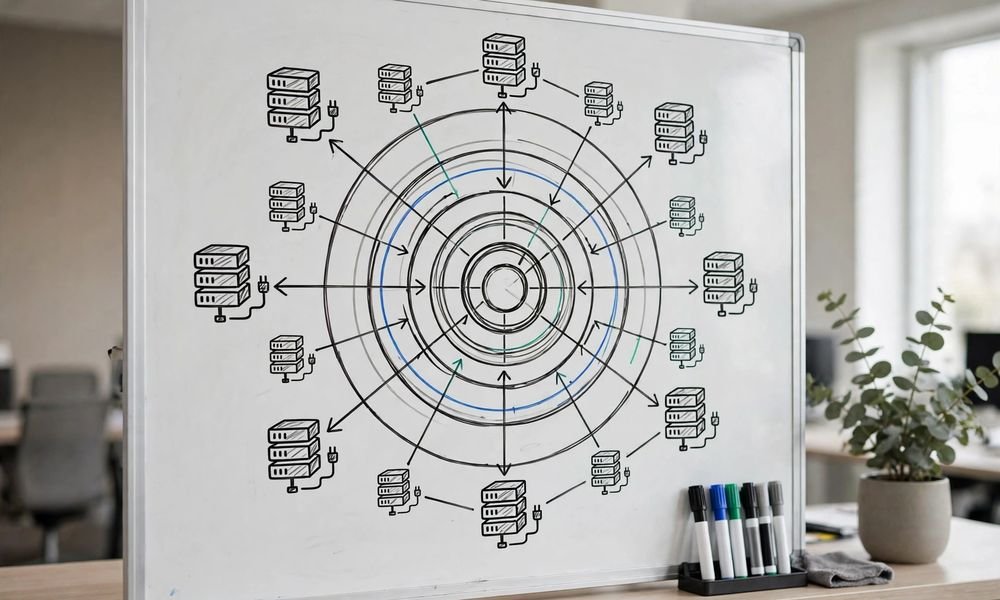
The table shows defence in depth in one view. Each layer controls a different boundary, and each contains a different kind of failure.
An attacker who gets past the network firewall still faces the subnet controls, and one who gets past those still faces security groups and identity checks. No single layer carries the whole job.
Encrypt traffic in transit and at rest
Encryption is a core part of the architecture, not an optional extra. Use TLS for traffic between services and for traffic from users, and keep certificates current and automated so that expiry never becomes an outage. Inside the cloud, use private connections for traffic between services where the provider offers them, so that sensitive traffic does not cross the public internet at all.
Encrypt data at rest as well, using the provider’s managed encryption for storage and databases, and keep the encryption keys under your control with a key management service. Separate the keys from the data they protect, and limit who can use them, because encryption that anyone can undo is not protection. Best for: teams handling regulated or sensitive data where encryption is both a control and a compliance requirement.
Protect the management plane
The management plane, the console and APIs that control your cloud account, is the most powerful attack target in the whole architecture. An attacker who gains administrative access does not need to break through your network at all. Protect it accordingly: require multi-factor authentication for every human account, use short-lived credentials for automation, and give each person and each service only the permissions it needs.
Separate administrative access from everyday access, and keep audit logging enabled on every management action so that you can see who changed what and when. Review privileged accounts regularly and remove any that are no longer needed.
The network architecture can be perfect and still fail if the keys to the whole account are poorly guarded. Best for: any team that has focused on network controls while the cloud console sits protected by a single password.
Monitor flows and detect anomalies
A security architecture needs eyes. Enable flow logs to record which connections were allowed and which were blocked, and send them to a central store where they are kept long enough to investigate. Add intrusion detection where it fits, and set alerts for the patterns that matter: traffic to unexpected destinations, connections from unusual locations, and sudden changes in volume.
Monitoring is only useful if someone looks at it, so assign ownership of the alerts and practise responding to them. A detection that nobody acts on is worse than no detection, because it creates a false sense of safety.
Review the logs after every architecture change, since a change that looks right on paper sometimes opens a path nobody intended. Best for: operations teams who need to find an intrusion while it is happening, not weeks later.
Checklist: review the architecture before you trust it
- A written threat model names the data that matters, the systems that hold it and the attacks expected.
- The network is segmented into public, application and data tiers, each with its own subnets and route tables.
- Every path between tiers is narrow, explicit and documented, with no broad allowances.
- Services authenticate each other with mutual TLS or identity-aware controls, not by network location.
- Traffic is encrypted in transit and at rest, with keys managed separately from the data.
- The management plane requires multi-factor authentication and least-privilege access.
- Flow logs are enabled, stored centrally and monitored, with alerts on unusual patterns.
- The design is reviewed regularly and tested with simulated attacks.
Frequently asked questions
What is cloud network security architecture?
It is the design of the controls that protect traffic, resources and data inside a cloud network. It covers segmentation, firewall layers, identity, encryption and monitoring, and how they fit together so that a failure in one control does not expose everything.
What is zero trust in cloud networking?
Zero trust means no connection is trusted just because it starts inside the network. Every connection is authenticated and authorised based on identity, so a compromised server inside the network cannot move freely. It replaces location-based trust with verification at every step.
How many network tiers should a cloud architecture have?
Three is the usual starting point: public, application and data. The public tier faces the internet, the application tier runs your code, and the data tier holds databases with no internet route. Larger systems sometimes add a shared-services tier for logging and monitoring.
Is a firewall enough to secure a cloud network?
No. A firewall is one layer. A secure architecture also needs segmentation, identity controls, encryption and monitoring, because a firewall cannot fix a weak credential, an unpatched application or a misconfiguration elsewhere.
What is the biggest cloud network security mistake?
Putting sensitive resources on a flat network where every resource can reach every other, or opening a sensitive port to the whole internet. Both mistakes turn a single compromise into a full breach, and both are prevented by segmentation and default-deny rules.
How often should a cloud security architecture be reviewed?
At least twice a year, and after any major change such as a new service, a new connection or an incident. Architecture reviews should test the design against the current threat model, not just confirm that the old design is still in place.