AI in healthcare explained in plain terms means software that learns patterns from medical data and uses them to support doctors, nurses, researchers and patients. It does not replace clinical judgement. It reads scans, flags risks, drafts notes and searches research, while a qualified clinician stays responsible for every decision that affects a patient.
The central question is where AI genuinely helps in medicine, and where you should stay sceptical. The honest answer is that AI is strongest as a second pair of eyes and a tireless assistant. It is weakest wherever the data is thin, biased or out of date, and wherever a decision needs empathy, context or accountability that only a human can provide.
Key takeaways
- AI in healthcare supports diagnosis, imaging, drug discovery, administration and patient care, but it does not replace clinicians.
- Its value comes from pattern recognition at scale, not from understanding medicine the way a doctor does.
- Evidence quality varies widely, so ask whether a tool was tested on patients like you, in settings like yours.
- Privacy, bias and accountability are the real limits, and they matter as much as accuracy.
What AI in healthcare actually is
Most medical AI is narrow, which means it does one job well rather than understanding medicine in general. A system trained to spot signs of disease on chest images will not also plan a treatment course, and a language model that drafts a clinic letter does not examine patients. Keeping that distinction in mind prevents most misunderstandings about what these tools can do.
The common methods are machine learning, deep learning and natural language processing. Machine learning finds patterns in structured records such as blood results and vital signs. Deep learning, built on layered networks, is often used for images and scans, while natural language processing reads and writes text, which makes it useful for summarising notes and searching guidelines. None of these methods reasons the way a clinician does. They match patterns in the data they were trained on, so when that data is broad, recent and representative the results can be impressive, and when it is narrow or skewed the system can be confidently wrong.
How AI helps with diagnosis
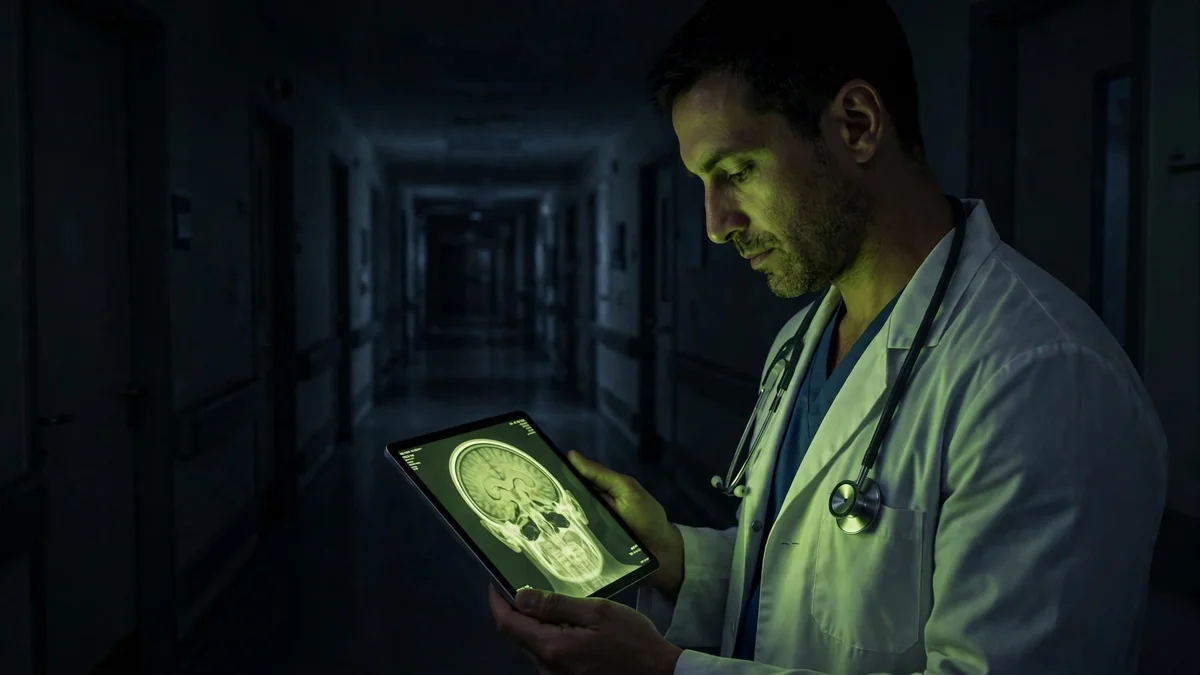
AI tools can review images, laboratory results and medical histories far faster than a person, and highlight findings that deserve a closer look. In radiology, software can mark a suspicious area on a scan so the radiologist examines it first. In pathology, it can scan tissue samples and draw attention to regions that look abnormal, and it can also sort referrals by urgency and suggest which tests are most useful.
The key point is that these tools assist rather than decide. A radiologist still reviews the scan, weighs the patient history and signs the report, and a flagged finding is a prompt, not a verdict. That workflow, often called human-in-the-loop, is the standard in serious clinical use. Used well, it reduces delays and missed clues. Used badly, with too many false alarms, it creates extra work and alert fatigue, so hospitals watch closely how often a system is right and how often it cries wolf.
AI in medical imaging
Imaging is the most mature clinical use of AI, largely because scans are digital, plentiful and standardised. Modern systems can segment organs, measure changes over time and compare a new scan with earlier ones from the same patient. That helps clinicians track whether a condition is stable, improving or getting worse, and makes measurements more consistent between different readers.
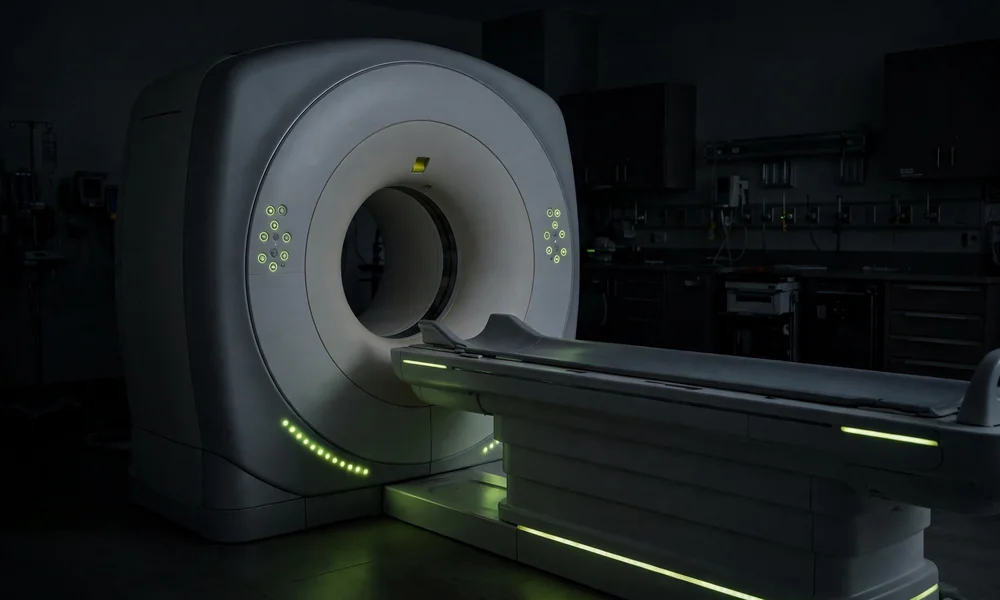
Imaging AI is also used to speed up scans, reconstructing clearer images from less data. Shorter scans are easier for patients, especially children and people who find enclosed scanners distressing, and they free up scanner time for others. As with diagnosis, the image is only part of the story, and the clinical report still comes from a qualified professional who knows the patient.
AI in drug discovery and research
Developing a new medicine is slow and expensive, and AI is changing the early stages of that work. Researchers use it to sift through vast libraries of molecules, predict how a compound might behave and identify promising candidates for laboratory testing. It can also analyse genetic and protein data to suggest which biological targets are most worth pursuing for a particular disease.
That does not mean new drugs arrive overnight. A candidate found by software still needs laboratory work and staged human trials that take years. What AI offers is a better starting point: fewer dead ends, faster screening and a clearer sense of which ideas deserve the costly work that follows. It can also match patients to suitable clinical trials and help researchers spot patterns across thousands of records, which is particularly valuable for rare diseases, where cases are scattered across many hospitals.
AI in patient care and everyday practice
Much of AI in healthcare is about the daily work of looking after patients. Remote monitoring tools can track heart rate, blood pressure, blood sugar and movement, then alert a care team when something changes. For people with long-term conditions, that can mean earlier intervention and fewer emergency visits, provided the alerts are tuned well and someone is actually watching them.
Chat-based tools answer routine questions, help patients book appointments, explain how to prepare for a procedure and remind them to take medication. They work best for straightforward, well-defined tasks, and are not a substitute for speaking to a clinician about new symptoms, worsening pain or anything that feels urgent.
What the evidence does and does not show
The evidence for AI in healthcare is uneven, and that is worth stating plainly. Some imaging tools have been tested in large studies and in routine practice. Others have only been tested on archived data, which is a much weaker test, because a system that performs well on old scans may behave differently on new patients in a busy clinic. Before trusting a claim, ask whether the tool was tested prospectively, on patients like those it will serve, and whether the results were published for independent scrutiny.
Regulators in several countries now review AI medical tools before they can be marketed for clinical use, classifying them according to risk. Approval is a floor rather than a guarantee: it means the tool met the standard for its stated use, not that it is right for every patient. The strongest evidence measures outcomes that matter to patients, such as earlier treatment, rather than accuracy alone.
The limits: bias, privacy and accountability
Bias is one of the most serious limits. If a system is trained mainly on data from one group of patients, it may perform worse for others, for example people of a different age, ethnicity or sex, or people whose conditions present differently. That is a known failure mode, not a theoretical concern, and it is why testing across diverse patient groups is essential before a tool is used widely.
Privacy is the second limit. Medical AI needs large amounts of sensitive data, and patients deserve to know how their information is used and protected. Strong safeguards include removing identifying details where possible and keeping clear audit trails. A data breach response plan matters here too, because health records are among the most sensitive data any organisation holds. Accountability is the third limit: current practice places responsibility with the clinician who acts on the output, which is one reason clinicians must understand a tool well enough to question it.
AI in healthcare compared with other uses
| Use | What it does | Main strength | Main risk |
|---|---|---|---|
| Imaging support | Highlights findings on scans | Consistent, fast review | False alarms and missed cases |
| Diagnosis support | Suggests conditions and tests | Spots patterns humans miss | Over-reliance on suggestions |
| Drug discovery | Screens molecules and targets | Faster early research | Candidates still fail trials |
| Patient monitoring | Tracks signs and alerts teams | Earlier warning of change | Alert fatigue from noisy data |
| Administration | Drafts notes and schedules care | Less paperwork for clinicians | Errors slipping into records |
| Patient chat tools | Answers routine questions | Available around the clock | Unsuitable for urgent symptoms |
The table shows why a single verdict on medical AI makes little sense. Imaging support and administration are already useful in routine practice, while drug discovery is promising but slow to reach patients. The right question is always about a specific tool, a specific job and a specific group of patients, and a guide to Perplexity shows how general answer engines differ from tools built for clinical use.
A practical checklist before trusting an AI health tool
- Check that the tool is approved or cleared for its stated clinical use in your country, and that the approval covers your situation.
- Ask whether it was tested prospectively on patients similar to you, in a setting similar to yours.
- Confirm that a qualified clinician reviews its output before any decision is made.
- Find out what data it uses, how your information is protected and whether you can opt out.
- Ask how the provider monitors accuracy over time and what happens when the tool makes a mistake.
- Be wary of tools that promise a diagnosis from a single symptom or a single photo, with no clinician involved.
Frequently asked questions
Can AI diagnose illness on its own?
No. AI can highlight patterns and suggest possibilities, but a diagnosis requires a clinician who can examine the patient, order tests and take responsibility for the decision. Consumer apps that offer a diagnosis should be treated as information only.
Is AI in healthcare safe?
It can be safe when it is properly tested, approved for its stated use and overseen by clinicians who check its output. Safety depends on the specific tool, the patients it serves and how it is monitored after deployment, so a general claim of safety means little without that detail.
Will AI replace doctors?
There is no realistic prospect of AI replacing doctors in the near term. It can take over routine analysis and paperwork, but diagnosis, treatment planning and care all require judgement, communication and accountability that software does not have.
How is my medical data used by AI tools?
It depends on the tool and the health system. Data may be used to provide your care, to improve the service or, in some cases, for research, usually with identifying details removed. Ask the provider for a clear explanation and check whether you can opt out of secondary uses.
Why do AI tools sometimes perform worse for some patients?
Because they learn from the data they were trained on. If that data under-represents a group, the system may be less accurate for people in that group. Testing across diverse populations and monitoring performance after deployment are the main safeguards.
Should I trust an AI symptom checker?
Use it as a starting point for a conversation with a clinician, not as a final answer. It can help you describe symptoms and decide whether to seek care, but it cannot examine you or rule out serious conditions.
The bottom line
AI in healthcare is best understood as a powerful assistant with clear limits. It reads images quickly, sifts research, drafts paperwork and watches for changes that a busy team might miss. It does not understand patients, take responsibility or replace the judgement that sits at the heart of medicine.
The tools worth trusting are the ones that have been tested on real patients, that keep a clinician in charge and that are honest about their limits. The claims worth doubting promise certainty, speed without oversight or a diagnosis from a single input.
This article is general information about AI in healthcare, not medical advice. If you have a health concern, speak to a qualified clinician, and seek urgent care if symptoms are severe or worsening.