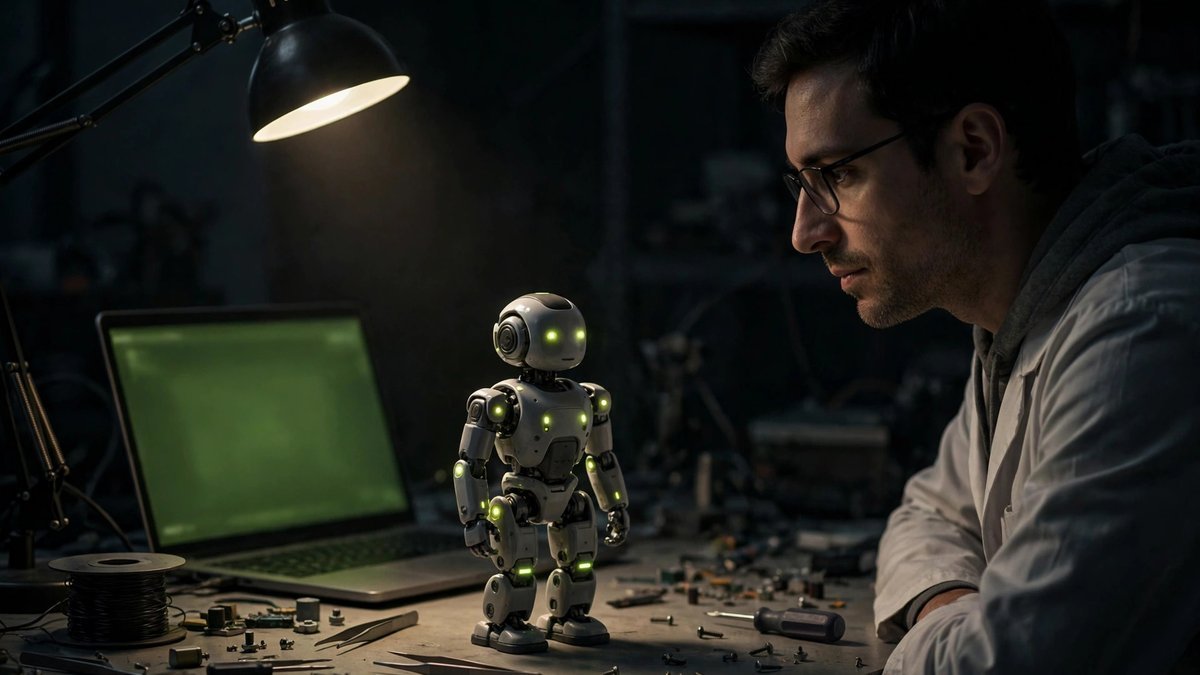
AI and robotics in 2027 will be defined by a split: software intelligence is advancing fast, while physical robots improve more slowly and stay in controlled environments. The central question is what machines will actually do for work in 2027. The answer is that AI will handle more of the thinking — drafting, triage, analysis and coordination — while robots handle more of the moving, but only for narrow, repeatable tasks in factories and warehouses.
That split matters because the two fields are often talked about as one. They are not. AI improves at the speed of software, with new models arriving in months. Robots improve at the speed of hardware, with each generation taking years to design, test and manufacture. Understanding the difference is the key to judging every claim you will hear about 2027.
Key takeaways
- AI and robotics in 2027 combine fast-moving AI software with slower-moving physical robots.
- AI agents will do more office work — drafting, triage and coordination — with human oversight for consequential decisions.
- Humanoid robots will work in factories and warehouses on single tasks, not as general-purpose home helpers.
- Robot vision, grasping and safety systems are the bottlenecks that decide which deployments succeed.
- The practical test for any 2027 claim is paid deployment on a measurable task, not a demonstration video.
AI in 2027: agents do the routine work
The most important AI development for 2027 is not a smarter chatbot but the spread of agents — systems that can plan and carry out multi-step tasks using tools, files and other software. An agent can draft a report from several sources, check it against internal data, send it for approval and file the result, all without a person driving each step. That capability already exists; in 2027 it becomes ordinary.
What changes is the management around it. Organisations will need to decide what agents may do without asking, what needs human approval, and how their work is audited. The early adopters learned that an agent with broad access and no limits is a risk, not a benefit. Expect agent governance — permissions, logging and approval policies — to become a standard part of IT, much as user permissions are today.
Best for: teams with repetitive, well-documented workflows where an agent’s output can be checked quickly, such as support triage, document processing and internal knowledge search.
Robotics in 2027: narrow jobs, real value
Physical robots in 2027 will be most visible where the work is repetitive and the environment controlled. Warehouses are the clearest example: robots that move totes, sort parcels and load machines already work alongside people, and their numbers will grow. Agility Robotics’ Digit moves totes at logistics operators including GXO, and Figure’s robots work at BMW’s Spartanburg plant, handling parts in production and logistics roles.
Humanoid robots attract the most attention because they look like us, but their advantage is practical, not theatrical: the world is built for the human body, so a human-shaped robot can use existing stairs, doors and workstations. That matters in factories and warehouses designed around people. It does not yet make a home robot practical, because homes are far less structured than factories.
The honest picture is that 2027 robotics is a story of small fleets doing single tasks, not of general-purpose machines. A robot that sorts parts for one shift, reliably, is more valuable than a robot that can do ten things badly. Judge every announcement by that standard.
Where AI meets the robot: vision and grasping
The meeting point of AI and robotics is perception: a robot that can see, understand and handle the physical world. Vision systems have improved rapidly, with cameras and AI models that can identify objects, judge distances and track movement in real time. That is why modern warehouse robots can pick items from a bin that is never arranged the same way twice.
Grasping remains harder. A human hand can pick up a glass, a cable or a soft package without thinking; a robot gripper must be told, or must learn, how much force to use and where to hold. Progress is real — tactile sensors and learned grasping policies are improving — but dexterous manipulation is still the main limit on what robots can do. Expect steady gains in 2027, not a sudden breakthrough.
Our guide to robot vision systems explained covers how machines see, and our guide to AI robots in warehouses shows where the technology is already earning its keep.

Safety: the requirement that decides everything
A robot that works beside people must be safe, and safety is the requirement that most limits how fast robotics can spread. Industrial robots traditionally worked behind fences; the new generation works alongside people, which means it must detect them, slow down, and stop before contact. Standards exist for this, and they are strict for good reason: a heavy machine moving at speed can injure someone before they can react.
AI adds a new safety question. A robot that learns from experience may behave differently from the robot that was tested, so the safety case has to cover not just the machine as delivered but how it changes. That is why deployments proceed in stages — a fenced pilot, then a shared space with limits, then wider use — and why regulators and insurers are paying close attention.
Best for: organisations that can start with a contained pilot, measure safety and reliability over months, and expand only when the evidence supports it. For the safety framework, see our AI robotics safety guide.
Jobs, skills and the human side
The question people ask most about AI and robotics in 2027 is what happens to jobs. The honest answer is that the effect is uneven. Repetitive physical and clerical tasks are the most automatable, and the people who do them will feel the change first. But most jobs are bundles of tasks, and automating some of them changes the job rather than eliminating it. A warehouse worker who no longer carries totes all day may instead supervise robots, handle exceptions and maintain equipment.
The skills that gain value are the ones machines lack: judgement in ambiguous situations, handling the unexpected, working with people, and knowing when a system’s output is wrong. Organisations that invest in retraining their staff alongside their automation will do better than those that treat people as a cost to be removed. The history of automation is clear on this point: the firms that combine machines with skilled people outperform those that simply cut headcount.
| Area | What AI and robotics will do in 2027 | What they will not do | How to judge progress |
|---|---|---|---|
| Office work | Draft, triage, summarise and coordinate routine tasks | Replace judgement on novel or high-stakes decisions | Time saved on measurable tasks, with quality checked |
| Warehouses | Move, sort and load on fixed routes and single tasks | Handle unpredictable layouts without human help | Units in paid, sustained deployment |
| Manufacturing | Parts handling, inspection and machine tending | Reconfigure themselves for new products unaided | Uptime and defect rates over months |
| Healthcare | Assist with logistics, documentation and imaging support | Replace clinical judgement or hands-on care | Regulatory approval and clinical evidence |
| Homes | Improve in vacuuming, mowing and single-purpose devices | Act as general-purpose household helpers | Products sold at scale, not demos |
How to evaluate AI and robotics in 2027
The market for AI and robotics in 2027 will be noisy, with impressive demonstrations and bold claims. A simple framework helps separate substance from showmanship. First, ask what the system does on a specific task, measured over weeks, not minutes. Second, ask what happens when it fails — who notices, what breaks, and how quickly it recovers. Third, ask what it costs in full: purchase, integration, maintenance, training and supervision.
Fourth, and most important, ask for a reference deployment: a named customer, doing real work, willing to say so. The robotics companies with the strongest positions in 2027 will be those that can point to such deployments. The AI vendors with the strongest positions will be those whose agents work reliably inside a customer’s systems, not only in a demo environment. Our guide to robotics and AI explained gives a broader view of how the two fields fit together.
- Define one measurable task before buying anything, and insist on a pilot against it.
- Measure reliability over weeks, including failure rates and recovery time.
- Count the full cost: integration, maintenance, training and supervision.
- Keep a human in the loop for consequential decisions, especially in AI agents.
- Start safety work early, with staged deployment from fenced pilot to shared space.
- Ask for named reference deployments doing real, paid work.
- Invest in retraining staff alongside automation, so people move to higher-value work.
Frequently asked questions
Will robots take warehouse jobs in 2027?
Some tasks will be automated, particularly moving and sorting. But warehouses still need people for exceptions, maintenance, supervision and work the robots cannot do. The role changes more than it disappears.
What is the difference between AI and robotics?
AI is software intelligence: understanding language, images and data, and making decisions. Robotics is the physical side: machines that move and manipulate the world. They overlap where AI gives robots perception and judgement.
Are humanoid robots ready for homes?
No. Homes are unstructured and unpredictable, and no current humanoid handles that reliably. Industrial and warehouse settings, where tasks repeat and the environment is controlled, are where they work today.
How do I start with AI agents safely?
Pick one narrow, measurable task, give the agent limited permissions, require human approval for consequential actions, and log everything. Expand only when the pilot proves reliable.
What limits robot progress most?
Dexterous manipulation — grasping varied objects reliably — and safety certification for working alongside people. Both are improving steadily, but neither will be solved overnight.
Should a small business invest in AI and robotics in 2027?
In AI, yes, for specific tasks such as drafting, triage and customer support, where the cost is low and the benefit measurable. In physical robotics, probably not yet, unless a clear, repetitive task and a proven product exist.