NFC explained in plain terms means a short-range wireless technology that lets two devices exchange a small amount of data simply by being held close together, usually within a few centimetres. The central question is why such a tiny range is a feature rather than a flaw, and the short answer is intent: a tap is a deliberate act, and the short range makes accidental connections almost impossible.
Think of a handshake instead of a shout. Bluetooth shouts across a room, and anyone nearby can hear it. NFC shakes hands, quietly, at arm’s length, and only with the person standing in front of you. That intimacy is what makes it safe for payments.
NFC stands for Near Field Communication, and it grew out of the contactless smart cards used in transport and access systems in the 1990s. It was standardised in 2003, built into phones from around 2010, and it became ordinary the day tap-to-pay arrived at the checkout.
Key takeaways
- NFC is a short-range wireless technology, working over a few centimetres.
- It lets devices exchange small amounts of data with a simple tap.
- It powers contactless payments, transit cards, and phone pairing.
- It can work passively: a tag needs no battery of its own.
- Its short range is a security feature, not a limitation.
What NFC is
NFC is a set of wireless standards for communication over a distance of about four centimetres, at the radio frequency of 13.56 MHz. It is slow by modern standards, transferring data at up to 424 kilobits per second, but speed is not the point: NFC moves tiny pieces of information, a card number, a web address, a pairing key, and it moves them instantly.
It works in three modes. In card emulation mode, a phone pretends to be a contactless card, which is how tap-to-pay works: the terminal thinks it is talking to a bank card, and the phone answers as one. In reader mode, the phone reads passive tags, small stickers or cards that hold a little data. In peer-to-peer mode, two powered devices exchange data directly, which is how phones once shared photos with a tap.
The clever part is the passive tag. A tag has no battery: it is a tiny chip and an antenna printed on a sticker, and when a phone’s NFC field reaches it, the field itself powers the chip, which wakes up and answers. That is why a transit card works without charging, and why a poster can carry a link that any passing phone can read.
NFC is built on older radio-frequency identification, RFID, but it is a two-way conversation rather than a one-way broadcast, and it is standardised so that any NFC phone works with any NFC terminal or tag. That universality is why it succeeded where earlier contactless systems stayed local. Our guide to the Internet of Things explains the connected devices that depend on NFC taps every day, from door locks to payment terminals, and how they fit into the wider world of wireless things.
How NFC works
It begins with a magnetic field. When an NFC device is active, it generates a small alternating field around its antenna, extending only a few centimetres. A passive tag entering that field draws power from it through induction, the same principle as a wireless charger, and the chip wakes with just enough energy to reply.
The reply is a conversation in tiny steps. The reader sends a command, the tag answers, and the two exchange a few dozen bytes: an identifier, a small payload, perhaps a web address or a payment token. The whole exchange takes a fraction of a second, which is why a tap feels instant at a checkout.
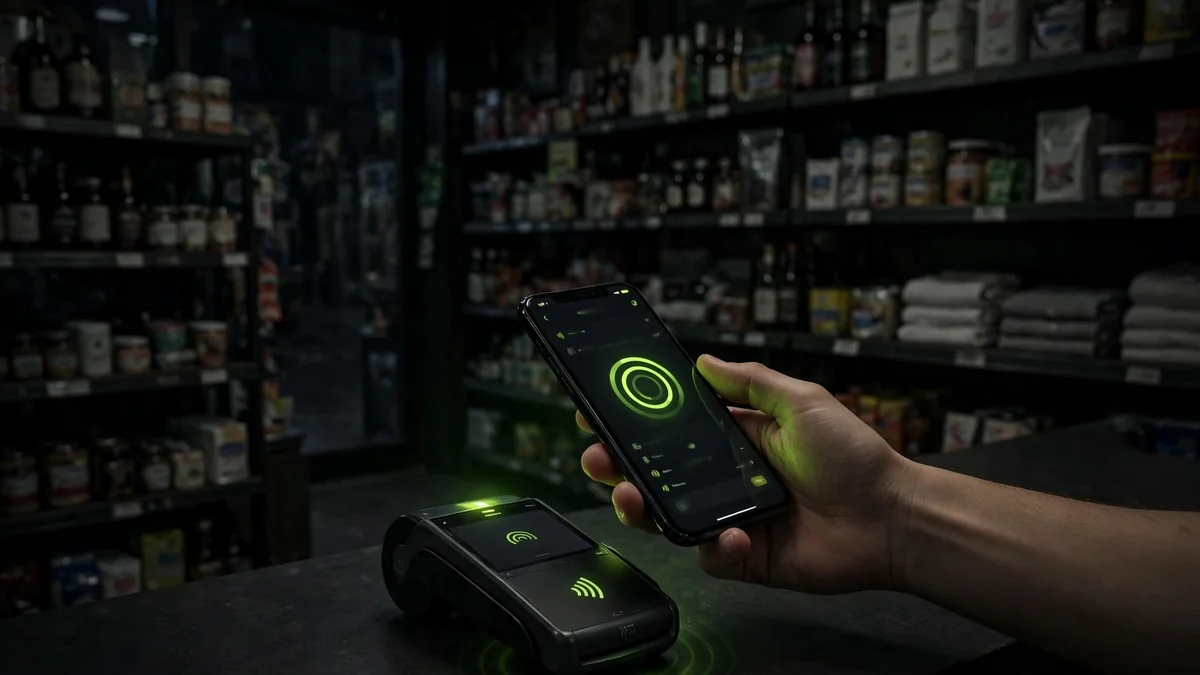
For payments, the phone adds a layer of protection. It does not hand over the real card number; instead, it uses tokenisation, sending a one-time code that stands in for the card, and the payment is authorised only after the phone confirms the owner’s identity, with a fingerprint, a face, or a PIN. A stolen phone cannot pay without that check, and a skimmed token cannot be reused.
For tags, the data is simpler. A tag can hold a web address, a Wi-Fi password, or a short instruction, and a phone that taps it acts on it immediately: opening a page, joining a network, or launching an app. Museums use tags beside exhibits, shops use them on shelves, and hotels use them as room keys, all for the same reason: a tap is the simplest interface there is. Our guide to 5G explains the longer-range mobile technology that NFC is often paired with, where NFC handles the tap and the mobile network carries everything after it.

Comparing NFC with Bluetooth and QR codes
| Aspect | QR code | Bluetooth | NFC |
|---|---|---|---|
| Range | Line of sight | Up to 100 metres | A few centimetres |
| Setup | Open camera, scan | Pair once, then connect | Just tap |
| Power needed | None, printed | Battery on both sides | Tag needs none |
| Data rate | Tiny, a link | Fast, for audio and files | Slow, for small exchanges |
| Best for | Menus and links | Headphones and speakers | Payments, tickets, pairing |
Where NFC is used
Contactless payment is its defining use. Tapping a phone or a card at a terminal has replaced cash and chip-and-PIN for small purchases in much of the world, and the pandemic accelerated it everywhere. The same tap unlocks transit gates, from London’s Underground to buses in dozens of cities, with the phone acting as the ticket.
Access control is the older use that never went away. Office badges, hotel keys, and gym passes are NFC cards or tags, and a phone can now carry the same credential, so a lost badge is replaced by an app instead of a trip to reception.
Pairing is the quiet helper. Tapping a phone to a speaker, a pair of headphones, or a printer passes the Bluetooth pairing details in an instant, sparing the user the usual menu hunt. The NFC tap does the introduction, and Bluetooth carries the conversation.
Tags are spreading into everyday objects. A tag on a medicine bottle can open instructions, a tag on a wine bottle can prove it is genuine, and a tag on a museum exhibit can offer an audio guide. Because a tag costs pennies and needs no power, it can be stuck almost anywhere.
Strengths and limits
The greatest strength of NFC is its simplicity. There is nothing to set up, no menu to find, and no pairing code to type: hold the phone near the thing, and it works. That simplicity is why it succeeded at checkouts, where every second of friction costs sales.
Its short range is also a security strength. An attacker would have to stand within centimetres to intercept a transaction, and the payment itself is tokenised and requires the owner’s biometric check. Skimming a contactless card from across the street, a common fear, is not how the technology works.
Its limits are range and speed. NFC cannot stream music, transfer a photo album, or connect across a room, and it was never meant to. It is an introducer, not a carrier, and it hands off to Bluetooth or Wi-Fi for anything larger.
Adoption is uneven too. Not every phone has NFC, and not every terminal accepts it, though both gaps are closing. In some countries, tap-to-pay is universal; in others, it is still arriving, and the experience depends on where you stand.
NFC checklist
- Use NFC for the tap, then hand off to Bluetooth or Wi-Fi for real data.
- Keep payment tokens tokenised: never send a real card number.
- Require a biometric or PIN check before any payment is authorised.
- Test tags with the phones your audience actually uses.
- Keep tag payloads small and simple: a link or an identifier, not a file.
- Place tags where a phone can comfortably reach them.
- Remember tags can be rewritten: lock them if the data must not change.
- Check transit and payment support before promising tap-to-pay.
- Plan for phones without NFC: always offer a fallback.
Frequently asked questions
What is NFC?
NFC, or Near Field Communication, is a short-range wireless technology that lets two devices exchange small amounts of data by being held within a few centimetres of each other. It powers contactless payments, transit cards, and tap-to-pair.
How is NFC different from Bluetooth?
Bluetooth works across a room and carries fast data such as audio. NFC works over a few centimetres and carries tiny exchanges, such as a payment token or pairing details. The two often work together: NFC makes the introduction, Bluetooth carries the conversation.
Is tap-to-pay safe?
Yes, when used as designed. The phone sends a one-time token instead of the real card number, the payment needs a fingerprint, face, or PIN, and the range is so short that interception would require standing almost against the terminal.
What is an NFC tag?
An NFC tag is a small chip and antenna, often printed on a sticker, that holds a little data and needs no battery. A phone’s NFC field powers it when held close, and the phone reads or acts on what the tag contains.
Do all phones have NFC?
Most modern smartphones do, though some budget models omit it. It is standard on iPhones and on most Android phones, and it can usually be switched on or off in the settings.
Can NFC transfer files?
Only tiny ones. NFC is too slow for files, so phones use it to agree the connection and then hand the transfer to Bluetooth or Wi-Fi. The tap starts the job; another technology finishes it.
The bottom line
NFC explained in one line is this: a handshake, not a shout, a tap that exchanges just enough data to pay, open, or connect, safely, because it only works at arm’s length.
Use it where a deliberate tap is the right gesture, keep payments tokenised and checked, and let it hand the heavy work to Bluetooth and Wi-Fi. It is the smallest wireless technology in your pocket, and one of the most useful.
This article is general information about how NFC works, not advice about which payment or access system suits a particular business.