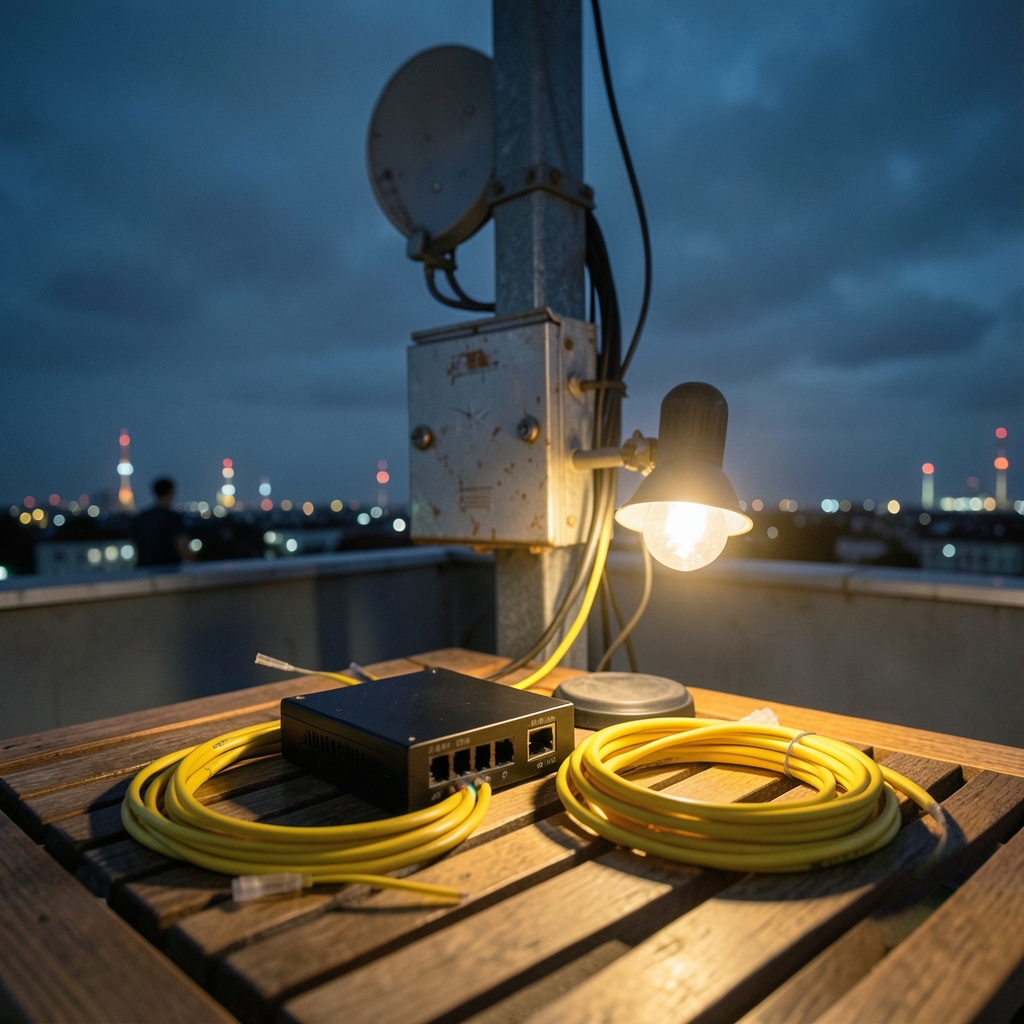
What actually happens when a request leaves a user’s browser and lands on a server inside a cloud provider’s data center? Most explanations jump straight to “it goes over the internet,” which hides the interesting part. Between the physical fiber and the application container sit virtual networks, tunnels, route tables, gateways, and security policies that determine whether traffic flows, stalls, or gets silently dropped. Understanding that stack is what separates teams who debug cloud outages in minutes from teams who file support tickets and wait. (Cloud computing)
The layered model behind every cloud network
Cloud networking is not one technology. It is a stack of layers, and problems that look mysterious usually live at the boundary between two of them.
At the bottom is the physical fabric: switches, routers, and fiber inside and between data centers. Above that sits the provider’s underlay network, which carries encapsulated traffic without knowing or caring what is inside it. Next comes the overlay, where customer virtual networks live. Finally, there are service layers: load balancers, NAT gateways, private interconnects, DNS, and firewalls.
The split between underlay and overlay is the single most important idea in cloud networking. The underlay is the provider’s problem. The overlay is yours. When a routing change breaks connectivity, the first useful question is always which layer broke.
Virtual private clouds are the isolation primitive

The virtual private cloud (VPC) is the standard building block. AWS introduced the concept in 2009, and Azure Virtual Network and Google Cloud VPC followed with similar models. Each one gives you an isolated address space, subnets inside it, route tables, and security controls. (NIST Cloud Computing Program)
What differs is the default scope. Some providers treat a VPC as regional, so connecting two regions means peering or transit gateways. Others offer a global VPC where subnets in different regions share one address space automatically. That design choice shapes everything downstream: how you plan IP ranges, how you connect environments, and how much routing you maintain by hand.
A practical rule that holds across providers: plan address space before you build anything. Overlapping CIDR ranges are the most common reason two networks cannot be peered later. Teams that start with a documented IP plan avoid months of painful renumbering.
For a broader view of how these building blocks combine with compute and storage layers, see cloud infrastructure and architecture.
Software-defined networking and the control plane
Cloud networks are software-defined. A centralized controller computes forwarding state and programs it into virtual switches, separating the control plane (decisions) from the data plane (packet movement). This is the same idea formalized in the OpenFlow specification, published around 2008, which defined how a controller can program forwarding behavior on switches remotely.
Why does this matter to someone designing workloads? Because network behavior becomes an API. Security groups, route tables, and peering connections are all objects you create and change programmatically. That is powerful and dangerous in equal measure. A misconfigured route table propagates in seconds, not hours.
The practical consequence is that network changes deserve the same review process as code. Many teams now keep network definitions in version control and apply them through pipelines, which makes drift visible and rollbacks possible.
Overlays, encapsulation, and why VXLAN exists
Virtual networks need to stretch across physical networks that were never designed for them. The standard solution is encapsulation: wrapping a customer’s packet inside another packet that the underlay can route.
VXLAN is the best-known example. Standardized in RFC 7348 in 2014, it tunnels Layer 2 frames over a Layer 3 network, which lets providers scale far beyond the roughly 4,000-segment limit of traditional VLANs. Geneve is a newer, more flexible alternative used in some environments.
Encapsulation has costs. Each wrapper adds header bytes, which reduces the payload that fits in a given packet size. That is why MTU problems are a recurring cloud headache: a path that works fine for small requests can fail for large ones when encapsulation eats the headroom. If large uploads or TLS handshakes hang while small requests succeed, suspect MTU before anything else.
Routing between networks: peering, transit, and hybrid links
Once you have more than one network, you need routing. The options form a rough ladder of complexity.
| Connection type | Typical use | Main trade-off |
|---|---|---|
| VPC peering | Two networks, simple topology | Does not scale past a few dozen links |
| Transit gateway or hub | Many networks, central control | Hub becomes a critical dependency |
| Site-to-site VPN | Quick hybrid link over internet | Variable latency, encryption overhead |
| Dedicated interconnect | Steady high-volume hybrid traffic | Lead time and committed cost |
BGP is the routing protocol underneath most hybrid and multi-cloud links. It handles failover and path selection, but it also means a bad route advertisement can black-hole traffic across an entire estate. Route filtering and prefix limits are not optional extras.
Deciding how many networks you actually need is a design question in itself. Splitting workloads across accounts and networks improves blast-radius control but multiplies connection management. There is a useful walkthrough on when to split workloads across cloud accounts that covers the trade-offs concretely.
Security architecture: from perimeter to identity
Traditional network security assumed a trusted inside and an untrusted outside. Cloud networks dissolve that boundary. Workloads talk to managed services, other clouds, and SaaS APIs, often across public endpoints.
Zero-trust architecture, described in NIST Special Publication 800-207 published in 2020, reframes the problem: no implicit trust based on network location, and every request authenticated and authorized. In practice this means several concrete habits.
- Default-deny security groups, with explicit allow rules reviewed regularly.
- Private endpoints for managed services instead of routing traffic over the public internet.
- Identity-based policy for service-to-service calls rather than relying only on IP allowlists.
- Logged and analyzed flow data, because you cannot defend traffic you cannot see.
The most common mistake is treating security groups as documentation rather than enforcement. Rules accumulate over years, nobody removes the wide-open ones, and the effective policy becomes “allow everything on the internal range.” Periodic rule audits catch this cheaply.
For a deeper look at how policy, identity, and network controls fit together, the material on enterprise AI and cloud security is worth reading alongside this section.
East-west traffic, service mesh, and eBPF
North-south traffic (in and out of your network) gets most of the attention, but east-west traffic between services usually dominates volume. Managing it with traditional firewalls and load balancers becomes unwieldy at scale.
Two approaches have become common. Service meshes move policy, retries, and observability into sidecar proxies or node-level agents, so every service-to-service call is governed consistently. eBPF, merged into the Linux kernel in 2014, lets programs run inside the kernel to inspect and filter packets with low overhead, which makes it popular for networking, security, and observability tooling in Kubernetes environments.
Both add operational surface area. A service mesh that nobody understands is worse than no mesh at all, because it introduces a new place for traffic to fail. Start with the smallest mesh footprint that solves a real problem, such as mutual TLS between a handful of services, and expand only when the need is clear.
Performance: latency, anycast, and the physics you cannot code around
Cloud providers route users to nearby regions using anycast, where the same IP address is advertised from multiple locations and BGP sends each user to the closest one. Global load balancers build on this to steer traffic by health and geography.
But no architecture beats physics. Light in fiber travels roughly 200 kilometers per millisecond, so a round trip between continents costs real time no matter how efficient your code is. That is why data placement decisions matter more than most tuning. Putting a database on the wrong continent cannot be fixed with a faster framework.
Three practical performance habits:
- Measure round-trip time between tiers before optimizing anything else.
- Keep chatty service-to-service calls inside one region or availability zone.
- Watch data transfer costs as a design signal, since unexpected egress often reveals traffic crossing boundaries it should not.
Tracking transfer costs is genuinely useful as an architecture diagnostic. There is a clear method for tracking cloud data transfer costs that turns billing data into a map of where traffic actually flows.
Operating a cloud network day to day
Design is half the job. The other half is keeping the network understandable as it grows.
Document the topology. A current diagram of networks, peerings, gateways, and CIDR ranges saves hours during incidents. If the diagram is stale, it is worse than none.
Instrument flows. Enable flow logs and keep them long enough to investigate. Most “random” connectivity failures follow a pattern that logs reveal quickly.
Test failure paths. Force a route failover in staging. Break a peering link on purpose. Teams that have rehearsed recovery handle real outages with far less drama.
Read provider changes carefully. Region launches, new interconnect locations, and default behavior changes can affect your design. Knowing how to interpret these announcements prevents surprises, and there is a solid guide on how to read a cloud region announcement that explains what to look for.
Inventory before you move. Migrations fail on networking details more often than on compute. Before any move, list every connection, DNS record, and firewall rule that the workload depends on. A checklist for what to inventory before a cloud migration covers the items teams most often forget.
As networks grow more automated, the boundary between infrastructure and intelligence keeps blurring. Routing decisions increasingly come from telemetry and policy engines rather than static configuration. That shift is explored in the discussion of AI cloud architecture and intelligent infrastructure, which is a useful next step once the fundamentals are solid.
Conclusion
Cloud networking architecture rewards a layered mental model. Physical fabric, underlay, overlay, and services each fail in different ways, and knowing which layer you are debugging shortens incidents dramatically. The VPC remains the isolation primitive, software-defined control planes make the network programmable, and encapsulation such as VXLAN makes scale possible at the cost of MTU care. Security has shifted from perimeter to identity, east-west traffic needs deliberate governance, and physics still sets the floor on latency. Teams that plan address space early, document topology honestly, and rehearse failure paths end up with networks that are boring in the best sense: they just work, and when they do not, the cause is findable.
Frequently asked questions
What is cloud networking architecture in simple terms?
It is the design of how data moves between users, services, and storage inside a cloud provider. It covers virtual networks, subnets, routing, gateways, security rules, and the physical and software layers underneath. Think of it as the road system plus the traffic laws for your workloads.
Do I need a separate VPC for every application?
Usually not. A common pattern is one VPC per environment (production, staging, development) with subnets separating tiers. Separate VPCs make more sense when you need hard isolation, different compliance boundaries, or independent network ownership between teams.
What causes the most common cloud networking failures?
Three causes dominate: overlapping IP address ranges that block peering, security group or firewall rules that silently drop traffic, and MTU mismatches introduced by encapsulation. Route table errors and expired VPN tunnels are close behind. Flow logs and route inspection resolve most of these quickly.
Is a service mesh required for microservices?
No. A service mesh helps when you have many services needing consistent mutual TLS, retries, and traffic policy. For a handful of services, native platform features and good libraries often suffice. A mesh adds a control plane you must operate, so adopt it for a specific problem rather than by default.
How does hybrid cloud connectivity actually work?
Most hybrid links use either an encrypted tunnel over the public internet or a dedicated private circuit from a provider. Both carry traffic between your network and the cloud, and both typically use BGP to exchange routes and handle failover. Dedicated links offer more predictable latency at higher cost and longer setup time.
How much does cloud network design affect cost?
Significantly. Traffic that crosses regions, availability zones, or the public internet generates charges, and architecture determines how much of that happens. Chatty designs that span zones quietly inflate bills. Reviewing egress and cross-zone transfer regularly often reveals straightforward savings.








