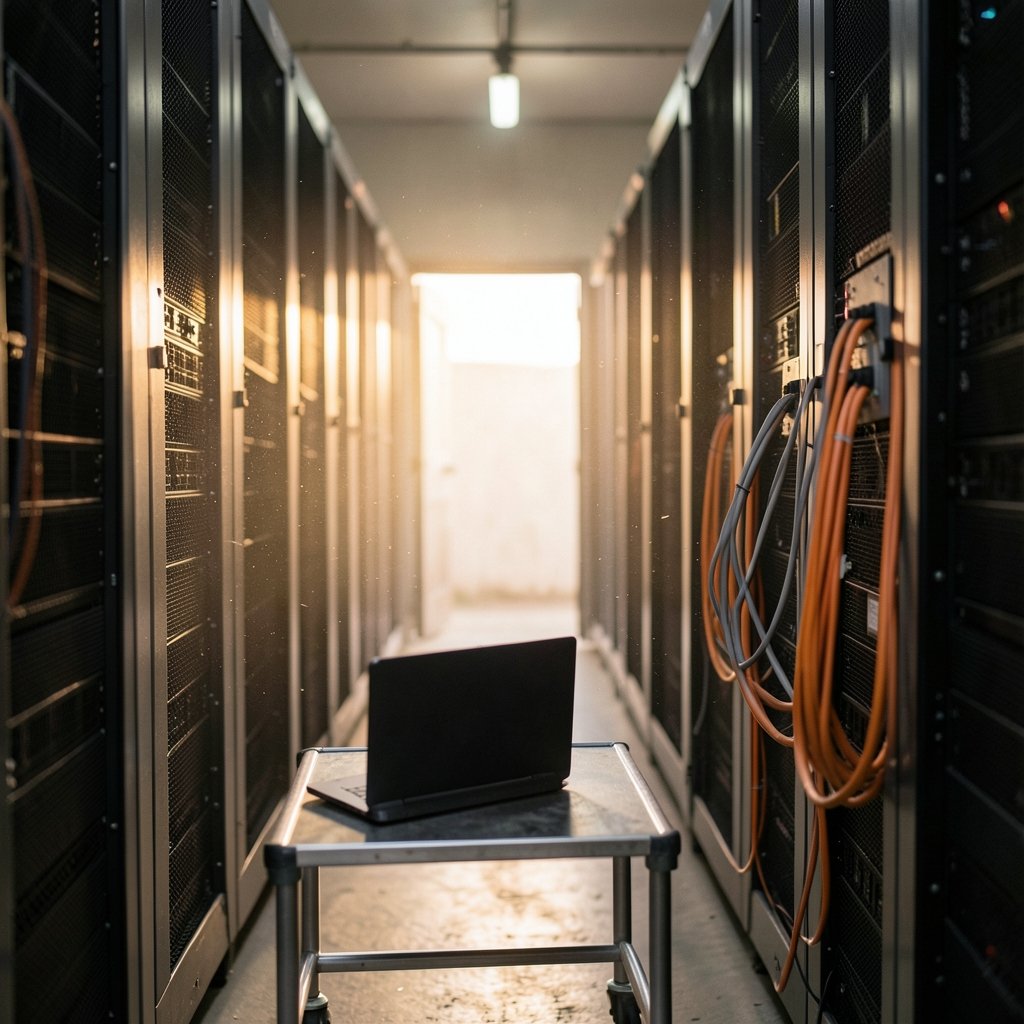
A single typo in a config file can burn through thousands of dollars in idle GPU time before anyone notices. That risk explains why Terraform has become a quiet workhorse for teams building AI infrastructure. Graphics processors are scarce, expensive, and often reserved months in advance. Managing them by hand, through cloud consoles and ad-hoc scripts, leads to waste. Terraform offers a different path: describe the infrastructure you want, let the tool build it, and keep a record of every change. (AI Chips and Computing Infrastructure) (Infrastructure as code)
This article looks at how Terraform fits into AI infrastructure work, where it shines, where it stumbles, and what practical habits separate teams that sleep well at night from teams that don’t.
Why AI Infrastructure Strains Traditional Provisioning
AI workloads are not like a typical web application. A standard app might scale from two servers to twenty and nobody blinks. An AI training job might demand eight H100 GPUs, a high-bandwidth interconnect, and terabytes of fast storage, all in one region, all at once. Get the networking wrong and the job stalls. Get the instance type wrong and the budget evaporates.
Traditional provisioning methods struggle here for three reasons:
- Scarcity. GPU capacity is limited. A manual request that fails halfway leaves orphaned resources consuming quota.
- Cost density. A single high-end GPU node can cost more per hour than a dozen general-purpose servers. Mistakes scale financially.
- Reproducibility. Research teams need identical environments across experiments. Hand-built clusters drift.
Infrastructure as code addresses all three. The question is whether Terraform is the right tool for that job, and mostly, the answer is yes, with caveats worth understanding.
What Terraform Actually Does

Terraform is an open-source infrastructure-as-code tool first released in 2014. It uses a configuration language called HCL and a plugin model where providers connect to cloud platforms and services. Instead of clicking through a console, an engineer writes a declarative description of the desired end state. Terraform compares that description to reality and makes the changes needed to close the gap. (Introduction to Terraform)
For AI infrastructure, that model maps neatly onto the core building blocks: GPU node pools, virtual networks, storage buckets, managed training services, and access policies. The major cloud providers all ship Terraform providers covering their AI and machine learning services, so SageMaker endpoints, Vertex AI pipelines, and Azure Machine Learning workspaces can all be expressed as code alongside the networking and identity resources they depend on.
That single-language approach matters more than it first appears. A training pipeline rarely lives in isolation. It needs a network, a service account, a storage bucket, and a logging destination. Describing all of it in one place means the whole stack gets reviewed, versioned, and deployed together.
The State File: Terraform’s Brain and Its Weak Spot
Terraform keeps a state file that records what it believes exists in the real world. Terraform depends on this file. It is also where most operational pain comes from.
Two engineers running Terraform at the same moment against the same state can corrupt it. A state file stored on someone’s laptop is a single point of failure. The fix is well established: use a remote backend with locking, such as a cloud object store plus a locking mechanism, so only one operation runs at a time.
Practical tips that save real headaches:
- Never store state in version control. It can contain sensitive values.
- Enable encryption on the state bucket from day one; retrofitting is painful.
- Split state by environment and by blast radius. A GPU training cluster and a shared networking layer probably should not share one state file.
- Treat state migrations as production changes. Plan them.
Teams that treat state casually often learn the lesson during an incident, which is the worst time to learn it.
Designing GPU Node Pools as Code
The most common AI infrastructure pattern in Terraform is the managed Kubernetes node pool with GPU instances attached. Whether the platform is a managed Kubernetes service on any major cloud, the shape of the configuration is similar: a node pool resource with a GPU machine type, a taint or label to keep non-GPU workloads off those nodes, and autoscaling rules.
A few design decisions deserve care:
| Decision | Common Mistake | Better Approach |
|---|---|---|
| Autoscaling | Letting GPU pools scale to zero by default | Keep a small warm pool for latency-sensitive inference |
| Taints and labels | Forgetting taints, so web pods land on GPU nodes | Taint GPU pools and require explicit tolerations |
| Instance diversity | Hardcoding one GPU family | Allow fallback instance types to survive capacity shortages |
| Spot capacity | Ignoring interruption handling | Use spot for batch training with checkpointing |
The capacity shortage point deserves emphasis. GPU availability fluctuates. A configuration that insists on one exact instance type will fail to provision during busy periods. Allowing several acceptable types, ordered by preference, dramatically improves the odds of getting capacity when it is needed.
This is also where the overlap between cloud reliability practice and AI operations becomes obvious. The same skills that make a web service resilient, such as redundancy, health checks, and graceful failure, transfer directly to accelerator fleets. Anyone curious about that crossover can read about how cloud reliability skills transfer to AI infrastructure.
Modules, Reuse, and the Testing Gap
Terraform modules package configuration for reuse. A well-built GPU cluster module lets a research team spin up a compliant training environment in minutes without understanding every underlying resource. That leverage is real, and it is why platform teams invest in modules.
The risk is a module that nobody tests. Terraform added a native testing framework in version 1.6, released in October 2023, which lets teams write assertions against module behavior. For AI infrastructure, this is not a luxury. A module that silently drops a taint or misconfigures a network policy can cost thousands before anyone notices.
What actually works in practice:
- Test modules against a small, cheap environment before promoting them.
- Pin provider versions. Provider updates occasionally change resource behavior.
- Run a plan in CI on every pull request and require review of the diff.
- Keep a documented rollback path for anything touching GPU capacity.
The plan-review habit is the single highest-value practice. A human reading a plan diff catches mistakes that automated checks miss, especially around resource replacement. Terraform sometimes needs to destroy and recreate a resource to apply a change, and on a GPU node pool that means downtime and lost work.
License Changes and the OpenTofu Fork
No honest discussion of Terraform in 2026 can skip governance. In August 2023, the tool’s license changed from the Mozilla Public License 2.0 to the Business Source License 1.1. That shift prompted the creation of OpenTofu, a fork announced in September 2023 and housed under the Linux Foundation.
For most teams, the practical impact was modest. Terraform still works, still has broad provider support, and remains widely used. But organizations with strict open-source procurement rules, or those wary of vendor concentration, now have a genuine alternative. OpenTofu aims for compatibility with existing configurations, which lowers switching costs.
There is a second governance thread worth tracking. IBM announced its acquisition of HashiCorp, Terraform’s creator, in April 2024, with the deal completing in early 2025. How that ownership shapes the roadmap is a fair question for any team making a multi-year infrastructure bet. The lesson is not to panic. It is to keep configurations portable and avoid depending on features unique to one implementation unless the benefit clearly justifies the lock-in.
Where Terraform Fits and Where It Doesn’t
Terraform is excellent at provisioning. It is less suited to certain adjacent jobs, and knowing the boundary saves frustration.
Strong fits:
- Provisioning GPU node pools and the surrounding network
- Managing managed AI service endpoints and their IAM policies
- Standing up storage and data pipelines
- Enforcing consistent environments across teams
Weaker fits:
- Day-to-day workload orchestration inside a cluster, which belongs to Kubernetes
- Rapid iteration on model code, which belongs to CI pipelines
- Real-time scaling decisions, which belong to autoscalers
A useful mental model: Terraform builds the stage, Kubernetes runs the play. Teams that try to force Terraform into runtime orchestration end up fighting the tool. Teams that let each layer do its job move faster.
For readers thinking about the broader architecture around these choices, a look at AI cloud architecture and how infrastructure becomes intelligent provides useful context on where provisioning sits in the larger picture.
Security and Cost Guardrails
Two concerns dominate AI infrastructure reviews: who can touch the GPUs, and what the bill looks like.
On security, Terraform makes least-privilege policy explicit and reviewable. Service accounts, role bindings, and network rules live in code, which means they get the same scrutiny as application changes. That is a meaningful improvement over console-driven setup, where permissions accumulate quietly.
On cost, the guardrails that work are unglamorous:
- Tag every resource with an owner and a project from the start.
- Set budget alerts at the account and project level.
- Use policy-as-code checks to block oversized GPU requests without approval.
- Schedule automatic shutdown of idle development clusters.
The tagging point is where many teams stumble. Retrofitting tags onto hundreds of existing resources is tedious. Adding them in the module from the beginning takes minutes.
Practical Habits That Separate Good Teams From Great Ones
Drawing the threads together, a few habits recur among teams that run AI infrastructure smoothly.
They keep configurations small and composable rather than one giant file. They review plans religiously. They document module interfaces so researchers can self-serve without filing tickets. They treat provider upgrades as scheduled maintenance, not surprises. And they accept that some manual intervention is fine, as long as it is recorded and repeatable.
The teams that struggle tend to share a different profile: one person holds all the knowledge, state lives somewhere convenient rather than somewhere safe, and the first sign of trouble is a bill. The gap between these two profiles is rarely talent. It is discipline applied early.
For anyone building the surrounding documentation and runbooks, there is a useful parallel in how technical writing supports enterprise infrastructure teams, since clear docs are what let a platform scale beyond its original authors.
Conclusion
Terraform will not make AI infrastructure easy. GPUs will still be scarce, bills will still demand attention, and state files will still require care. What Terraform does offer is a way to make the infrastructure predictable: described in text, reviewed by humans, versioned like software, and reproducible on demand. That predictability is worth a great deal when the resources involved are expensive and the margin for error is thin. The teams getting this right treat Terraform as one layer in a stack, pair it with strong state management and testing habits, and stay alert to the governance shifts that continue to reshape the tool’s ecosystem.
Frequently Asked Questions
Is Terraform a good fit for provisioning GPU clusters?
Yes, for the provisioning layer. Terraform handles node pools, networking, storage, and identity well. It is not designed for runtime orchestration inside a cluster, which is better left to Kubernetes and its autoscalers.
What is the biggest risk when using Terraform with AI infrastructure?
State file mismanagement. A corrupted state file, or one without locking, can cause Terraform to lose track of expensive resources or attempt destructive changes. Remote backends with locking and encryption are required, not optional.
How does Terraform handle GPU capacity shortages?
It cannot create capacity that does not exist, but it can improve your odds. Configurations that allow multiple acceptable instance types and use spot capacity for batch work provision far more reliably than those pinned to a single GPU family.
What changed when Terraform’s license moved to BUSL?
In August 2023 the license shifted from MPL 2.0 to the Business Source License 1.1. This led to the OpenTofu fork under the Linux Foundation. Most teams kept using Terraform, but organizations with strict open-source policies gained a viable alternative.
Should AI teams use Terraform or Kubernetes operators?
Both, typically. Terraform provisions the cluster and its node pools. Operators and autoscalers manage workloads inside it. Trying to handle runtime scaling through Terraform leads to slow, brittle workflows.
How can teams keep AI infrastructure costs under control with Terraform?
Tag resources from the start, set budget alerts, use policy checks to flag oversized GPU requests, and schedule shutdowns for idle development clusters. These habits are simple but require discipline to maintain as teams grow.