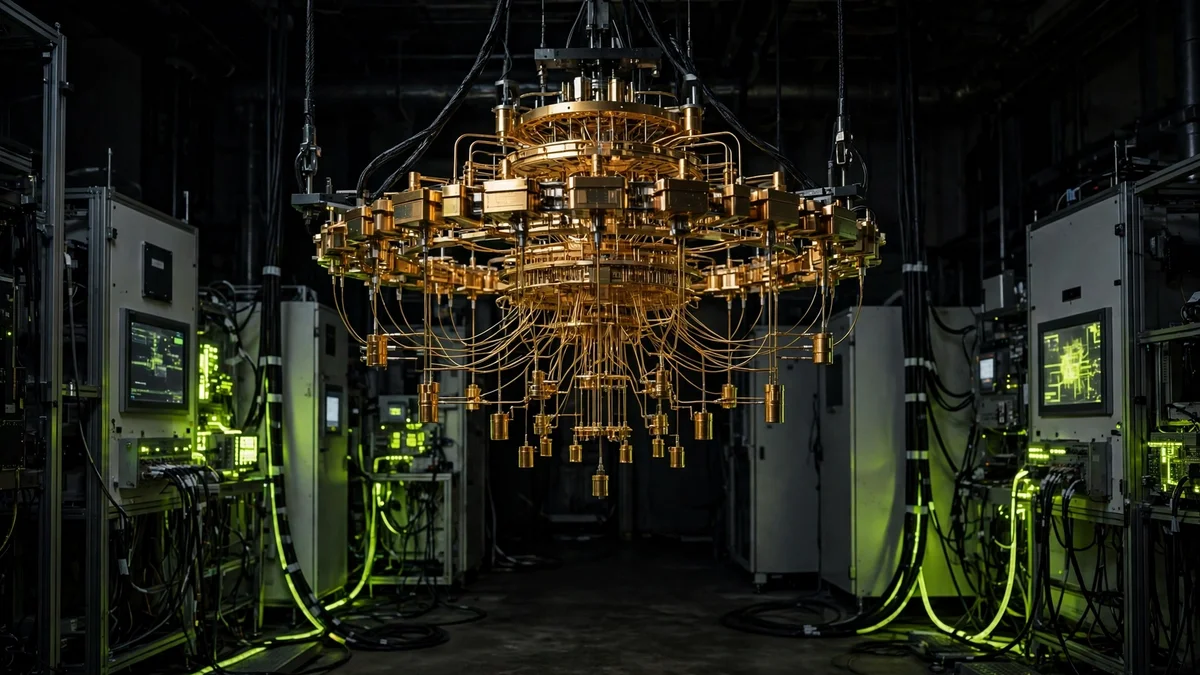
Quantum computing for enterprise is no longer a topic for physics departments alone, and boardrooms are starting to ask what it means for their business. The central question is simple: should your organisation invest in quantum computing now? For most enterprises, the honest answer is to start small, with one pilot project and a plan for post-quantum security, rather than buying hardware or betting on a single vendor.
A quantum computer does not replace your servers. It is a specialist machine for a narrow set of problems, such as simulating molecules and optimising complex schedules, where classical computing runs out of road. Everything else will keep running on classical machines.
Key takeaways
- Quantum computers suit simulation, optimisation and certain search problems, not general-purpose work.
- Error correction crossed a key threshold in late 2024, but no machine yet beats a classical computer on a business problem.
- Enterprises access quantum hardware through the cloud: IBM, Amazon Braket and Microsoft Azure Quantum.
- The most urgent enterprise action is post-quantum cryptography: NIST published its first standards in August 2024.
- Start with one small pilot, a named owner and a clear success measure.
What quantum computing actually does
A classical computer stores information as bits, each one a zero or a one. A quantum computer stores information as qubits, which can hold a combination of zero and one at the same time, a property called superposition. Qubits can also be linked, so measuring one tells you something about the others, a property called entanglement.
Those two properties let a quantum computer explore many possible answers at once. That sounds like a general speed-up, but it is not: quantum computers only help with problems whose structure matches what qubits do well. For everyday computing, from running a database to rendering a web page, a classical computer is faster, cheaper and far more reliable.
The problems where quantum computing may eventually help fall into three groups: simulating molecules and materials; optimising choices among huge numbers of combinations, such as delivery routes; and certain kinds of search and factoring, including breaking some encryption in use today. Our guide to quantum computing chips explains the hardware in more detail.
Where the hardware stands in late 2026
Quantum hardware has improved enormously, and still is not ready for general business use. The machines are noisy: qubits lose their state quickly, and every operation carries a chance of error. Progress is now measured less by qubit count than by qubit quality and by error correction, which combines many fragile physical qubits into one reliable logical qubit.
Google’s Willow chip, announced in December 2024, is the clearest milestone so far. Willow has 105 superconducting qubits, and Google showed its error rate fell by about half each time the error-correction code grew, from a three-by-three grid to five-by-five to seven-by-seven. That result, published in Nature, is known as operating below threshold: adding qubits made the result better, not worse. The logical qubit produced outlived its best physical qubit by a factor of 2.4. Google also claimed a benchmark speed-up, but that was a test designed to show quantum capability, not a business problem, so the error-correction result matters more.
IBM takes a different approach, with the broadest cloud offering and the largest ecosystem. Its Condor processor, announced in December 2023, holds 1,121 superconducting qubits, the largest count on a single IBM chip, yet IBM describes its 156-qubit Heron processors as its best-performing systems, because their error rates are lower. Its published roadmap targets Starling, a system designed for 200 logical qubits, by 2029, but roadmaps here have slipped before.
Other approaches matter too. IonQ and Quantinuum build trapped-ion machines, holding atoms in electromagnetic traps and manipulating them with lasers. Their counts are lower, IonQ’s Forte at 36 qubits and Quantinuum’s H2 at 56, but their qubits hold their state for seconds and can connect any pair directly. QuEra’s Aquila, a neutral-atom system with 256 qubits on Amazon Braket, is an analogue simulator rather than a general-purpose machine.
How enterprises actually access quantum computers
Almost no enterprise buys a quantum computer. The machines need cooling to a fraction of a degree above absolute zero, specialist engineers and a dedicated facility. Instead, enterprises rent time on them through the cloud, as they do with classical computing power. That is the practical route for every pilot in this guide.
Three cloud routes cover most of the market. IBM Quantum Platform offers IBM’s superconducting processors, with a free tier for learning, and its Qiskit software kit is the most widely used in the field. Amazon Braket offers several vendors’ machines through one service, including IonQ, Rigetti and QuEra, alongside simulators. Microsoft Azure Quantum offers IonQ and Quantinuum hardware, plus Microsoft’s own simulators. Google’s hardware is more restricted, aimed mainly at researchers.
Most enterprise work is hybrid: a classical computer does the bulk of the work, and the quantum processor handles the one step that benefits from it. Your team therefore needs classical software and cloud skills as much as quantum knowledge. Our guide to cloud computing for enterprises covers the cost and governance questions that apply here too.
| Provider | Qubit type | Flagship system | Strengths | Weaknesses |
|---|---|---|---|---|
| IBM Quantum Platform | Superconducting | Heron, 156 qubits | Broadest cloud access | Short coherence times |
| Google Quantum AI | Superconducting | Willow, 105 qubits | Leading error-correction results | Restricted access, research-focused |
| IonQ, via Braket and Azure | Trapped ion | Forte, 36 qubits | Long coherence, full connectivity | Low qubit count, slower gates |
| Quantinuum, via Azure | Trapped ion | H2, 56 qubits | Very high gate fidelity | Low qubit count |
| QuEra, via Braket | Neutral atom | Aquila, 256 qubits | Large qubit count | Analogue machine, not general-purpose |
What enterprises can use it for today
Today, the realistic enterprise use is learning and piloting, not production deployment. No quantum computer has yet solved a general business problem faster or cheaper than a classical computer outside a laboratory. That is a reason to run small, cheap pilots now, so your team understands the technology before it matters.
Pharmaceutical and chemical companies are the furthest ahead, because molecular simulation is the most natural fit for qubits. Simulating a molecule classically gets harder very quickly as it grows, and quantum computers model that behaviour directly.
Financial services are the second active area. Banks and asset managers are testing quantum methods for portfolio optimisation, risk modelling and fraud detection. These pilots run on small, simplified versions of the real problem, and none has replaced a classical system in production.
The security question comes first
For most enterprises, the most urgent quantum issue has nothing to do with buying quantum time. It is the risk to today’s encryption. A large enough quantum computer could break the public-key encryption that protects websites, email and stored data. No machine today can do that, but data stolen now could be stored and decrypted later: a risk known as harvest now, decrypt later.
The good news is that the fix is already standardised. In August 2024, the US National Institute of Standards and Technology published its first three post-quantum cryptography standards: FIPS 203, which specifies ML-KEM for key exchange; FIPS 204, which specifies ML-DSA for digital signatures; and FIPS 205, which specifies SLH-DSA as a hash-based signature standard. These algorithms are designed to resist attack by both classical and quantum computers.
Your security team should start with an inventory, not a purchase. Find out where your organisation uses public-key encryption: in transport security, virtual private networks, stored data and code signing. Data that must stay secret for ten years or more, such as health records and trade secrets, deserves priority. Then plan a staged migration to the NIST standards. The migration takes years in a large organisation, so starting now is cheap and starting late would be a scramble.
Costs, skills and honest limits
Quantum pilots are cheap compared with most enterprise technology bets, because you pay for cloud time rather than hardware. Pricing is usually charged per task and per run, and it varies by vendor and machine, so check current pricing before budgeting. The larger cost is people: a pilot needs someone who understands quantum algorithms, someone who understands your business problem, and someone who can judge the results against the classical baseline.
Skills are the real bottleneck. Few engineers can write quantum programs, and fewer still can explain the results to a finance director. Train one or two existing staff, usually from your data science or high-performance computing team, and pair them with a vendor or university partner for the first pilot.
Be wary of vendor claims: qubit counts quoted without error rates, and demonstrations on problems nobody in your business actually has. Ask every vendor for the error rate, the comparison against the best classical method on the same problem, and the price at the size you need.
Your first quantum pilot: a decision framework
Use this checklist before committing any budget.
- Name one business problem, in one sentence, with a number attached: a cost, a time or an error rate to improve.
- Confirm the problem is hard classically: write down what the best classical solver achieves today.
- Check the problem fits a quantum strength: simulation, optimisation or search, not general data processing.
- Pick one cloud provider and one machine, and run the smallest version of the problem first.
- Assign a named owner and a second person to review results, so the pilot does not depend on one enthusiast.
- Set a success measure in advance: the quantum result must beat the classical baseline by a stated amount, or stop.
- Budget for people first and quantum time second, and set a review date six months out.
- Start the post-quantum cryptography inventory in parallel, because that work has a longer lead time.
Frequently asked questions
Will a quantum computer replace our servers?
No. Quantum computers are specialist machines for a narrow set of problems, and they will work alongside classical computers, not instead of them. Your databases, applications and websites will keep running on classical hardware.
How much does a quantum pilot cost?
Less than most enterprise pilots, because you rent cloud time rather than buying hardware. Pricing is charged per task and per run and varies by vendor, so get a quote first. The main cost is staff time.
Is our data at risk from quantum computers today?
Not from a working machine, because none exists that can break current encryption. The risk is that data stolen today could be decrypted years from now, so data that must stay secret for a decade or more deserves a migration plan to the NIST standards now.
Which vendor should we choose?
Do not choose a vendor before you choose a problem. Superconducting systems offer the broadest access, trapped-ion systems offer higher fidelity at lower counts, and neutral-atom systems suit simulation. Test on two machines and compare first.
When will quantum computing be ready for production use?
Nobody knows, and anyone who gives you a firm date is selling something. Error correction is progressing, with IBM targeting 200 logical qubits by 2029, but useful, fault-tolerant machines are still years away.
The bottom line
Quantum computing for enterprise in late 2026 is a technology to learn, not one to bet the business on. The hardware is improving, error correction has crossed its first real threshold, and cloud access makes experimenting cheap. But no machine yet beats a classical computer on a real business problem, and vendor roadmaps are promises, not guarantees.
The two moves that pay off now are a small, honest pilot on a problem you can measure, and a post-quantum cryptography plan for the data that must stay secret the longest. Do those two things and review them in six months. Our outlook on where quantum computing is heading sets out the longer-term picture.