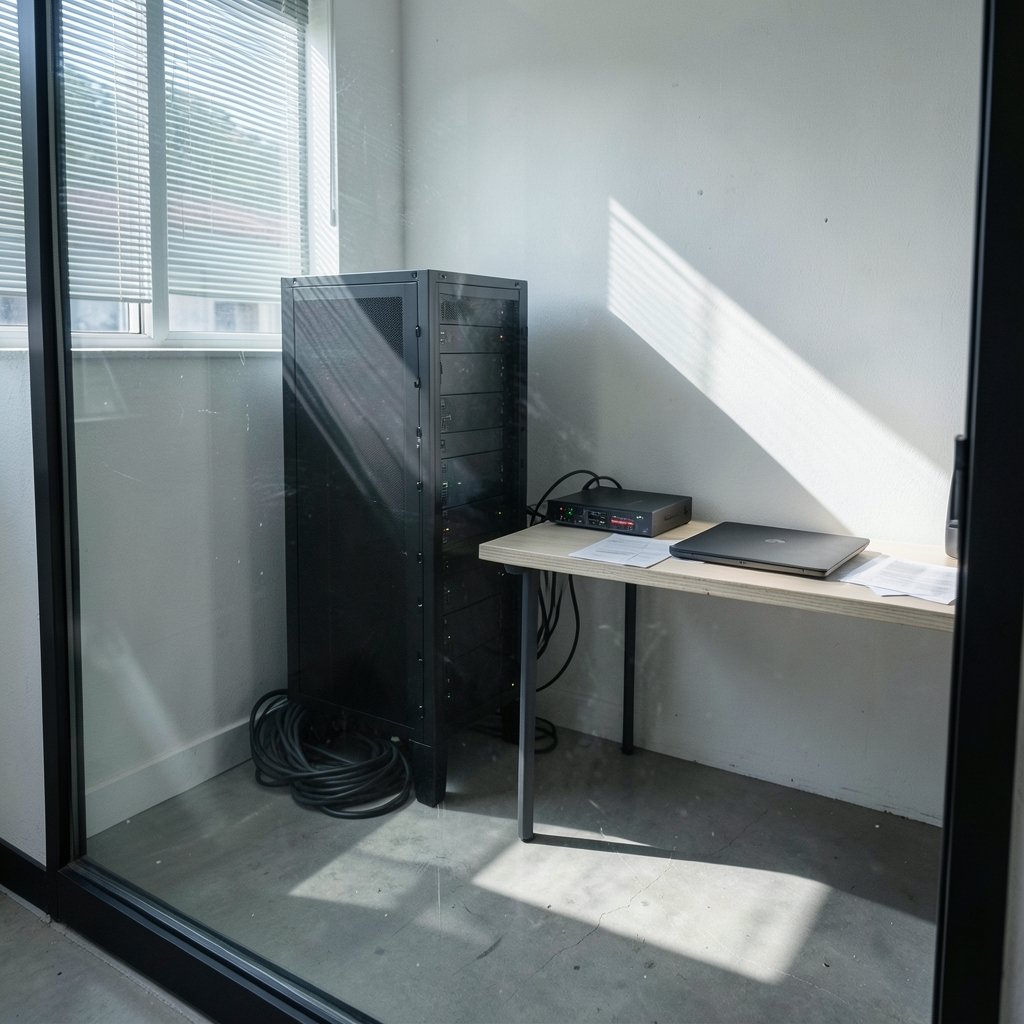
What happens to a customer’s medical record, a law firm’s contract draft, or a bank’s fraud model when it gets typed into a chatbot hosted by someone else? For a growing number of organizations, that question has a single, uncomfortable answer: nobody outside the vendor really knows. Private AI architecture is the response to that discomfort. It is the practice of designing AI systems so that model weights, prompts, and sensitive data stay inside an environment the organization controls, rather than crossing into a third-party API on every request.
The term itself is slippery. No standards body has defined “private AI,” and vendors stretch it to mean everything from a dedicated cloud tenant to a USB stick with a language model on it. What follows is a practical look at what the architecture actually involves, where the real trade-offs sit, and which mistakes teams make most often.
What “Private AI” Really Means in Practice
Strip away the marketing and private AI comes down to control over three assets: the model weights, the prompts and context, and the data used for training and inference. A deployment is private to the degree that all three remain within a boundary the organization governs, whether that boundary is a physical data center, a dedicated cloud account, or a trusted execution environment inside shared hardware.
There is no single standard definition, and that ambiguity causes real problems during procurement. Two vendors can both claim “private AI” while one keeps prompts for thirty days for abuse monitoring and the other processes everything in an isolated enclave. The only reliable approach is to ask for the specific data flows in writing: where prompts are stored, how long, who can read them, and whether any human reviews them.
The distinction between open weights and open source matters here too. Several popular model families publish downloadable weights under licenses that restrict commercial use or impose conditions, so “open” does not automatically mean freely deployable. Teams that plan to self-host should read the license before committing engineering time.
The Three Deployment Patterns

Most real-world private AI implementations fall into one of three shapes, and each carries a different cost and risk profile.
| Pattern | Where inference runs | Best fit | Main trade-off |
|---|---|---|---|
| Fully on-premises | Organization’s own GPU servers | Regulated data, air-gapped sites, predictable workloads | High capital cost, hardware refresh cycles |
| Private cloud tenant | Dedicated VPC or account with a cloud provider | Variable demand, teams without data center staff | Configuration errors can expose data |
| Hybrid split | Sensitive tasks local, general tasks hosted | Most enterprises in practice | Routing logic becomes a security control |
The hybrid pattern deserves attention because it is where most organizations actually land. A support team might route queries containing personal data to a locally hosted model while sending generic drafting requests to a hosted API. That works, but only if the routing decision is enforced by code rather than left to user judgment. A common failure is a well-meaning employee pasting a sensitive document into the “general” tool because it produces better answers. If the architecture allows that path, the privacy guarantee is fiction. (Privacy-enhancing technologies (Wikipedia))
For teams thinking through how these patterns fit into a broader estate, the cloud infrastructure and architecture resources at 9481.org cover the networking and isolation primitives that private AI builds on.
Regulation Is the Usual Starting Gun
Few organizations pursue private AI out of pure enthusiasm for infrastructure work. The driver is usually legal.
In Europe, the General Data Protection Regulation (Regulation (EU) 2016/679) has applied since May 2018 and places strict conditions on transferring personal data to processors in third countries. The full text of the GDPR sets out those transfer rules, and they are a frequent argument for keeping inference in-house. Whether a given AI vendor acts as a processor or a controller is fact-specific, and getting that classification wrong is an expensive mistake.
The EU AI Act (Regulation (EU) 2024/1689) adds another layer. It entered into force on 1 August 2024, with obligations phased in over time: prohibitions applied from February 2025, general-purpose AI rules from August 2025, and most high-risk obligations from August 2026, with some provisions later still. Because the timeline is staggered, teams should check the current phase against the official text of the EU AI Act rather than relying on secondhand summaries.
In the United States, health data brings its own regime. The HIPAA Security Rule requires safeguards for electronic protected health information, and using a cloud AI service generally means putting a business associate agreement in place. The HHS guidance on the HIPAA Security Rule explains what those safeguards require. Health systems frequently cite this as the reason inference stays in a controlled environment. (NIST SP 800-53 Security and Privacy Controls)
A useful risk framing for all of this comes from the NIST AI Risk Management Framework, which organizes AI risk work around govern, map, measure, and manage functions. It is not a compliance checklist, but it gives teams a shared vocabulary.
Building Blocks: RAG, Confidential Computing, and Privacy-Preserving Training
Three technical approaches do most of the heavy lifting in private AI systems, and each solves a different problem.
Retrieval-augmented generation keeps a vector store and retrieval layer local, so an organization can ground model answers in internal documents without shipping those documents to a third party. The original RAG paper by Lewis and colleagues describes the method in detail. In practice, the vector database becomes the new sensitive asset: if it is not access-controlled per user, a private model will happily summarize documents the asker was never allowed to see.
Confidential computing uses hardware-based trusted execution environments, such as Intel SGX and TDX, AMD SEV-SNP, or Arm CCA, to protect data while it is being processed, including during inference. The promise is strong, but performance overhead and threat models vary substantially by platform, and vendor claims deserve scrutiny against independent research.
Federated learning trains across devices or sites without centralizing raw data. The federated learning paper by McMahan and colleagues introduced the approach. It reduces privacy risk but does not eliminate it; gradient leakage attacks are well documented, which is why federated setups are often paired with differential privacy, a formal guarantee that adds calibrated noise to protect individuals in aggregate results. The US Census Bureau’s statistical safeguards program for the 2020 Census is a well-known public-sector example of differential privacy in production.
Where Private AI Architecture Usually Goes Wrong
Practical experience across these projects surfaces a predictable set of failures. None of them are exotic; most are ordinary engineering discipline problems wearing AI clothing.
The first is treating “private” as a binary. Teams buy an on-premises appliance and assume the work is done, then discover that telemetry, crash reports, and license checks all phone home with prompt fragments attached. Privacy is a property of the whole system, including the boring plumbing.
The second is ignoring the retrieval layer. A locally hosted model connected to an internal document store with no per-user permissions is arguably worse than a hosted API, because it creates a confident-sounding oracle over everything the company knows.
The third is underestimating GPU operations. Self-hosted inference means driver updates, model quantization decisions, capacity planning, and monitoring for silent quality drift. A model that quietly degrades after a quantization change can do real damage before anyone notices.
The fourth is routing by policy instead of by code. As noted above, if users can choose between a private and a public tool, some will choose wrong. Enforcement belongs in the application layer.
The fifth is skipping the audit trail. Regulators and internal risk teams will ask who used which model, with what data, and what it produced. Systems built without logging cannot answer, and retrofitting logging into an inference stack is painful.
For teams working through capacity and latency decisions, the guidance on AI inference architecture for enterprises covers batching, caching, and hardware selection in more depth than fits here.
What Actually Works: A Practical Sequence
Teams that get this right tend to follow a similar order of operations rather than starting with hardware.
- Classify the data first. Map which workloads touch regulated or confidential data and which do not. This single exercise usually shrinks the private scope dramatically and saves money.
- Define the boundary in writing. Document where prompts, outputs, embeddings, and logs live, and who can access each.
- Pick the smallest deployment that satisfies the boundary. Often that is a private cloud tenant rather than a data center build.
- Enforce routing in code. Make the private path the default and require explicit, logged justification for anything else.
- Instrument quality and cost from day one. Track latency, refusal rates, and spend per workload so the system stays honest.
- Re-review licenses and regulations on a schedule. Model licenses change, and the EU AI Act obligations arrive in stages.
The sequencing matters because it prevents the most expensive mistake: building a large private GPU estate for workloads that never needed one. A surprising share of enterprise AI traffic is low-sensitivity drafting and summarization that a well-governed hosted model handles fine.
The Economics and the Honest Trade-offs
Private AI is not free, and pretending otherwise damages credibility with finance teams. Self-hosted inference shifts spending from per-token fees to capital expenditure, staffing, and utilization risk. A GPU cluster that sits idle half the time is more expensive than the API it replaced, even if the invoice looks different.
The honest framing is that private AI buys control, and control has a price. That price is justified when the data is regulated, when the workload is stable and high-volume enough to keep hardware busy, or when the model itself is a competitive asset worth protecting. It is harder to justify for experimental projects or spiky, low-volume usage.
There is also a maturity question. Confidential computing and privacy-preserving training are improving quickly, but they are not plug-and-play. Teams should pilot them against real workloads before making architectural commitments, and should expect some platforms to disappoint.
Finally, private AI does not remove the need for governance. A model running inside your own walls can still produce biased outputs, leak information through clever prompting, or be misused by insiders. The enterprise AI systems and architecture overview is a reasonable next read on how governance, evaluation, and operations fit together around the model itself.
Conclusion
Private AI architecture is less a product category than a discipline: knowing exactly where your weights, prompts, and data live, and being able to prove it. The regulatory pressure is real and increasing, the technical options are genuinely workable, and the failure modes are almost entirely ordinary engineering oversights rather than exotic attacks. Organizations that classify their data first, define their boundary in writing, enforce routing in code, and resist the urge to build a data center for workloads that never needed one will end up with systems that are both defensible and affordable. The ones that buy an appliance and call it private will eventually discover what their telemetry has been sending home.
Frequently Asked Questions
Is private AI the same as on-premises AI?
No. On-premises deployment is one way to achieve private AI, but a dedicated cloud tenant or a confidential computing enclave can also keep data under organizational control. What matters is the boundary around weights, prompts, and data, not the physical location of the hardware.
Does using open-weight models automatically make an AI system private?
No. Open weights let an organization self-host, but privacy depends on the whole stack: where prompts are logged, whether telemetry leaves the environment, and who can access the retrieval store. Several open-weight licenses also restrict commercial use, so the license needs review before deployment.
How does the EU AI Act affect private AI design?
The EU AI Act phases in obligations over several years, with prohibitions applying from February 2025, general-purpose AI rules from August 2025, and most high-risk obligations from August 2026. Private deployments can help with documentation and control requirements, but they do not exempt an organization from the regulation’s substantive duties.
Can a private AI system still leak sensitive information?
Yes. A locally hosted model connected to an internal document store without per-user permissions can expose material to anyone who asks the right question. Insider misuse, prompt injection, and inadequate logging are all live risks regardless of where inference runs.
Is confidential computing mature enough for production inference?
It depends on the platform and workload. Trusted execution environments are shipping in mainstream processors, but performance overhead and threat models vary, and vendor claims should be checked against independent testing before committing a production system to them.
What is the cheapest way to start with private AI?
Usually a private cloud tenant combined with strict routing rules and a local retrieval layer, rather than buying GPU servers. That approach keeps sensitive data inside a controlled boundary while avoiding capital spending on hardware that may sit idle.