Perfect forward secrecy explained in plain terms starts with a burglary. Suppose an attacker steals a server’s private key today: can they now read every conversation that server ever had? The central question is whether a single theft can unlock the past, and the answer, when forward secrecy is in place, is no, because each session used a fresh key that was thrown away when the session ended, and the stolen key cannot recreate it.
Perfect forward secrecy, usually shortened to PFS, is the property of a protocol that protects past sessions even if the long-term keys are later compromised. It is achieved by agreeing a new session key for every connection, using that key only for that session, and then discarding it for good.
The idea matters because attackers record encrypted traffic now and decrypt it later. Without forward secrecy, a future key theft opens the entire archive. This article explains how PFS works, where it comes from, and how to make sure you have it.
Key takeaways
- Forward secrecy protects past sessions even if long-term keys are later stolen.
- Each session uses a fresh ephemeral key that is discarded when the session ends.
- It defeats record-now, decrypt-later attacks against stored traffic.
- TLS 1.3 requires forward secrecy; older configurations may not have it.
- Ephemeral Diffie-Hellman is the mechanism that delivers it in practice.
What perfect forward secrecy is
The word perfect is a piece of cryptographic optimism: it means the secrecy of past sessions does not depend on the long-term key at all. If the key is stolen, published, or compelled from its owner, the sessions recorded before the theft remain unreadable, because their keys were never derived from it.
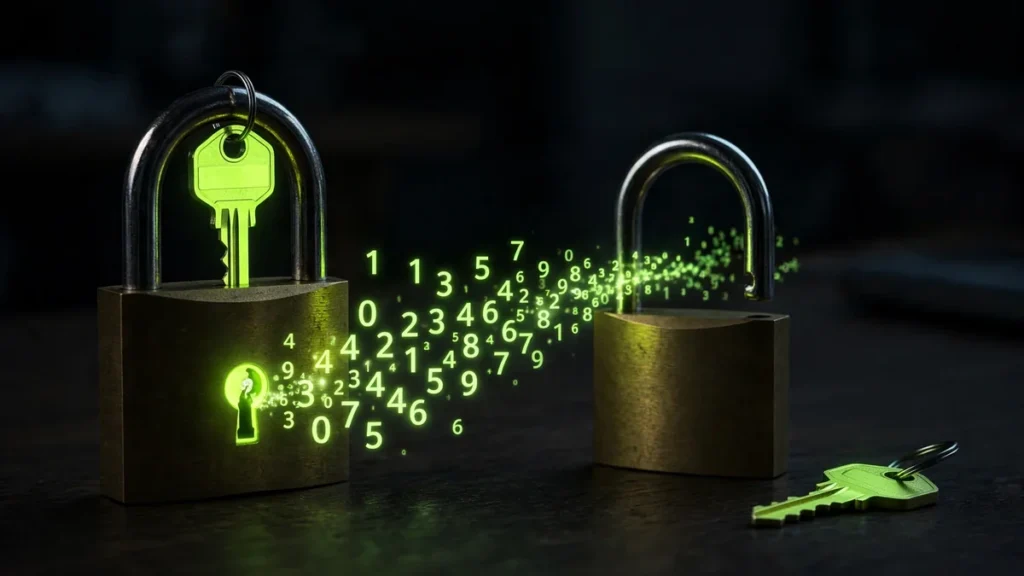
The mechanism is ephemeral key exchange. At the start of each session, the two sides generate fresh, random private numbers, agree a session key, and then delete those numbers when the session ends. The long-term key is used only to authenticate the exchange, to prove who the parties are, and never to protect the data itself.
Contrast that with the older RSA key transport used in early TLS. There, the browser encrypted the session key under the server’s public key and sent it across, which meant the server’s private key could decrypt every session key, past and future. One stolen key opened the whole archive, and that is the failure PFS exists to prevent.
How forward secrecy works in TLS
In a modern TLS handshake, the server and the browser perform an ephemeral Diffie-Hellman exchange, each generating fresh private numbers for this session only. The server signs its part of the exchange with its certificate key, which proves its identity without ever exposing the session key to that long-term key.
Once the session key is agreed, the data flows under a symmetric cipher, and when the session closes, both sides delete the ephemeral numbers and the session key. Nothing remains that could recreate them, not on the server, not in a backup, and not in a log.
Messaging apps take the idea further with ratcheting. The Signal protocol runs a new Diffie-Hellman exchange with every message, so each message has its own key, and a stolen key exposes at most one message, while the next message is already safe again. Our guide to end-to-end encryption explains that design, and our guide to TLS explains the handshake that brings PFS to the web.
Record now, decrypt later
The attack PFS defends against is patient rather than clever. An adversary records encrypted traffic as it passes, stores it cheaply, and waits. Years later, a key is stolen, a vulnerability is found, or a computer grows fast enough, and the archive is decrypted at leisure.
Without forward secrecy, that attack works against everything recorded: years of emails, logins, and business traffic, all opened by one theft. With forward secrecy, the archive is worthless, because each session’s key was unique and is gone, and no single piece of information can recreate any of them.
This is why forward secrecy matters even for traffic that seems dull today. A login page, a search query, or a routine business call may become sensitive years later, when a person changes jobs, a company is acquired, or a government changes its mind about what it wants to know. PFS is insurance against a future you cannot predict.
It is also why the Snowden revelations accelerated its adoption. The documents showed bulk collection of encrypted traffic at scale, and the industry’s answer was to make that collection useless by ensuring that no later compromise could unlock what had been stored.

Comparing forward secrecy with static keys
Static keys are simpler. A long-term key encrypts every session, there is no exchange to perform, and the system is easier to build and to debug. That simplicity is also the danger, because the key becomes a single point of failure for the entire history of the service.
Ephemeral keys cost a little computation at the start of each session, and they make debugging harder, since a recorded session cannot be decrypted even by its owner. But they remove the catastrophic failure mode, which is why the trade is worth making everywhere it is available.
The table below compares the two approaches.
| Aspect | Forward secrecy, ephemeral keys | Static keys |
|---|---|---|
| Past sessions after key theft | Stay secret | Fully exposed |
| Record-now, decrypt-later | Defeated | Works against the archive |
| Setup cost per session | Small, one key exchange | Almost none |
| Debugging recorded traffic | Hard, even for the owner | Easy with the key |
| Where it is required | TLS 1.3, modern messaging | Legacy systems only |
The practical result is that forward secrecy is the default for anything new, and the absence of it in an old system is a reason to upgrade. TLS 1.3 removed the non-forward-secret options entirely, so any server speaking the modern protocol already has the property.
Where forward secrecy is used
The web is the largest deployment. Every TLS 1.3 connection negotiates ephemeral keys, which means the padlock in your browser now carries forward secrecy by default, and the record-now, decrypt-later attack against web traffic is largely dead.
Messaging apps are the second great deployment. Signal, WhatsApp, and others ratchet their keys forward with every message, so a compromised phone exposes far less than it would under a static design, and the protection is automatic, needing nothing from the user.
Virtual private networks and SSH use ephemeral exchange for the same reason, and modern email encryption is moving in the same direction, though email’s store-and-forward design makes true forward secrecy harder to achieve there than in a live session.
Even some password managers and backup systems now use per-session or per-item keys, so that a breach of the master key does not expose the entire history. The principle is spreading beyond live connections into stored data, which is where its next decade of work lies.
Limits and common mistakes
Forward secrecy protects the session keys, but it does not protect the endpoints. If an attacker compromises the server itself, or the user’s device, they can read the data live, before it is encrypted, and no property of the protocol can stop that. PFS is about the traffic, not the machines at either end.
It also does not protect the long-term key’s other uses. A stolen certificate key can still impersonate the server going forward, issuing fake credentials and intercepting new sessions, until the certificate is revoked and replaced. Our guide to threat modelling explains how to think about which threats a control actually addresses, and which it does not.
The most common mistake is assuming PFS is present when it is not. Old servers, misconfigured load balancers, and legacy clients can still negotiate the old RSA key transport, and a single weak endpoint can undo the protection for the whole connection. The fix is to check what your server actually negotiates, and to disable the non-forward-secret options outright.
Another mistake is keeping session keys in logs or crash dumps, where they survive the session they were meant to die with. The discipline of deleting keys must extend to every copy, including the ones the debugging tools make without asking.
Perfect forward secrecy checklist
- Use TLS 1.3, or TLS 1.2 with only ephemeral cipher suites enabled.
- Disable RSA key transport and all static key exchange on every server.
- Prefer elliptic-curve Diffie-Hellman for fast, ephemeral exchange.
- Check what your servers actually negotiate with a scanner, not just the config.
- Ensure load balancers and proxies preserve forward secrecy end to end.
- Delete session keys and ephemeral numbers when the session closes.
- Keep keys out of logs, crash dumps, and backups.
- Rotate long-term keys regularly, since they still authenticate new sessions.
- Test the failure path: a stolen key must not open recorded traffic.
Frequently asked questions
What is perfect forward secrecy?
It is the property that past sessions stay secret even if the long-term keys are later stolen, because each session used a fresh key that was discarded when the session ended.
How is forward secrecy achieved?
By ephemeral key exchange, usually Diffie-Hellman, where each session generates new private numbers, agrees a key, and then deletes the numbers, so nothing can recreate the key later.
Does forward secrecy protect me if my device is hacked?
No. It protects recorded traffic against later key theft, but an attacker on your device or on the server can read data live, before it is encrypted.
Is forward secrecy the same as encryption?
No. Encryption hides the data, and forward secrecy is a property of how the encryption keys are managed, ensuring that one theft cannot unlock the past.
Do I have forward secrecy on the web?
Almost certainly, if the site uses TLS 1.3 or a modern TLS 1.2 setup. Older servers and clients may still negotiate the old RSA key transport, which does not provide it.
What is a record-now, decrypt-later attack?
It is the practice of storing encrypted traffic today and decrypting it years later, after a key is stolen or computers improve, and forward secrecy is the defence that makes the stored traffic worthless.
The bottom line
Perfect forward secrecy explained in one line is this: a key that is used once and thrown away cannot be stolen later, so the past stays secret.
It costs almost nothing, it is built into modern protocols, and it is the difference between a theft that exposes a day and a theft that exposes a decade.
This article is general information about how perfect forward secrecy works, not advice about securing a particular system.