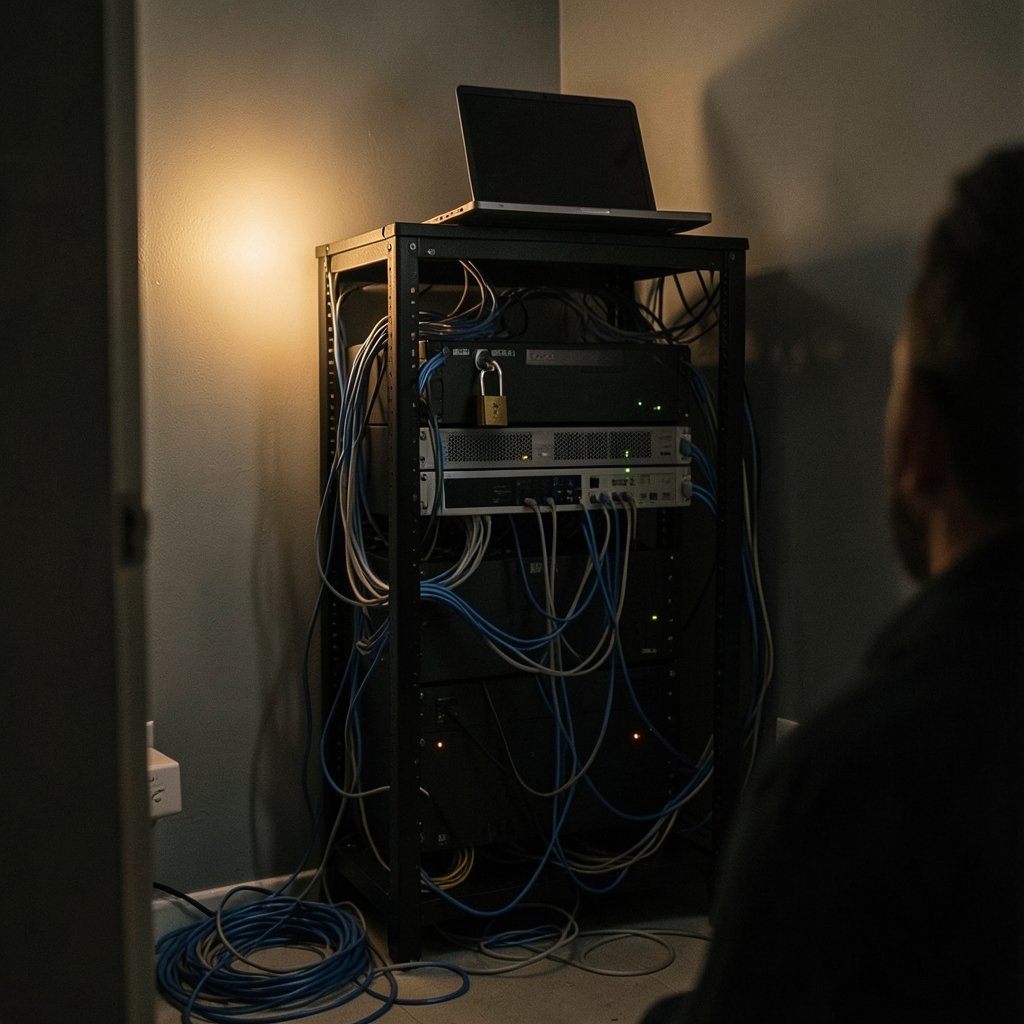
What happens when someone asks your AI model a question it was never meant to answer, and it happily replies? That scenario sits at the heart of inference endpoint security, the practice of protecting the API, network path, and data flows that serve a trained model’s predictions. It is a different discipline from training-time security, and far too many teams treat it as an afterthought once the model goes live.
This article walks through what actually breaks, what controls hold up under pressure, and where common deployments go wrong. The focus stays practical: real threats, realistic mitigations, and the honest gaps that no vendor can close today.
What inference endpoint security actually covers
An inference endpoint is the interface that accepts a request, runs it through a model, and returns a result. In most enterprises that means a REST or gRPC API sitting behind a load balancer, often wrapped in a gateway that handles authentication and rate limits. (Application programming interface (API))
Security for that endpoint splits into two overlapping halves. The first is conventional API and infrastructure hardening: transport encryption, identity, authorization, rate limiting, logging hygiene. The second is model-specific: prompt injection, sensitive data disclosure, model theft, and adversarial inputs. Teams that only do the first half are exposed to the second, and vice versa. A practical AI inference architecture guide is worth reading before designing controls, because the placement of gateways, caches, and model servers determines which controls are even possible.
One useful framing: assume the endpoint is public-facing even when it is not. Internal networks get breached, service accounts leak, and partner integrations widen the blast radius.
The threat model: what attackers actually go after

Prompt injection and instruction hijacking
Prompt injection remains the top entry in the OWASP Top 10 for LLM Applications, and it is the risk that most distinguishes inference endpoints from ordinary APIs. A user, or a document the model retrieves, smuggles instructions into the input. The model follows them because it cannot reliably tell data from instructions.
Indirect injection is the nastier variant. A poisoned web page, email, or PDF carries hidden instructions that fire when the model processes it. The research paper “Not what you’ve signed up for” by Greshake and colleagues documented how this turns a helpful assistant into an unwitting attacker’s tool. There is no general, reliable fix. Input filtering, privilege separation, and output validation reduce the damage but do not eliminate it. Any product claiming complete prompt-injection protection deserves hard questions.
Sensitive information disclosure
Inference endpoints handle raw user text, retrieved documents, and sometimes system prompts containing business logic. All of it can leak. The obvious path is a model that repeats confidential context back to the wrong user. The less obvious path is logging. Debug logs that capture full prompts and completions create a secondary copy of sensitive data in a system with weaker access controls than the model itself.
A recurring mistake: teams enable verbose request logging during a launch crunch and never turn it off. Months later, the log store holds customer conversations in plaintext.
Model theft and extraction
Model extraction attacks query an endpoint repeatedly and use the input-output pairs to train a replica. This was demonstrated against production machine learning APIs as far back as 2016, and the economics have only improved. Rate limiting, query monitoring, and anomaly detection on request patterns are the standard mitigations. They raise the cost of extraction; they do not make it impossible.
Unrestricted resource consumption
Inference is expensive. A single crafted request with a huge context window or a request flood can run up real money and degrade service for everyone else. The OWASP API Security Top 10 covers this under unrestricted resource consumption, alongside broken object-level authorization and broken authentication, all of which map directly onto inference APIs.
Supply chain and model artifacts
Model weights, tokenizers, and serving frameworks are dependencies like any other. Malicious or tampered model files are a known risk, and deserialization of untrusted model formats has been a documented concern. Treat model artifacts with the same suspicion as third-party code: verify provenance, scan, and pin versions.
Controls that actually hold up
Identity and authorization first
Every inference request should carry an authenticated identity, and authorization should be scoped to specific models and actions. OAuth 2.0 remains the baseline authorization framework for API access, and its token model fits inference endpoints well when scopes are narrow. Avoid shared API keys passed around in environment variables. They cannot be attributed to a user, revoked per-person, or scoped per-model.
Object-level authorization matters too. If the endpoint accepts a document ID or conversation ID, check that the caller owns it. Broken object-level authorization is the most common serious flaw in API deployments, and inference APIs inherit it whenever they reference stored context.
Rate limits that reflect cost, not just volume
Token-based rate limits beat request-count limits for inference. A hundred small requests may cost less than one enormous one. Limit by tokens per minute per identity, cap context length, and cap output length. Then monitor for extraction patterns: high-volume, systematic queries that sweep the input space.
Input and output handling
Treat model output as untrusted. Escape it before rendering, validate it before passing it to downstream tools, and never let it directly trigger privileged actions without a check. For inputs, filtering helps against known patterns but should be paired with architectural controls: least-privilege tool access, sandboxed execution, and human confirmation for high-impact actions.
Logging hygiene and data minimization
Log metadata, not content, by default. Request IDs, timestamps, token counts, model versions, and outcome codes give you observability without storing conversations. When content logging is genuinely needed for debugging, use short retention windows, field-level encryption, and strict access control. This is one of the clearest lessons in any solid enterprise security advisory, and it applies with unusual force to AI systems.
Network and transport basics
TLS everywhere, mutual TLS for service-to-service calls, private networking for model servers, and no direct internet exposure of inference processes. These are unglamorous and frequently skipped when teams spin up a quick endpoint for a pilot.
A comparison of common deployment patterns
| Pattern | Typical exposure | Strongest controls | Main weakness |
|---|---|---|---|
| Public REST API with API keys | Internet-facing | Rate limits, WAF, key rotation | Weak attribution, key sprawl |
| API gateway with OAuth scopes | Internet-facing | Per-user identity, scoped tokens | Gateway misconfiguration |
| Private VPC endpoint | Internal only | Network segmentation, mTLS | Assumes internal trust is safe |
| Embedded in a product backend | Indirect | Backend authorization, output escaping | Injection reaches downstream tools |
The table hides a pattern worth naming: many teams start with the first row and never migrate. Pilots become production, and the quick API key setup quietly becomes the permanent security model.
Where governance fits
Technical controls need a frame. The NIST AI Risk Management Framework gives a voluntary structure for mapping, measuring, and managing AI risk, and its Generative AI Profile extends that to the specific hazards of generative systems, including data privacy and confabulation. These are not endpoint security standards, but they help justify budget and organize evidence for auditors.
Regulation is catching up too. The EU AI Act sets obligations that phase in over time, with general-purpose model requirements applying on a published schedule. Compliance timelines and implementation guidance have shifted, so verify current status against the official text rather than a summary.
Threat modeling benefits from a structured adversary catalogue. MITRE ATLAS documents tactics and techniques used against AI systems, modeled on the familiar ATT&CK framework, and it is a reasonable starting point for mapping which attacks apply to a given endpoint.
Practical mistakes that show up again and again
The same failures recur across organizations, and most are avoidable:
- Treating the system prompt as a secret. It will leak. Never put credentials or sensitive business rules in it.
- Logging full prompts and completions by default. Enable content logging deliberately, with retention limits.
- Giving the model broad tool access. Scope every tool to the minimum the task needs, and require confirmation for destructive actions.
- Skipping per-user rate limits. Shared limits let one abusive caller degrade everyone.
- Assuming internal means safe. Lateral movement is normal in breaches.
- Ignoring cost as a security signal. Sudden spend spikes often mean abuse.
Capacity planning deserves a mention here because it intersects with security. Under-provisioned endpoints fail open in ugly ways: timeouts, retries that amplify load, and desperate operators disabling controls to restore service. Understanding why memory capacity matters for inference planning helps avoid that spiral.
Measuring whether your controls work
Security you cannot measure is security you cannot defend in a review. Useful signals include the share of requests with authenticated, attributable identities; the percentage of traffic covered by token-based rate limits; median time to revoke a compromised credential; and the count of endpoints logging content without an approved exception.
Latency monitoring belongs in the same dashboard. Attack traffic and misconfiguration both show up as latency anomalies, and end-to-end measurement is the only way to spot them early. A guide to measuring inference latency end to end covers the instrumentation side.
Teams building a security function around these systems should also think about staffing. A clear AI security role description helps hiring managers separate genuine model-security skills from generic cloud security experience. (OWASP Top 10 Web Application Security Risks)
Conclusion
Inference endpoint security is not one control but a stack: identity and authorization, cost-aware rate limiting, careful input and output handling, disciplined logging, and a governance frame that survives audit. The model-specific risks, especially prompt injection and data disclosure, have no clean fixes, so defense in depth is the only honest strategy. Start with the boring parts. Authenticate every request, scope every permission, log metadata instead of conversations, and assume the endpoint is exposed. Teams that get those basics right are already ahead of most deployments, and they have room to layer on the harder protections as the threat landscape shifts.
Frequently asked questions
What is an inference endpoint?
An inference endpoint is the API or service interface that accepts input, runs it through a trained model, and returns a prediction or generated response. It is the runtime surface of an AI system, as opposed to the training pipeline, and it is where most production security exposure lives.
Is prompt injection solvable?
Not with any single control available today. Input filtering, privilege separation, output validation, and sandboxed tool access reduce impact, but no general defense reliably stops a determined attacker. Design assuming some injections will succeed, and limit what a successful one can do.
How is inference endpoint security different from API security?
The infrastructure and identity layers overlap heavily. What differs is the model-specific threat surface: prompt injection, sensitive data disclosure through generated output, model extraction via systematic querying, and the cost profile of token-based workloads. Standard API controls are necessary but not sufficient.
Should we log prompts and completions?
By default, no. Log metadata such as request IDs, token counts, and model versions. Enable content logging only for defined debugging windows, with short retention, encryption, and restricted access. Unmanaged prompt logs are one of the most common sources of AI-related data exposure.
How do we prevent model theft?
Raise the cost of extraction. Use token-based rate limits, monitor for systematic high-volume query patterns, require authenticated identities so abuse is attributable, and rotate or restrict access when anomalies appear. These measures deter casual extraction but cannot stop a well-resourced adversary.
Which frameworks should guide our program?
The OWASP LLM Top 10 is the most widely used taxonomy for model-specific risks, and the OWASP API Security Top 10 covers the API layer. For governance, the NIST AI Risk Management Framework and its Generative AI Profile provide a voluntary structure, while MITRE ATLAS helps with adversary-focused threat modeling. Use them together rather than picking one.




