
What separates an AI platform that quietly scales to thousands of users from one that stalls in pilot purgatory? Ask ten infrastructure leaders and you will hear ten different answers, but the honest ones usually mention the same unglamorous things: memory bandwidth, power delivery, network fabric, and governance paperwork that nobody enjoys writing. Enterprise AI infrastructure is less about picking the fastest chip and more about building a system where compute, networking, storage, cooling, and compliance all move together. Get one piece wrong and the whole platform underperforms, sometimes in ways that take months to diagnose.
This article walks through the layers that matter, the trade-offs that bite in practice, and the mistakes that show up again and again when organizations move from demo to production.
What enterprise AI infrastructure actually includes
The term gets used loosely, so it helps to define it. Enterprise AI infrastructure is the combination of hardware, software, networking, data pipelines, and operational controls that an organization uses to train, fine-tune, serve, and govern AI models inside its own environment or a controlled cloud tenancy.
That definition matters because it rules out a few common shortcuts. A single GPU workstation is not enterprise infrastructure. Neither is a chatbot wrapper pointed at a public API, at least not on its own. Enterprise-grade means the system has to handle multi-tenancy, audit trails, cost allocation, and failure recovery, often while serving several business units at once.
The stack usually breaks down into five layers:
| Layer | What it covers | Typical failure mode |
|---|---|---|
| Compute | GPUs, accelerators, CPU hosts | Buying capacity without matching memory needs |
| Networking | East-west fabric, storage links | Congestion that shows up only at scale |
| Storage and data | Training sets, feature stores, checkpoints | Slow reads that starve expensive GPUs |
| Facilities | Power, cooling, rack density | Retrofitted halls that cannot handle the heat |
| Governance | Access control, logging, policy | Audit gaps discovered during a review |
Each layer has its own specialists, and the friction usually appears between them rather than inside them.
The compute layer: accelerators and the memory wall
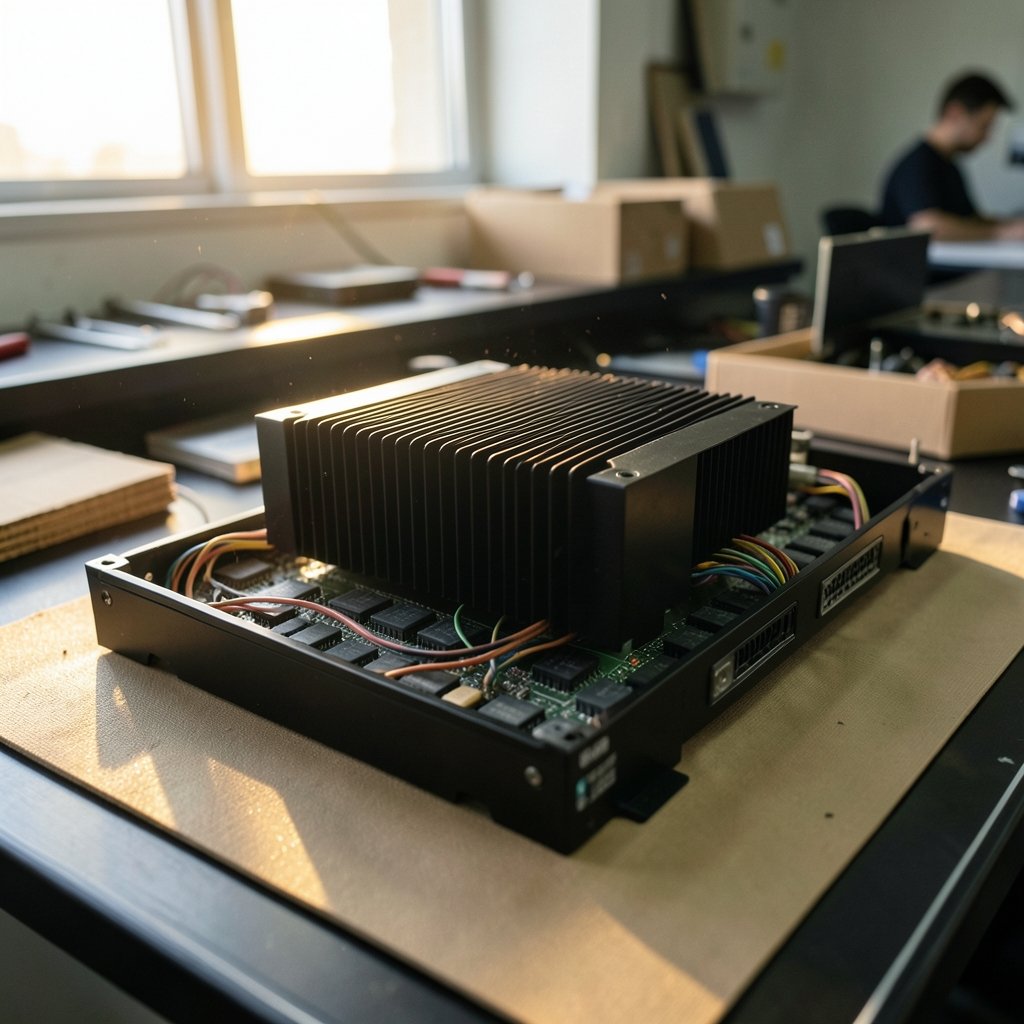
NVIDIA’s H100 became the reference point for large-model work after its 2022 launch, with 80 GB of high-bandwidth memory per GPU. The H200 variant, announced in late 2023, pushed memory to 141 GB. Then came rack-scale designs: the GB200 NVL72, announced in March 2024, bundles 72 Blackwell GPUs and 36 Grace CPUs into a single NVLink domain.
The practical lesson is that memory capacity and bandwidth often matter more than raw floating-point throughput. A model that does not fit in accelerator memory has to be sharded across devices, which multiplies network traffic and complicates everything downstream. Teams that buy on headline compute numbers and ignore memory find themselves re-architecting within a quarter.
High-bandwidth memory supply is the quiet constraint behind all of this. A small number of suppliers dominate HBM production, and qualification timelines for each new generation have repeatedly become bottlenecks. The JEDEC memory standards body published HBM3 in 2022 and has been working on HBM4 since. If your procurement plan assumes accelerators arrive on a fixed schedule, build in slack.
For a broader view of how silicon choices ripple through the rest of the stack, see this overview of AI chips and computing infrastructure. (NIST Artificial Intelligence overview)
Networking and storage: where pilots quietly die
Two things reliably surprise teams moving from a handful of GPUs to a real cluster: how much the network matters, and how much the storage layer matters.
On networking, there are broadly two philosophies. InfiniBand has been the default for tightly coupled training for years. Ethernet, pushed by the Ultra Ethernet Consortium founded in July 2023, is being standardized specifically for AI workloads, aiming to combine familiar operations tooling with the congestion control that training demands. The trade-off is rarely about peak speed. It is about whether your network team can operate the fabric at three in the morning. (Artificial intelligence)
Storage is the underrated half of the pair. Training jobs read enormous datasets repeatedly, and checkpointing large models writes terabytes back to disk. A storage tier that performs fine for a web application can add hours to a training run. The fix is usually tiered: fast local or parallel storage for hot data, object storage for the archive, and a cache layer in between.
On the operational side, the human layer matters as much as the hardware. Teams that document their runbooks and escalation paths before launch recover from incidents far faster, which is why how technical writing supports enterprise infrastructure teams is worth reading before the first production cutover.
Power, cooling, and the physical reality of AI racks
A modern AI rack can draw well over 100 kW. That number breaks a lot of assumptions inherited from general-purpose data centers, where 10 to 15 kW per rack was normal for years.
NVIDIA’s GB200-class systems are designed for direct-to-chip liquid cooling. Air cooling can sometimes be stretched with careful containment, but at high density it generally stops being viable. The ASHRAE data center thermal guidelines are the standard reference for planning these environments, and they are worth reading before signing a colocation contract rather than after.
Practical guidance from operators tends to converge on a few points:
- Model power and cooling before ordering hardware, not after.
- Check whether the facility can deliver the amperage your racks need, along with the square footage.
- Plan for liquid cooling loops even if the first deployment is air-cooled.
- Budget for redundancy in power, because a training run that dies at hour 40 is expensive.
Retrofitting an existing hall is often the single largest hidden cost in an AI program. Organizations that assume they can drop new racks into old space frequently discover the electrical service needs an upgrade that takes a year to schedule.
Governance, regulation, and the compliance layer
Infrastructure decisions increasingly have a legal shadow. The EU AI Act, Regulation (EU) 2024/1689, entered into force on 1 August 2024, with obligations for general-purpose AI models applying from 2 August 2025 and high-risk requirements phased in through 2026 and 2027. The full text on EUR-Lex is the authoritative source, and it is dense but worth reading directly rather than relying on summaries.
In the United States, the NIST AI Risk Management Framework, published as version 1.0 in January 2023, has become a common reference for structuring internal AI governance. It is voluntary, but many enterprises map their controls to it because it gives auditors something familiar to work with.
Two practical implications follow. First, data residency and tenant isolation stop being abstract architecture questions and become compliance requirements. Second, logging and lineage need to be designed in from the start, because reconstructing them later is painful. Teams building multi-tenant assistants should read this guide to separating tenant data in an enterprise assistant before the first customer onboards.
Confidential computing is another option. Hardware approaches such as NVIDIA’s confidential computing mode on H100 and AMD’s SEV-SNP protect data while it is in use, as well as at rest and in transit. Overhead varies by workload, so benchmark before committing.
Export controls add a geopolitical dimension. U.S. rules issued in October 2022 and October 2023, with further updates since, restrict advanced AI chip exports to certain countries. These rules change frequently, so procurement teams should check the current text rather than rely on last year’s summary.
For a deeper treatment of the security side, this resource on enterprise AI and cloud security covers the controls that matter most.
Building the operating model alongside the hardware
Hardware without an operating model is an expensive space heater. The organizations that succeed tend to treat AI infrastructure as a product with internal customers, not as a project with an end date.
That means a few concrete practices:
- Chargeback or showback for GPU hours, so business units see the cost of what they request.
- An evaluation set for every model before it goes live, at initial launch and after. This guide to designing an evaluation set for enterprise assistants walks through the method.
- Capacity forecasting tied to the roadmap, so hardware orders land before demand spikes.
- A named owner for the platform, with authority over standards.
Hiring and role design matter too. The skills needed span infrastructure engineering, ML platform work, and governance, and they rarely live in one person. These questions to ask about enterprise AI operations roles help frame interviews around real operational scenarios rather than tool trivia.
Benchmarking deserves a mention as well. MLPerf, run by MLCommons, publishes training and inference results quarterly and has become the closest thing to a common yardstick. Treat the numbers as a starting filter, not a verdict, since benchmark configurations rarely match production workloads.
Common mistakes and what actually works
A few patterns show up repeatedly across organizations of very different sizes.
Buying compute before understanding the workload. Inference and training have almost opposite infrastructure profiles. Inference rewards memory bandwidth and low latency; training rewards interconnect and sustained throughput. Buying one configuration for both usually means doing both badly.
Ignoring the data layer. Teams spend months on accelerator procurement and weeks on storage. Then training jobs sit idle waiting on reads.
Treating the network as plumbing. Fabric congestion is subtle and appears only under load. Test it with realistic traffic before production.
Underestimating facilities lead time. Electrical upgrades and cooling retrofits have long lead times. Start those conversations early.
Skipping the evaluation setup. Without a repeatable way to measure quality, every model change becomes an argument rather than a measurement.
What works, in practice, is unglamorous: pilot small, measure honestly, document decisions, and build the governance layer in parallel with the hardware rather than after it. Organizations that read their infrastructure roadmap with deployment constraints in mind, as described in this piece on reading an enterprise roadmap with deployment in mind, tend to avoid the worst sequencing errors.
Conclusion
Enterprise AI infrastructure rewards patience and punishes shortcuts. The compute layer gets the headlines, but memory bandwidth, network fabric, storage throughput, cooling capacity, and governance controls determine whether a platform actually works at scale. None of these layers is optional, and the seams between them are where most programs fail.
The organizations that get this right tend to share a temperament rather than a vendor list. They plan facilities before ordering racks. They measure model quality with a repeatable test process. They document their runbooks. They read the regulation rather than the summary of the regulation. And they treat the platform as a long-lived product with real internal customers, which is the difference between a demo that impresses and a system that earns its keep.
FAQ
What is enterprise AI infrastructure?
It is the combined hardware, software, networking, data, facilities, and governance layer an organization uses to train, deploy, and manage AI models in a controlled environment. It differs from a single workstation or a public API wrapper because it must handle multi-tenancy, auditing, cost allocation, and failure recovery across multiple business units.
How much does enterprise AI infrastructure cost?
Costs vary enormously by scale and approach. The dominant expenses are usually accelerators, networking fabric, storage, and facilities work such as power and cooling upgrades. Cloud consumption models shift spending from capital to operating budgets but often cost more over long periods at steady utilization. Facilities retrofits are frequently the largest hidden line item.
Do we need liquid cooling for AI workloads?
Not always, but high-density racks above roughly 100 kW generally require it. Direct-to-chip liquid cooling is designed into rack-scale systems like the GB200 NVL72. Air cooling can work at lower densities with careful containment, but planning for liquid loops during facility design is cheaper than retrofitting later.
What is the difference between InfiniBand and Ethernet for AI?
InfiniBand has been the traditional choice for tightly coupled training because of its low latency and congestion handling. Ethernet, with efforts like the Ultra Ethernet Consortium’s AI-focused standardization, aims to deliver comparable performance with more familiar operations tooling. The right pick depends as much on your team’s operational skills as on benchmark numbers.
How do regulations affect AI infrastructure design?
Regulations shape architecture. The EU AI Act phases in obligations for general-purpose and high-risk systems through 2025 to 2027, which drives requirements for logging, documentation, and data handling. Frameworks like the NIST AI Risk Management Framework give organizations a structure for internal controls. In practice, compliance requirements push tenant isolation and audit logging into the design phase.
How should we benchmark AI infrastructure?
Start with MLPerf results as a rough filter, then build your own evaluation using workloads that resemble production. Benchmark the full pipeline, including data loading, storage, and the accelerator. Measure at realistic concurrency levels, and repeat the tests as software and models change, because a configuration that performs well today may not in six months.




