
An AI risk assessment framework is a structured way for an organisation to find, score and respond to the risks its AI systems create. It turns vague worries about bias, errors, privacy and misuse into a documented list of risks with owners, ratings and actions. The central question is how to assess AI risk without drowning in paperwork, and the answer is to start with a simple inventory and a consistent scoring method, then deepen the assessment only where the stakes are highest.
Most organisations now use AI in more places than they realise. A chatbot answers customers, a screening tool ranks job applicants, and a third-party tool quietly uses AI inside a product the team bought off the shelf. Each of these systems can fail in ways that harm people, break the law or damage trust, and without a framework those risks stay invisible until something goes wrong.
Key takeaways
- An AI risk assessment framework inventories AI systems, identifies their risks, scores them consistently and assigns owners and actions.
- Start with the highest-stakes systems, such as those affecting hiring, credit, health or safety, and expand from there.
- The NIST AI Risk Management Framework organises the work into Govern, Map, Measure and Manage.
- Score risk by likelihood and impact, and record the reasoning so the rating can be challenged and revisited.
- Assessment is a repeating cycle, not a one-off form: reassess when the model, data or context changes.
What an AI risk assessment framework does
A framework gives a team a repeatable process for answering three questions about every AI system: what could go wrong, how bad would it be, and what are we doing about it. It replaces ad-hoc judgement with a shared method, so that two teams assessing the same system reach similar conclusions.
The framework also creates a record. When a regulator, an auditor or a customer asks how a system was assessed, the team can show the inventory, the risk ratings, the mitigations and the decisions.
Documentation is not the point, but it is often the difference between a defensible decision and an embarrassing one. Our guide to AI model risk management explains how assessment fits into the wider job of managing model risk over time.
A good framework is proportionate: a low-risk internal tool summarising meeting notes needs less scrutiny than a model deciding who gets a loan.
The framework should scale the effort to the stakes. Best for: any organisation running more than a handful of AI systems, or any system that affects people directly.
The NIST AI Risk Management Framework
The best-known framework is the NIST AI Risk Management Framework, known as the AI RMF, published by the US National Institute of Standards and Technology in January 2023. It is voluntary guidance, not a law, and it organises AI risk work into four functions: Govern, Map, Measure and Manage.
Govern covers the policies, roles and accountability that make the rest possible. Map establishes the context of each system: its purpose, its users and who it could harm.
Measure evaluates the risks that mapping identified, using testing, evaluation and monitoring. Manage turns those findings into decisions: mitigate, transfer, avoid or accept each risk, and keep watching for change.
The four functions form a cycle rather than a straight line, because a model update or a change in use can reopen risks that were settled before. The framework is published on the NIST AI Risk Management Framework site.
NIST also describes the qualities that make AI trustworthy, including safety, security, privacy, fairness, transparency and accountability. These give teams a shared vocabulary for discussing what “good” looks like. Best for: teams that want a widely recognised, flexible structure rather than a prescriptive checklist.
Other frameworks worth knowing
ISO/IEC 42001 is an international standard for AI management systems, published in late 2023. Unlike the NIST framework, it is designed to be audited and certified, so it suits organisations that need to demonstrate compliance to customers or regulators. It asks organisations to set up a management system with policies, objectives, risk processes and continual improvement.
The EU AI Act takes a different approach: it is law, not guidance. It sorts AI systems into risk categories, from unacceptable-risk practices that are banned, through high-risk systems that must meet strict requirements, to lower-risk systems with lighter duties.
Organisations operating in the EU need to classify their systems under the Act and meet the duties that follow. Our guide to AI governance frameworks compares the main options and helps teams choose one that fits their situation.
Most teams do not need to pick a single framework and follow it exclusively. A common approach is to use the NIST AI RMF as the working method, map its outputs to ISO/IEC 42001 for certification, and check the EU AI Act classifications for legal duties.
The frameworks overlap heavily. Best for: regulated or multinational organisations that need both a working method and a demonstrable standard.
Building your inventory first
Every assessment starts with an inventory, and most organisations are surprised by what it reveals. The inventory should list every AI system the organisation builds, buys or uses, including models embedded in third-party software. For each system, record its purpose, its owner, the data it uses, the people it affects and the decisions it influences.
The inventory is also where risk tiering begins. A simple three-tier system works well: high risk for systems that affect people’s livelihoods, health, safety or legal rights; medium risk for systems that shape important business decisions; and low risk for internal tools with limited impact.
Tiering focuses effort on the systems that need it most. Our guide to choosing an AI risk assessment template helps teams pick a starting format that fits their regulatory environment.
Keep the inventory alive. Assign an owner, review it on a fixed schedule, and update it whenever a team adopts a new tool or a vendor adds AI features to an existing product.
An inventory that is a year out of date gives a false sense of coverage. Best for: the first step of any assessment programme, before any scoring begins.
Identifying risks: what can go wrong
Risk identification works best as a structured exercise, not a brainstorm. For each system, walk through the main risk families: accuracy and reliability, bias and fairness, privacy and data protection, security and misuse, transparency and explainability, and human oversight. Ask what happens when the model is wrong, when the data is biased and when the system is attacked.
Include the risks that come from how the system is used, not just how it was built. A model can be accurate and still cause harm if it is used for a purpose it was not designed for, or if staff stop checking its work because it is usually right. Over-reliance is one of the most common AI risks, and it grows as systems get better.
Third-party risk deserves its own attention. When a vendor supplies the model, the team cannot inspect its training data or test it as thoroughly, so the assessment must rely on vendor documentation and contracts. Our guide to AI third-party risk management explains how to vet vendors without slowing delivery.
Scoring risk: likelihood and impact
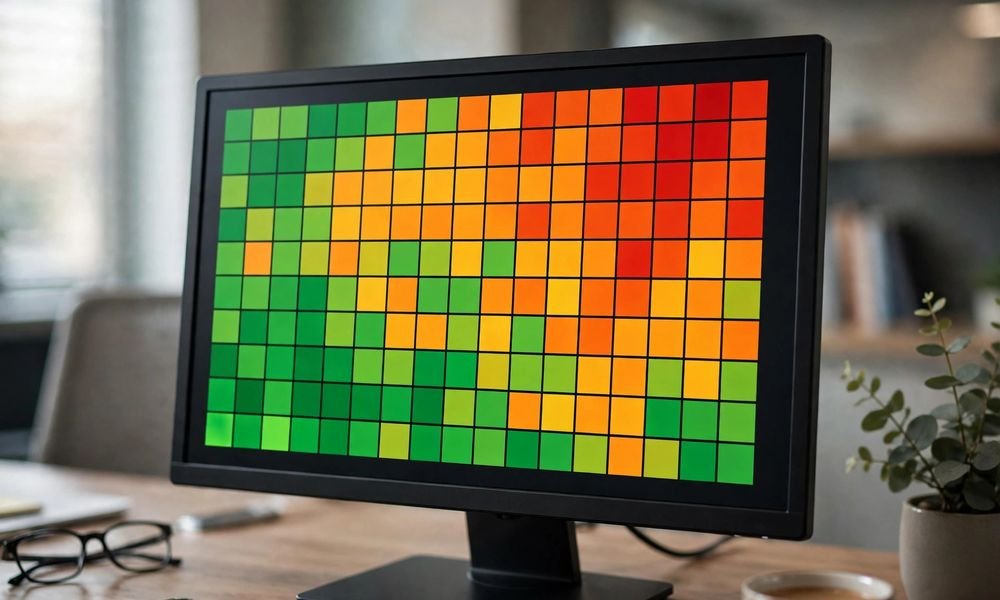
Once risks are identified, score each one by likelihood and impact, using a simple scale such as one to five for each. Likelihood asks how probable the harm is, given the system’s design, data and use.
Impact asks how serious the harm would be if it happened. Multiplying the two gives a risk score that lets teams rank risks and prioritise action.
Scoring is a judgement, not a measurement, so the reasoning matters more than the number. Record why each score was chosen, who chose it and what evidence supports it. That record lets another person challenge the score, and it lets the team revisit the rating when circumstances change.
Set clear thresholds for action. A common approach is that high scores require mitigation before deployment, medium scores need a documented plan and owner, and low scores are accepted and monitored.
Whatever the thresholds, they should be written down and applied consistently. The table below shows a simple scoring grid.
| Impact \ Likelihood | Rare (1) | Possible (2–3) | Likely (4–5) |
|---|---|---|---|
| Minor (1) | Low: monitor | Low: monitor | Medium: plan a fix |
| Serious (2–3) | Low: monitor | Medium: plan a fix | High: mitigate before use |
| Severe (4–5) | Medium: plan a fix | High: mitigate before use | High: stop or redesign |
From assessment to action
An assessment that ends with a report and no action is wasted effort. Each significant risk needs a response: mitigate it by changing the model, the data or the process; transfer it through insurance or a contract; avoid it by limiting or stopping the use; or accept it with a documented reason and a monitoring plan. The response should have an owner and a deadline.
Mitigations vary by risk. Bias can be reduced with better data, fairness testing and human review of borderline cases; privacy risk, by minimising the data collected.
Security risk can be reduced with access controls and input validation. Every mitigation should be tested to confirm it actually works.
Reassessment is part of the cycle. Revisit the assessment when the model is retrained, when the use changes, when an incident occurs, or on a fixed schedule such as every six or twelve months.
A framework that is only used once is not a framework; it is a form. Best for: turning assessment findings into owned, dated actions that are tracked to completion.
Assessment checklist
Use this checklist to run an assessment for one AI system, and keep the completed version as part of the system’s record.
- Is the system in the inventory, with a named owner and a clear statement of purpose?
- Who is affected by the system, and what decisions does it influence?
- Which risk families apply: accuracy, bias, privacy, security, transparency, oversight?
- Has the system been tested on data that reflects the people it will affect?
- Is each risk scored for likelihood and impact, with the reasoning recorded?
- Does every significant risk have a response, an owner and a deadline?
- Is there a monitoring plan, and a trigger for reassessment when things change?
- Who approved the assessment, and where is the record kept?
Frequently asked questions
What is an AI risk assessment framework?
It is a structured process for finding, scoring and responding to the risks an AI system creates. It typically covers inventorying systems, identifying risks, rating them by likelihood and impact, and assigning owners and actions.
Is the NIST AI Risk Management Framework mandatory?
No. The NIST AI RMF is voluntary guidance, published in January 2023. Organisations choose to adopt it because it is widely recognised and flexible, but it is not a law and there is no certification against it.
How is an AI risk assessment different from a data protection impact assessment?
A data protection impact assessment focuses on privacy risks to personal data, and it is required in some cases under laws such as the GDPR. An AI risk assessment is broader: it covers accuracy, bias, security, transparency and other harms as well as privacy.
How often should AI risk assessments be repeated?
Reassess when the model, data or use changes, when an incident occurs, or on a fixed schedule. Many teams review high-risk systems every six months and lower-risk systems annually.
Who should own AI risk assessment?
Ownership should sit with the team accountable for the system, supported by risk, legal and technical specialists. The system owner knows the use case best, while specialists bring the methods and the challenge that keep assessments honest.
Do small organisations need a formal framework?
Yes, but a light one. A small team can run the same steps, inventory, identify, score, act, on a single page per system. The discipline matters more than the size of the document, and a short assessment is far better than none.