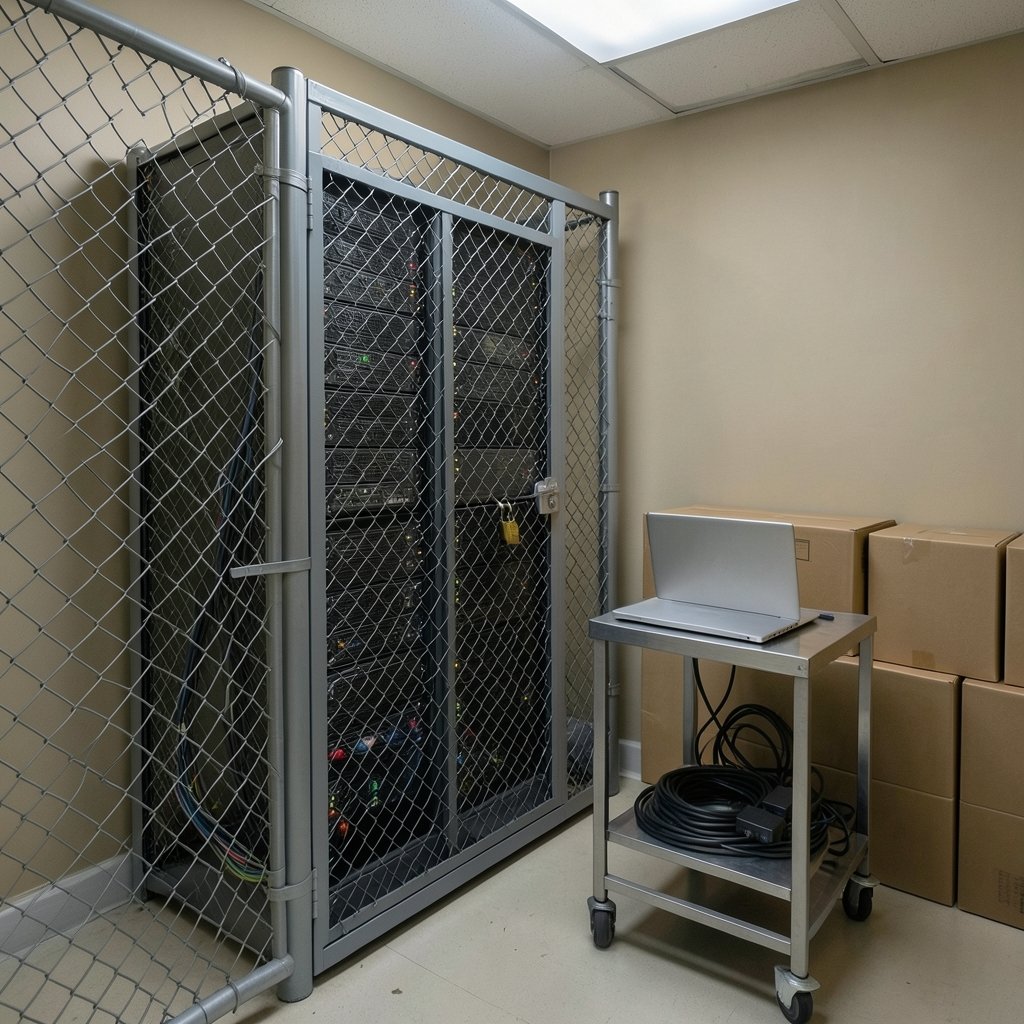
What happens when a model that can write and run code gets tricked into running the wrong code? That question frames AI model isolation, a term that gets used often and defined rarely. Teams buy tools labeled “isolated,” assume they mean the same thing, and discover during an incident that they do not. Getting the vocabulary straight is practical rather than academic. It determines which controls you actually deploy.
This article separates the three distinct ideas that travel under the label, walks through the practical controls that make each one real, and flags where the common mistakes happen. It also touches on how isolation decisions interact with release planning and failure handling, which is where most operational surprises surface.
Why “AI Model Isolation” Means Three Different Things
The phrase has no single standardized definition. In practice, it covers at least three separate concerns:
| Sense | What is being isolated | Typical threat |
|---|---|---|
| Execution containment | The model’s runtime environment | Prompt injection leading to arbitrary code or data access |
| Tenant and workload isolation | Model-serving infrastructure shared by many users | Cross-tenant data leakage, noisy-neighbor resource abuse |
| Weight and data isolation | Model parameters and training data | Model theft, unauthorized extraction of proprietary weights |
A security engineer talking about sandboxing and a platform lead talking about namespace boundaries can both say “we have model isolation” and mean completely different things. Both can be correct and both can be insufficient. The first step for any team is to write down which sense applies to which system, because the controls barely overlap.
There is a fourth, unrelated usage that causes confusion too: “model isolation testing,” meaning evaluating a model without its tools or retrieval layer to see what it knows on its own. That is an evaluation practice, not a security control. And in privacy law, “data isolation” refers to separating personal data across processing purposes, which is a legal concept rather than an infrastructure one. Flagging the ambiguity out loud beats resolving it silently in a design document nobody reads.
Containment: Sandboxing Model Execution

The most concrete form of isolation concerns where model-generated actions actually execute. When an agent can call tools, write files, or run code, the blast radius of a successful prompt injection is set almost entirely by the sandbox around it.
The risk categories are well documented. The OWASP Top 10 for LLM Applications names excessive agency and model theft among the core threats, and both are containment problems at bottom: an agent with more permissions than it needs, and weights reachable by parties who should not have them. The project page for the OWASP Top 10 for large language model applications is worth reading in full because it maps threats to controls rather than just listing scary names.
The building blocks that actually work
- Deny network egress by default. A sandboxed model process that cannot reach the internet cannot exfiltrate data or pull a payload. Allowlist specific endpoints only when a task genuinely requires them.
- Mount a read-only filesystem and give the process a scratch directory that is wiped between sessions. Persistence is a feature for attackers.
- Drop privileges to a dedicated user with no access to host credentials, cloud metadata endpoints, or the container runtime socket.
- Set hard resource ceilings on CPU, memory, and wall-clock time so a runaway loop cannot take down neighbors.
- Log every syscall or tool call that leaves the sandbox boundary, and alert on patterns rather than individual events.
For the runtime layer itself, two open-source projects come up repeatedly. gVisor, documented in the gVisor project documentation, intercepts system calls in user space to shrink the host kernel attack surface. Firecracker microVMs take a different route, giving each workload a lightweight virtual machine boundary. Neither is magic. Both raise the cost of an escape substantially compared with a plain container sharing a host kernel.
Container-specific threats and countermeasures are catalogued in NIST SP 800-190, the application container security guide, which remains a solid checklist even though it predates widespread LLM deployment. Its core advice, that isolation between containers and the host is a design property rather than a default, has aged well.
The mistake almost everyone makes first
The classic error is sandboxing the model but not its tools. A code interpreter running in a hardened container that then calls an unsandboxed internal API has simply moved the weak point one hop downstream. Map the full call graph, extending beyond the process that hosts the model. The second classic error is treating the sandbox as a substitute for least-privilege credentials. If the sandboxed process holds a token that can read the production database, the sandbox is decoration. (Sandbox (computer security)))
Tenant Isolation in Multi-Tenant Model Serving
The second sense of the term concerns infrastructure. When one cluster serves many customers or internal teams, isolation means one tenant cannot see, starve, or influence another. Kubernetes documents the primitives for this in its guide to multi-tenancy, covering namespaces, network policies, and pod security standards as the raw materials.
In practice, namespace separation alone is weak. Namespaces are an organizational boundary, not a security boundary, unless network policy and admission control enforce them. A realistic layered approach looks like this:
- Network policy that denies all pod-to-pod traffic by default, with explicit allows for each service dependency.
- Separate node pools for tenants with different trust levels, so a kernel-level exploit in one pool does not cross into the other.
- Resource quotas and limits per namespace to prevent a single tenant’s inference burst from starving everyone else.
- Per-tenant encryption keys for any cached prompts, embeddings, or conversation history, so a storage misconfiguration does not become a cross-tenant disclosure.
- Distinct service accounts with scoped role bindings, never a shared admin identity.
The subtle failure mode here is shared caches. Prompt caches, KV caches, and embedding stores are performance features that quietly become data-sharing mechanisms. If two tenants’ requests can land in the same cache key space, isolation has a hole that no network policy will close. Partition caches by tenant identifier and treat that partitioning as a security requirement, not a tuning parameter.
This is also where release planning meets isolation. A new model version rolled out to a shared serving tier can change memory behavior, latency, and failure modes for every tenant at once. Teams that think carefully about when a model release matters to enterprise teams tend to sequence isolation changes and model changes separately, so a regression in one does not get blamed on the other.
Protecting Model Weights and Training Data
The third sense is the most commercially sensitive: keeping model parameters and training data away from parties who should not have them. Two threat models dominate. The first is outright theft, whether by an insider, a compromised dependency, or an attacker who reaches the storage layer. The second is extraction through the API itself, where an adversary queries a model repeatedly to distill its behavior.
Controls that hold up in practice:
- Encrypt weights at rest with keys the serving team cannot read, and rotate those keys on a schedule that does not depend on anyone remembering.
- Restrict weight access to a small set of service identities, with every read logged and reviewed.
- Rate-limit and monitor for extraction patterns, such as unusually broad query distributions or systematic probing of a narrow input space.
- Consider confidential computing where the threat model includes the infrastructure operator. Hardware trusted execution environments aim to isolate workloads, including model weights, from the host. The technology is real but operationally demanding, and it is not a default choice for most teams.
Training data deserves the same treatment, with an extra wrinkle: data used for fine-tuning often flows through pipelines built for convenience rather than confidentiality. A model that memorizes sensitive records has effectively copied them into a new location with weaker controls. Isolation has to extend to the fine-tuning corpus, not stop at the finished weights.
Regulatory and Framework Context
Isolation requirements increasingly arrive through compliance rather than engineering preference. The EU AI Act, published as Regulation (EU) 2024/1689, imposes risk-management and cybersecurity duties on certain AI systems, with obligations phased in over time. The practical effect is that containment and access controls become evidence you may need to produce, as well as defenses you hope never get tested. The official text of Regulation (EU) 2024/1689 is the place to check the current application dates rather than relying on secondhand summaries.
The NIST AI Risk Management Framework, published as AI 100-1, offers a voluntary structure organized around govern, map, measure, and manage. It is useful precisely because it does not prescribe specific isolation mechanisms. It gives teams a way to justify why a given control exists and how it will be measured, which is what auditors and incident reviewers ask for. The framework document itself, the NIST AI Risk Management Framework (AI 100-1), is short enough to skim in an afternoon.
One caution: neither document tells you how to configure a sandbox. Frameworks describe outcomes. Engineers still have to pick the runtime, write the network policy, and test the escape paths.
How Isolation Fails in Production
Isolation rarely fails because someone chose the wrong sandbox technology. It fails because the boundary eroded over time. Some patterns come up again and again:
The debug exception that stayed. An engineer opens egress for one endpoint to troubleshoot, and the allowlist entry survives three quarters and two team changes.
The shared credential. A service account created for convenience gets reused across tenants because rotating per-tenant credentials is tedious.
The untested escape path. The sandbox is configured correctly but nobody has tried to break out of it, so a misconfigured mount or a leaked socket goes unnoticed until it matters.
The fallback with full privileges. When the primary model or runtime fails, the fallback path runs with broader permissions than the primary ever had. Thinking through what a model fallback should actually do includes deciding what it is allowed to touch, because failover logic written under pressure tends to skip the permission review.
The monitoring blind spot. Isolation without detection means you learn about a breach from a customer. Log the boundary crossings and review them.
A useful discipline is a quarterly isolation review that asks three questions per system: what can this process reach, who else shares its infrastructure, and what would we see if it were compromised tomorrow. If any answer is vague, the boundary is probably thinner than the diagram suggests. (News)
Conclusion
AI model isolation is not one control but three overlapping programs: containing what the model can execute, separating the tenants that share its infrastructure, and protecting the weights and data that make it valuable. Each has its own threat model, its own tooling, and its own failure modes. Teams that conflate them end up with a hardened sandbox and a shared credential, or a clean namespace design and an unprotected weight store.
The workable approach is unglamorous. Define which sense of isolation applies to each system. Write the boundary down. Test it by trying to cross it. Review it on a schedule, especially when model versions or fallback paths change. Frameworks and regulations will tell you that isolation matters; only the engineering detail determines whether it exists.
Frequently Asked Questions
What is AI model isolation in simple terms?
It is the practice of keeping an AI model, and everything around it, separated from things it should not touch. That includes the environment where the model runs, the infrastructure it shares with other users, and the weights and data that define it. The separation is enforced with network rules, permissions, encryption, and runtime boundaries.
Is sandboxing the same as model isolation?
No. Sandboxing is one part of it, covering execution containment. It does not address tenant separation in shared serving infrastructure or protection of model weights. A team can have excellent sandboxing and still leak data across tenants through a shared prompt cache.
Do I need confidential computing to protect model weights?
Not automatically. Confidential computing uses hardware trusted execution environments to isolate workloads from the host operator, and it makes sense when the infrastructure operator is part of your threat model. For many teams, encryption at rest, tightly scoped service identities, and access logging cover the realistic risks at far lower operational cost.
How does prompt injection relate to isolation?
Prompt injection is the delivery mechanism; isolation determines the damage. If an injected instruction convinces an agent to run code, the sandbox’s egress rules, filesystem mounts, and privileges decide what that code can reach. Strong isolation does not prevent injection, but it caps the consequences.
What is the most common isolation mistake in production?
Boundary erosion through convenience changes. A temporary network exception, a reused service account, or a debug mount that nobody removed. These accumulate quietly, and the isolation you designed is not the isolation you are running six months later.
How often should isolation controls be reviewed?
Quarterly is a reasonable default for most teams, with an immediate review whenever a model version changes, a new tenant is onboarded, or a fallback path is modified. Any change to what a system can reach or who shares its infrastructure deserves a fresh look at the boundary.




