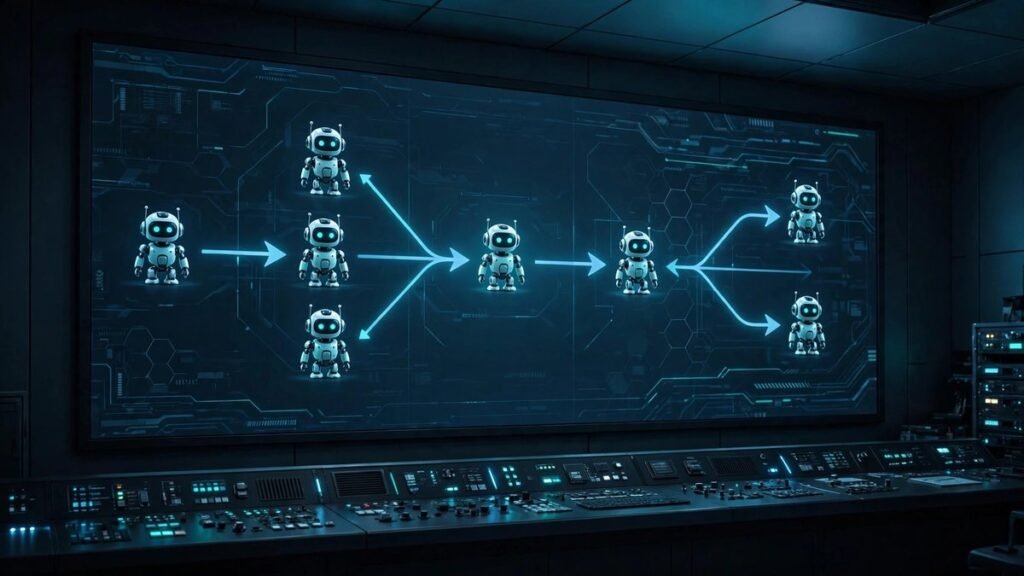
The A2A protocol, short for Agent2Agent, is an open standard that defines how artificial intelligence agents communicate with each other across different systems, and the question it answers is a practical one: how does an agent built by one team, on one framework, ask another agent for help without a custom integration? The short answer is that A2A gives agents a shared language for discovering each other, delegating tasks and exchanging results. An agent publishes a description of what it can do, another agent reads that description, and the two collaborate through standard messages without either side needing to know how the other was built.
That matters because the agent landscape is fragmenting. Different teams build agents on different frameworks, with different models and different tools, and without a shared protocol each pair of agents needs bespoke glue code. A2A is an attempt to stop that: one open standard, governed neutrally, that any agent can speak. Google introduced the protocol in April 2025, and in June 2025 donated it to the Linux Foundation, where it is now governed as a vendor-neutral project with support from more than 150 organisations.
Key takeaways
- The A2A protocol is an open, Apache 2.0-licensed standard for communication and task handoff between AI agents.
- Google introduced it in April 2025 and donated it to the Linux Foundation in June 2025, where it is governed neutrally.
- Agents advertise their capabilities through Agent Cards, JSON documents published at a well-known URL.
- A2A follows a client-server model: a client agent delegates a task and a server agent carries it out.
- A2A complements the Model Context Protocol: MCP connects agents to tools, while A2A connects agents to each other.
What the A2A Protocol Is
A2A is a protocol, not a framework and not a product. It does not tell you how to build an agent, which model to use, or how an agent should reason. It standardises the conversation between agents: how one agent finds another, how it asks that agent to do something, how progress and results are exchanged, and how the task’s lifecycle is managed. Because it is a protocol, agents built on different frameworks can interoperate as long as each side speaks A2A. That is the same idea that made the web work: HTTP does not care what server software you run, and A2A does not care what framework your agent was built with.
The protocol was announced by Google in April 2025 as an open standard for agent interoperability, with support from more than 50 technology companies at launch, including SAP, Salesforce, ServiceNow, Workday and Accenture. On 23 June 2025, at Open Source Summit North America, the Linux Foundation announced the formation of the Agent2Agent project, seeded with Google’s transfer of the protocol specification, its software development kits and its developer tooling. Founding members included Amazon Web Services, Cisco, Google, Microsoft, Salesforce, SAP and ServiceNow. The point of the donation was governance: a protocol becomes durable when no single vendor controls its roadmap, and the Linux Foundation provides that neutrality.
Best for: organisations whose agents are built by different teams, on different frameworks, and need to collaborate without custom integrations.
How A2A Works: Agent Cards, Messages and Tasks
A2A has two building blocks that everything else rests on: messages and tasks. A message is a unit of communication between agents, carrying content such as text, and a task is the unit of work: a client agent asks a server agent to perform a task, and the task has a lifecycle that both sides can observe. The task can be short, such as answering a question, or long-running, such as researching a topic and producing a report, with progress updates along the way.
Discovery starts with the Agent Card. An agent publishes a card, a structured JSON document available at a well-known URL, that describes what the agent is, what it can do, and where to send requests. Other agents read the card to discover capabilities and decide whether to delegate a task, without a human brokering the handoff. The card is the agent’s public identity: it lists the agent’s skills in a machine-readable form, so a client can match a task to the right agent automatically rather than relying on hard-coded addresses.
The exchange itself follows a client-server model. An A2A client delegates a task, and an A2A server is the agent that receives and carries it out. The client sends a message, the server works on the task, and the two exchange further messages as the work progresses. Because the exchange is structured and observable, a system can log it, audit it and trace a result back to the agent that produced it. That observability matters in enterprise settings, where an agent’s actions may need to be explained after the fact.
A2A and MCP: Two Protocols, Two Different Jobs
The most common confusion about A2A is whether it competes with the Model Context Protocol, and the answer is no. The two protocols connect different things. MCP connects an agent to tools and data: it is how an agent reaches a database, a ticketing system or an internal API. A2A connects an agent to another agent: it is how an agent delegates work to a peer that has its own memory, tools, policies and decision-making. A system can and usually should use both, with MCP on the agent-to-tool axis and A2A on the agent-to-agent axis.
Think of it this way. When the other side of a connection is a tool, a function that does one job and returns, you want MCP. When the other side is a worker, an autonomous agent with its own lifecycle that may take minutes or hours, you want A2A. The distinction matters because the two kinds of interaction need different things: a tool call needs a fast request and response, while an agent delegation needs task tracking, progress updates, and a way to handle a peer that changes its mind or fails partway through.
Our detailed comparison of MCP and agent-to-agent protocols works through this distinction with examples, and it is worth reading before you design a system that uses either protocol. The short version is that they are complementary layers of the same stack, and choosing between them is usually a sign that the architecture question has been framed wrongly.
What A2A Changes for Multi-Agent Systems
Before A2A, multi-agent systems were mostly built inside a single framework. A CrewAI crew, a LangGraph graph or an AutoGen group chat coordinated agents that all lived in the same codebase and spoke the framework’s internal language. That works well inside one team and one system, and it is still the right approach for many products. But it breaks down when the agents belong to different organisations, or when different teams in the same company standardise on different frameworks. Each pair of systems then needs a bespoke integration, and the number of integrations grows with the square of the number of systems.
The practical effect is visible in enterprise scenarios. A procurement agent in an SAP system can ask a finance agent in a different system to check a budget, without either team writing a custom connector. A customer support agent can hand a complex case to a specialist agent run by another department, and track the task until it is done. None of this requires the two agents to share a model, a framework or a deployment. The architecture question of one agent versus several is covered in our guide to multi-agent versus single-agent architecture, and A2A is what makes the multi-agent answer practical across organisational boundaries.
A2A Compared With Other Agent Protocols
| Protocol | Connects | Origin | Governance | Use when |
|---|---|---|---|---|
| A2A | Agent to agent | Google, April 2025 | Linux Foundation | Agents must collaborate across frameworks and vendors |
| MCP | Agent to tools and data | Anthropic | Agentic AI Foundation | An agent needs to reach tools, files or APIs |
| ACP (Agent Client Protocol) | Editor to coding agent | Zed, August 2025 | Open standard, Zed-led | An editor or host drives a coding agent |
| ACP (Agent Communication Protocol) | Agent to agent | IBM, BeeAI | Linux Foundation | Legacy reference; now part of the A2A effort |
Two notes on the table deserve emphasis. First, the ACP acronym is shared by more than one protocol, and the Agent Communication Protocol from IBM’s BeeAI project has merged into the A2A effort under the Linux Foundation, so new agent-to-agent work happens under A2A. Second, A2A and MCP are not alternatives; they are different layers, and a serious multi-agent system will usually speak both. The framework comparison in what AI agent frameworks do and how to choose one also helps here, because protocol support is now a real factor in framework selection.
When to Adopt A2A
Adopt A2A when your agents need to cross a boundary that a single framework cannot span. The clearest cases are cross-organisation collaboration, multi-vendor enterprise environments, and platforms that expose agents to third parties. If you run an agent platform and want other people’s agents to work with yours, publishing Agent Cards and speaking A2A is the standard way to do it. If you buy agents from several vendors and need them to cooperate, A2A is the integration layer that avoids a custom connector for each pair.
Decision checklist
- Boundary check: do your agents need to collaborate across teams, frameworks or organisations? If not, internal coordination is simpler.
- Discovery needs: do agents need to find each other dynamically, or are the pairings fixed? Agent Cards matter most when discovery is dynamic.
- Task lifetime: are delegations long-running with progress updates? A2A’s task model fits that shape.
- MCP coverage: have you already separated tool access onto MCP? A2A and MCP together cover the stack.
- Vendor support: do the agent platforms you use speak A2A? Check before committing.
- Security: can your authentication and audit requirements be met across the protocol boundary? Plan this before the first integration.
Limitations and Open Questions
A2A is young. It was introduced in April 2025, which means the ecosystem of implementations, tooling and operational experience is still forming. Specifications evolve, software development kits mature at different rates, and the practical details of running A2A in production, monitoring, debugging, versioning Agent Cards, are less settled than for older protocols. Early adopters should expect change and should budget for keeping up with specification updates.
Finally, a protocol does not solve the hard problems of multi-agent systems. It standardises how agents talk, but it does not decide which agent is in charge, how disagreements are resolved, or how you debug a failure that spans three agents in three organisations. Those are design problems, and they remain yours. A2A gives you a shared language for the conversation; it does not write the conversation for you.
Frequently Asked Questions
What does A2A stand for?
A2A stands for Agent2Agent. It is an open protocol that standardises how one AI agent finds another agent, assigns it a task, and tracks the outcome.
Who maintains the A2A protocol?
Google introduced A2A in April 2025 and donated it to the Linux Foundation in June 2025. It is governed as a vendor-neutral project, and in 2026 it joined the Agentic AI Foundation alongside the Model Context Protocol.
What is an Agent Card?
An Agent Card is a structured JSON document published at a well-known URL that describes an agent’s capabilities, skills and endpoint. Other agents read the card to discover what the agent can do and how to reach it.
Does A2A replace MCP?
No. A2A and MCP do different jobs. MCP connects agents to tools and data, while A2A connects agents to each other. Most multi-agent systems use both.
Do all my agents need to speak A2A?
No. A2A earns its place at boundaries between systems. Agents inside one codebase on one framework can coordinate internally, and A2A is used where agents need to collaborate across frameworks, vendors or organisations.