IS-IS explained in plain terms means understanding the routing protocol that carries the traffic of the world’s largest internet providers, quietly and reliably, while its better-known rival gets the attention. The central question is how a network with thousands of routers can agree on the best path to every destination, and the answer is for every router to build the same map of the network, and calculate the best routes from it.
IS-IS, short for Intermediate System to Intermediate System, is a link-state routing protocol standardised by the ISO in the late 1980s. It was designed to route the OSI protocol suite, but it was later extended to carry IP, and it is now one of the two main interior routing protocols used by large internet service providers, alongside OSPF.
The idea is simple: flood the facts, then calculate locally. Each router advertises the state of its own links to every other router, so that all of them hold the same picture of the network, and each router then runs Dijkstra’s algorithm on that picture to work out the shortest path to every destination. This article explains what IS-IS is, how it works, and where it is used.
Key takeaways
- IS-IS is a link-state protocol that gives every router the same map of the network.
- Each router advertises its own links, and floods the advertisements to all others.
- Routes are calculated locally with Dijkstra’s shortest-path algorithm.
- It organises networks into areas and levels for scale.
- It is the main interior protocol of large ISP backbones.
What IS-IS is
IS-IS is an interior gateway protocol, which means it routes traffic inside one organisation’s network, rather than between networks on the internet. It belongs to the link-state family, because each router describes its own links and the cost of using them, and every router in the area ends up with the same link-state database, which is the map from which all routes are calculated.
The protocol’s name comes from the OSI world, where a router was called an intermediate system. IS-IS was built to route OSI’s own network protocol, CLNP, and its packet format is deliberately independent of any one network layer, which is why it could later be extended to carry IP routes, and then IPv6, without changing its core design.
IS-IS organises a network into areas and levels. Level 1 routers know their own area in detail, Level 2 routers form the backbone that connects areas, and a router can be both, acting as the bridge between its area and the backbone. That hierarchy is what lets IS-IS scale to networks with thousands of routers, where a flat design would drown in updates. Our guide to OSPF explains the other great link-state protocol, and our guide to BGP explains the protocol that routes between networks on the internet.
How IS-IS works
Routers running IS-IS first find each other by sending hello packets, which carry the router’s identity, its area, and the type of adjacency it wants to form. On a broadcast network such as Ethernet, the routers elect a designated intermediate system, which speaks for the network itself, while on a point-to-point link the two routers simply form an adjacency directly.
Once adjacencies are formed, each router builds a link-state packet, or LSP, describing its own links, their costs, and the networks attached to them, and floods it to every other router in the area. Flooding is reliable: each router forwards a new LSP to all its neighbours except the one it came from, and keeps a copy, so that within seconds every router holds the same database.
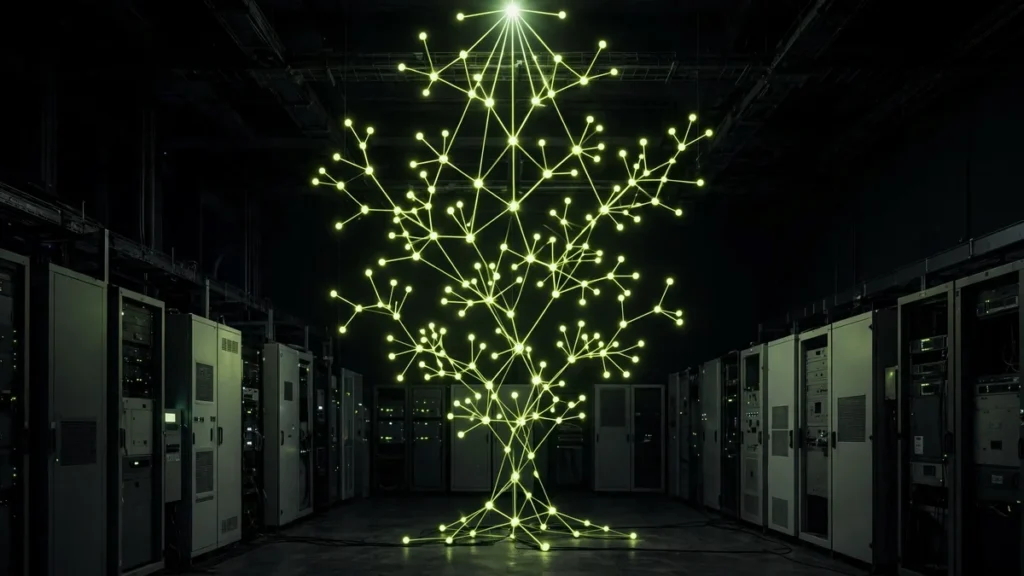
With the database complete, each router runs Dijkstra’s algorithm to build a shortest-path tree rooted at itself. The tree gives the best next hop to every destination, and the results are installed in the routing table. When a link fails, the routers attached to it flood a new LSP, every router recalculates, and traffic moves to the next best path, usually within seconds.
The cost of a link is a number the operator sets, usually reflecting bandwidth, and the path cost is the sum of the link costs along it. A short, slow path can lose to a longer, faster one, and the operator can steer traffic by adjusting costs, which is how providers balance load across their backbones and keep the busiest links from saturating.
IS-IS carries its routing information in TLVs, type-length-value fields, which are small tagged chunks of data. New information, such as IPv6 routes or traffic engineering data, is added as a new TLV type, without changing the packet format or the core protocol, which is why IS-IS has adapted to new requirements more easily than protocols with fixed packet layouts.

Comparing IS-IS with other routing protocols
IS-IS is one of several interior routing protocols, and each suits a different network. OSPF is its closest rival, BGP routes between organisations, and EIGRP is the Cisco protocol for enterprise networks, but each has its own trade-offs.
The table below sets out the main contrasts between the leading approaches.
| Aspect | IS-IS | OSPF | BGP |
|---|---|---|---|
| Scope | Inside one network | Inside one network | Between networks |
| Map | Full link-state map | Full link-state map | Path of networks |
| Metric | Cost, based on bandwidth | Cost, based on bandwidth | Policy and path length |
| Hierarchy | Areas and levels | Areas | Autonomous systems |
| Best for | Large ISP backbones | Enterprise networks | The internet itself |
The practical result is that IS-IS is the right choice for a large provider backbone that must scale, OSPF is the standard for enterprise networks, and BGP is the protocol that ties the networks of the internet together.
Where IS-IS is used
Internet service provider backbones are the largest use. The biggest ISPs run IS-IS across thousands of routers, carrying the routes that move traffic between cities and countries, and the protocol’s hierarchy and TLV design are the reasons it scales to networks of that size without breaking down.
Large enterprise networks use IS-IS where they have outgrown OSPF. A global company with data centres on several continents can run IS-IS as its interior protocol, with areas per region and a Level 2 backbone between them, which keeps each region’s routing database small while the whole network stays connected.
Data centres use IS-IS in the underlay that connects their switches. The protocol’s fast convergence suits fabrics where links are added and removed regularly, and its ability to carry extra information in TLVs lets it advertise the details that traffic engineering and segment routing need.
Mobile networks use IS-IS to connect base stations and core sites. A mobile operator’s transport network carries traffic from thousands of cell sites, and IS-IS provides the routing that lets that traffic reach the core, with the hierarchy keeping the routing load manageable as the network grows.
Teaching uses IS-IS as the second great link-state protocol. Students learn OSPF first, then IS-IS, which shows the same ideas, flooding and shortest-path calculation, in a different design, and its use in real provider networks makes it a standard topic in advanced networking courses and certifications.
Strengths and limits
The greatest strength of IS-IS is its scalability. The area and level hierarchy keeps routing databases small even in networks with thousands of routers, and the TLV design lets it carry new kinds of information without a protocol redesign, which is why providers that outgrow OSPF often move to IS-IS rather than the other way round.
It is also a strength that IS-IS is stable and fast. It converges in seconds after a failure, its flooding is efficient, and decades of deployment in the largest networks have made its behaviour well understood, which is why operators trust it with the traffic their businesses depend on.
The limits are real, though. IS-IS is less familiar than OSPF to most engineers, its configuration uses OSI-style addresses that feel alien to an IP-trained team, and its tooling and documentation are thinner, which can make hiring and troubleshooting harder outside the provider world.
IS-IS checklist
- Plan your areas and levels before you configure a single router.
- Use a consistent addressing plan, so areas stay easy to read.
- Set link costs to reflect bandwidth, and document them.
- Authenticate IS-IS packets, so a stranger cannot inject routes.
- Keep the Level 2 backbone fully connected, with no gaps.
- Watch for LSP flooding storms, which mean a link is flapping.
- Do not advertise IS-IS on interfaces facing the internet.
- Test a link failure, and check convergence takes seconds, not minutes.
- Document which routers are Level 1, Level 2, or both.
Frequently asked questions
What is IS-IS in simple terms?
IS-IS is a routing protocol that gives every router in a network the same map, by flooding descriptions of each router’s links to all the others, and each router then calculates the best path to every destination from that map.
What is the difference between IS-IS and OSPF?
They are both link-state protocols that flood maps and calculate shortest paths, but IS-IS uses areas and levels with a TLV packet design, while OSPF uses areas with fixed packet types. IS-IS is more common in large ISPs; OSPF is more common in enterprises.
What is a link-state packet?
It is a router’s description of its own links, their costs, and the networks attached to them. Each router floods its LSP to all others, so that every router holds the same database, which is the map Dijkstra’s algorithm runs on.
What are Level 1 and Level 2 in IS-IS?
They are the two levels of the hierarchy. Level 1 routers know their own area in detail, Level 2 routers form the backbone that connects areas, and a router can be both, bridging its area to the backbone.
What is a TLV?
It is a type-length-value field, a small tagged chunk of data inside a packet. New information is added as a new TLV type, which is why IS-IS could gain support for IPv6 and traffic engineering without changing its core design.
Is IS-IS still used today?
Yes, widely, in the backbones of the largest internet providers, in large enterprises, and in data centre fabrics. It is less visible than OSPF because it lives in provider networks, but it carries a large share of the world’s internet traffic.
The bottom line
IS-IS explained in one line is this: routers flooding descriptions of their links until every router holds the same map, then each calculating the shortest path to every destination from it.
It is quiet, scalable, and proven in the largest networks on Earth, and it shows how a well-designed protocol can carry the internet’s traffic for decades without ever needing to be replaced.
This article is general information about how IS-IS works, not advice about designing routing for a particular network.