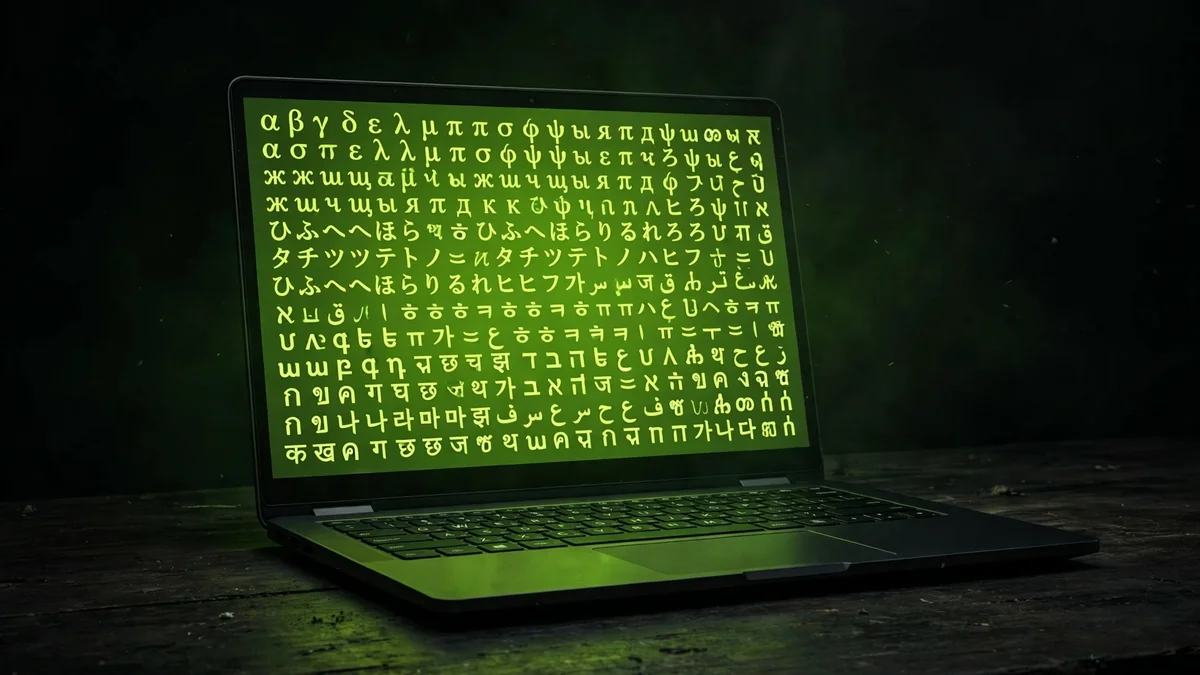
Unicode explained in plain terms is the universal system that lets computers represent every character used by every language in the world. The central question is how one computer can display English, Chinese, Arabic, and emoji side by side without confusion, and the short answer is that Unicode gives every character its own unique number, called a code point, that every device agrees on.
Before Unicode, computers used dozens of incompatible character sets, and a document written on one machine turned into gibberish on another. A letter that looked right in one country could appear as a different symbol elsewhere, because each system numbered characters differently. Unicode ended that chaos by creating a single shared catalogue for every writing system on Earth.
Today Unicode underpins everything digital, from the text messages on a phone to the web pages in a browser and the databases behind websites. It covers more than 150 writing systems, including Latin, Cyrillic, Arabic, Chinese, Japanese, and Korean, plus symbols, punctuation, and emoji. Understanding it explains why text usually just works, and why it sometimes does not.
Key takeaways
- Unicode is a universal standard that assigns a unique number, called a code point, to every character in every writing system.
- UTF-8 is the most widely used way of storing Unicode text, and it stays compatible with older ASCII text.
- One character can be written in several ways in Unicode, which is why two identical-looking texts can compare as different.
- Emoji, accented letters, and right-to-left scripts all work because Unicode treats them as ordinary characters.
- Most text problems today come from mixing encodings or assuming one byte always equals one character.
What Unicode is
Unicode is an industry standard maintained by the Unicode Consortium, a non-profit organisation that brings together technology companies, governments, and language experts. Its job is to define a character set that covers every writing system used by people today, and many used only in the past. The standard does not decide how characters look; it only decides what each character is and its identifying number.
Each entry in Unicode is called a code point, written in the form U+0041, where the number is in hexadecimal. The letter A is U+0041, the euro sign is U+20AC, and the smiling face emoji is U+1F600. These numbers never change once assigned, so a file written today can still be read decades from now. New characters are added in regular updates, usually to cover scripts, symbols, and emoji previously missing.
It helps to separate three ideas people often mix up. The character set is the list of characters and their numbers. The encoding, such as UTF-8, is the method used to turn those numbers into bytes for storage and transmission. The font is the design that decides how a character appears on screen, which is why the same letter can look different in different typefaces while remaining the same character underneath.
How Unicode works
When a computer stores text, it converts each character into bytes using an encoding. UTF-8 is the dominant encoding on the web and in most modern software, and it uses one byte for the Latin letters, two bytes for many European and Middle Eastern characters, three bytes for most Asian characters, and four bytes for emoji and rarer symbols. This variable length keeps common text compact while allowing the full range of characters.
One clever feature of UTF-8 is full compatibility with ASCII, the older seven-bit standard for English text. Every ASCII character keeps the same byte value in UTF-8, so old ASCII files are already valid UTF-8 files. That compatibility is a major reason UTF-8 won the encoding wars, since it let systems upgrade without breaking everything they had already stored.
UTF-16 is another common encoding, used internally by some operating systems and programming languages, including Java and JavaScript. It stores most characters in two bytes and uses pairs of two-byte units, known as surrogate pairs, for characters beyond its basic range. Our guide to Python shows how a popular programming language handles Unicode strings in practice, and the details matter, because code that counts characters instead of bytes can produce surprising results when emoji or accented letters are involved.
Unicode also handles characters that combine or change shape. An accented letter such as é can be stored either as a single code point or as the letter e followed by a separate combining accent mark, and both forms look identical on screen. Right-to-left scripts such as Arabic and Hebrew are stored in logical reading order, and the display software reverses them for the reader. Emoji can join together too, so a family emoji may be built from several individual person emoji linked by invisible joiner characters.
Unicode compared with ASCII
ASCII, short for the American Standard Code for Information Interchange, was the standard that ruled computing for decades, and it defined just 128 characters: the English alphabet, digits, punctuation, and a handful of control codes. It worked well for American English and nothing else, and every language beyond it needed its own incompatible extension. Unicode was created to replace that patchwork with a single system.
The table below sets out the main differences.
| Aspect | ASCII | Unicode |
|---|---|---|
| Characters covered | 128 | More than 150,000 |
| Languages supported | English only | Nearly every living language |
| Character size | One byte each | One to four bytes in UTF-8 |
| Emoji and symbols | None | Thousands included |
| Right-to-left scripts | Not supported | Fully supported |
| Modern use | Legacy and simple systems | The default almost everywhere |
ASCII has not disappeared, because it lives on inside UTF-8 as its first 128 characters. Our guide to machine translation shows another side of the story, since translation systems depend on Unicode to move text faithfully between languages that use entirely different scripts. Without a shared character standard, moving text between languages would be far harder than it already is.
Where Unicode is used
The web runs on Unicode. Web pages declare their encoding, almost always UTF-8, so browsers know how to turn the bytes they receive into readable text. When a page forgets to declare it, or a server sends the wrong label, the result is the familiar mess of question marks and strange symbols that users call mojibake. Search engines, social networks, and email all rely on the same standard to carry text between systems that have never met.
Programming languages have made Unicode their default too. Modern languages store text as Unicode strings, and files, databases, and application programming interfaces expect UTF-8 unless told otherwise. Developers still hit edge cases, such as sorting names in different languages, counting the length of a string that contains emoji, or comparing two texts that look identical but use different code points for the same letter.
Everyday devices depend on Unicode as well. Phones use it for keyboards in dozens of languages, for emoji, and for contacts written in scripts their owners read. Operating systems use it for file names, so a document named in Japanese or Arabic opens correctly on any machine. Even the humble text message relies on it, which is why an emoji sent from one brand of phone appears, usually in a slightly different style, on another.
Unicode also preserves languages that might otherwise fade from digital life. Minority and historical scripts, from Cherokee to Egyptian hieroglyphs, have code points of their own, which lets communities write, publish, and teach in their own writing systems. Scholars use it to digitise ancient texts, and archivists rely on it to keep documents readable for future generations.
Strengths and limits
The greatest strength of Unicode is its universality. One standard covers nearly every script in use, so software can be written once and work for users in any country. It removes the guesswork that used to plague text exchange, and it gives every language an equal footing in digital form. That shared foundation is what makes a multilingual internet possible at all.
It is also remarkably stable. Code points are never reassigned, so text encoded years ago remains valid, and the standard grows by adding new characters rather than changing old ones. Its open, well-documented design means that independent implementations agree with each other, which is why text usually moves between systems without anyone noticing the machinery underneath.
The limits are real, though they are mostly about complexity rather than failure. Some characters can be represented in more than one way, so software must normalise text before comparing it. Sorting and searching differ between languages, because alphabetical order is a matter of local convention, not something Unicode can dictate. And while Unicode covers most scripts, a few rare or newly discovered ones still wait for inclusion, which means their users must wait too.
Unicode checklist
- Save text files as UTF-8 unless there is a specific reason to use another encoding.
- Declare the encoding on every web page, so browsers never have to guess.
- Check for mojibake, such as stray question marks, after moving text between systems.
- Normalise text before comparing strings that may use different forms of the same character.
- Count characters with a Unicode-aware method, since one visible character may use several code points.
- Test forms and search with accented letters, emoji, and right-to-left scripts before launch.
- Choose fonts that cover the scripts your audience actually reads.
- Keep software and libraries updated, since new Unicode versions add characters every year.
- Store text as Unicode in databases, and set the database encoding to UTF-8 from the start.
Frequently asked questions
What is Unicode in simple terms?
Unicode is a universal standard that gives every character in every language its own unique number, so computers everywhere can agree on what a piece of text means. It covers letters, digits, punctuation, symbols, and emoji in more than 150 writing systems.
What is the difference between Unicode and UTF-8?
Unicode is the character set, the list of characters and their numbers, while UTF-8 is an encoding, the method used to turn those numbers into bytes for storage. Unicode defines what each character is, and UTF-8 defines how it is stored.
How many characters does Unicode have?
Unicode defines more than 150,000 characters, and the number grows with each new version as more scripts, symbols, and emoji are added. The standard has room for over a million code points, so there is plenty of space left.
Why do some characters show as boxes or question marks?
That happens when the font in use has no design for the character, or when text was read with the wrong encoding. The box means the character exists in Unicode but cannot be drawn here, while question marks usually mean the bytes were misinterpreted.
What is a code point?
A code point is the unique number Unicode assigns to a character, written in the form U+0041 for the letter A. It identifies the character itself, not how it looks, so the same code point can appear in many different fonts.
Is Unicode the same as ASCII?
No, but it includes ASCII. The first 128 Unicode code points match ASCII exactly, which is why plain English text works the same in both systems, while Unicode extends far beyond ASCII to cover the rest of the world’s writing.
The bottom line
Unicode explained in one line is this: a universal standard that gives every character in every language a unique number, so text can travel between any devices without losing its meaning.
It replaced a tangle of incompatible character sets with one shared catalogue, and UTF-8 made that catalogue practical by keeping it compact and compatible with the past. The next time text from another language or a row of emoji simply appears as it should, Unicode is the quiet reason why.
This article is general information about how Unicode works, not advice about choosing an encoding or configuring a system for a particular organisation.